Earlier this month on Insiders, Patricia Karvelas told the nation that Prime Minister Anthony Albanese ‘wants to make all those Indian Australians his voters’.
When Senator Jacinta Nampijinpa Price made essentially the same observation a year ago in an interview with Karvelas herself, it cost her a place on the Coalition frontbench.
Speaking on the ABC’s Afternoon Briefing last year, Senator Price observed:
‘Labor like to be able to ensure that they’re going to allow those in that would ultimately support their policies, their views, and vote for them as well.’
For this, Price was pilloried by progressives and rebuked by members of the Coalition. Some accused her of racism. Others called her comments ‘hurtful’. With the saga ultimately resulting in her removal from the coalition frontbench.
Yet recently, Karvelas noted the electoral upside for Albanese in Modi’s visit.
‘In the midst of a debate on multiculturism vs monoculturalism he [the Prime Minister] wants to make all those Indian Australians his voters.’
Panellist Sarah Martin went on to add that:
‘There is an electoral advantage there as well for the Prime Minster to bring that diaspora onside, as you say there’s a million Indians in Australia.’
Of course, these observations were not met with the same outrage, accusations of racism, and consequences that Senator Price faced. When a conservative Senator says migration is reshaping our electoral politics, it’s a scandal. When the crew on Insiders make the same observation, it’s merely analysis.
The other week, Senator Price reposted a clip of the podcaster Sam Bamford reacting to the Insiders segment, noting that the panel had said much of what she was condemned for saying a year earlier. With Multicultural Affairs Minister Anne Aly criticising Price for ‘divisive attention seeking’, notably not criticising the ABC panel who functionally made the same observation.
It’s called a Celebration Parallax, and progressives employ this tactic all the time:
First you insist something isn’t happening, declare them evil for noticing it, and then celebrate it openly once you feel confident it’s too late to reverse.
Victorian Premier Jacinta Allan declared to the crowd: ‘Victoria respects India… Yes, we are the home of the MCG and the Boxing Day Test. But much more importantly than that, we are home to more Indian Australians than anywhere else in the country.’
In her own words, and in my opinion, the Premier of Victoria, ranks the size of a foreign diaspora above the MCG and the Boxing Day Test above the shared institutions and traditions that bind Victorians together. She did not address the crowd as Australians, with a case for how she would make the state better and their lives with it. She addressed them as a voting bloc and pitched accordingly.
This is precisely what Senator Price warned about.
Our migration program, run at record levels no one voted for, is not integrating newcomers into the Australian story. It is fostering foreign diasporas at home and incentivising our political class to treat elections less as a battle of ideas and more as how to cobble together otherwise disparate voting blocs.
A recent survey commissioned by the Institute of Public Affairs has highlighted the increasing concern Australians have towards our migration program.
A majority (54 per cent) of Australians believe they do not recognise the country they grew up in.
48 per cent of respondents believe that Australia’s migration program has the intention of bringing immigrants to assist their chances at future elections.
Additionally, 31 per cent of respondents desired zero or negative net migration.
48 per cent wanted a migration rate between 0 and 100,000, at least three times below current levels.
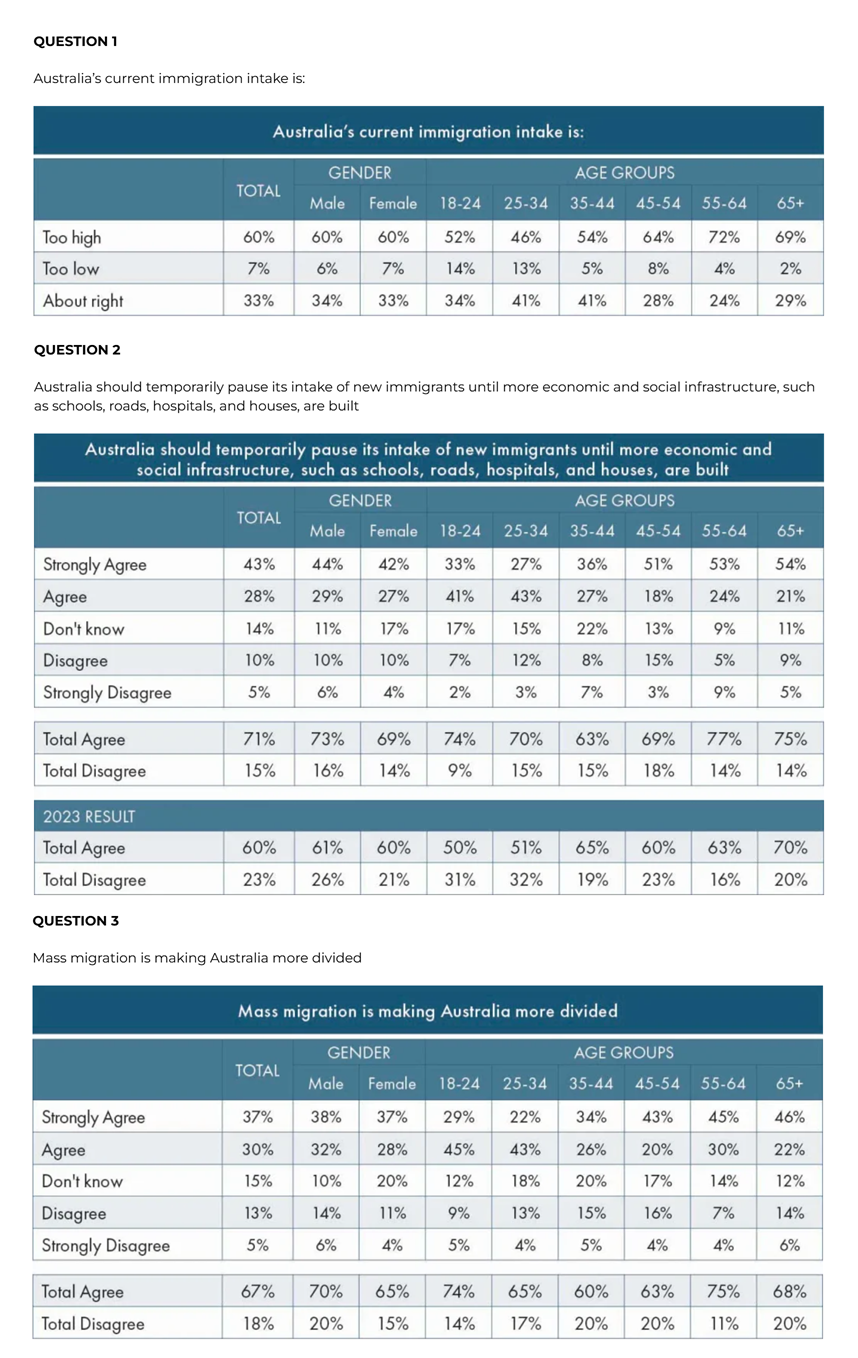
Whilst Australians are concerned about migration, progressives are gleeful. With Redbridge pollster Kos Samaras reporting that ‘85 per cent of the Indian diaspora voted for the Labor Party at the last election’ some progressives believe that the longer our migration program spirals out the control, the harder it is for conservative parties to win elections and the harder it is for Australians to regain control of their migration program.
Australians can see what is happening even if their leaders won’t say it. They see a migration program run at levels they never supported, a political class competing to flatter diasporas rather than serve citizens, and a democracy drifting further toward ethnic separatism.