Politics is complicated, particularly for young people.
My fellow Gen Z conservatives often find ourselves in a never-ending intellectual duel, not only with our progressive peers, but with ourselves. I am a small ‘c’ conservative and proudly so. Yet that does not mean I never question my assumptions. Like many young people trying to make sense of a disordered political age, I often find myself in an intellectual duel with myself, often finding myself caught between the conservative and the small ‘s’ economic socialist aspects of my own political instinct.
It is a paradox I don’t resent. I am often challenged by numerous people, including myself. In fact, I think it is where much of the interesting work of politics begins. Aristotle famously described man as ‘political animals’ conditioned to develop a system of governance based on core values directed at the common good, helping society to flourish and grow a virtuous civic culture. For me, conservatism begins here. It is not primarily an ideology of resentment or reaction but a disposition of loyalty and love – to family, community, nation, custom and the inheritance we have received from those before us and which we wish to protect for future generations.
This is also why I struggle to accept the dominant political choices placed before us.
The economic liberalism of the Right and the social liberalism of the Left both seem ill-equipped for the challenges of today. I remain deeply indebted to the principles of the Glorious Revolution – free speech, free expression, parliamentary sovereignty, ordered liberty, and the restraint of arbitrary power. Yet, I cannot accept the modern cosmopolitan liberalism that commoditises the individual as a detached consumer, discards ancient liberties and Western ethos, untethered from place, duty, inheritance, and obligation.
The problem is not liberty itself. Conservatives should never abandon liberty. The problem is liberty detached from the common good. A society cannot survive if it regards every inherited institution as an obstacle, every tradition as a prejudice and every obligation as a form of oppression. Nor can it survive if the market is permitted to dissolve the very communities and loyalties upon which a free society depends.
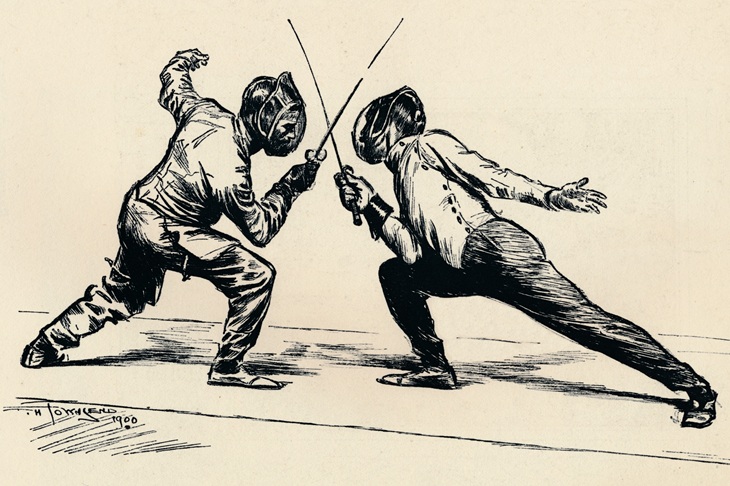
This is the fencing match taking place within the souls of modern politics, with each side preparing a fleche to counter the other’s argument in a cosmic battle for the heart of political discourse. Duty against desire. Truth against personal truth. Democracy against plutocracy. Dignity against servility. Justice and mercy against cruelty and indifference. Each side lunges, parries and counterattacks, but too often the deeper question is missed.
What kind of society are we trying to conserve and for whom?
The choice before us is not simply Left and Right. It is between politics that accepts managed decline and one that seeks renewal. We need a politics ordered not merely towards individual appetite or economic efficiency, but towards what is true, good, and beautiful. It may sound unfashionable, but it is precisely the sort of language that politics needs to recover, where the nation is not just a marketplace, but a moral community.
For conservatives, this means recovering the confidence to think beyond the tired orthodoxies of the late 20th Century. To create a truly democratic government that upholds its civic duty and the customs and traditions of its nation, the political environment must transcend beyond pursuing an exclusively partisan agenda and realise that social conservatism can be reconciled with a small ‘s’ socialist political economy. This would provide an alternative to the Progressive New Left and the Neoliberal economics of the Right. It would be a truly Centrist politics, which seeks to contribute to the common good. One that defends personal liberty while rejecting the fetishistic commodification of the individual.
In the great fencing match of political ideology, conservatives must regain their posture. To conserve is not merely to slow down change nor to defend whatever happens to exist. It is to preserve what is worthy, reform what is broken and pass on a society that is fit for future generations. Burke understood this as a covenant between the dead, living, and the unborn. The covenant cannot be honoured if conservatism becomes little more than a defence of corporate interests, managerial language and tax policy.
If the Right is serious about national renewal, it must be willing to re-examine its political economy. It must speak to the working-class, not as an electoral demographic to be flattered, but as citizens whose labour, families, and communities are central to the nation’s life. The ‘forgotten people’ of Menzies’ dream are not only the professionals of the suburbs. They are also the plumbers, tradies, and diesel fitters, factory workers and small business owners who are often socially conservative, economically interventionist but deeply sceptical of the political class that seems to have forgotten them. These people don’t necessarily want revolution, but stability, dignity, and a country that honours their contribution. They want institutions that work, communities that are safe, and a wage that can support their family.
The world may be chaotic, but we must never surrender hope in its redemption. The match is not over. But conservatives must decide whether they intend merely to retreat or whether they are prepared to advance with discipline, courage and purpose.
I, for one, am ready with my sabre.
Are you?