I think I’ve finally figured out why the leaders of Europe are so upset at the United States. The never-ending outpouring of rage from European and British elites, directed at the US and the Trump administration, makes sense to me at long last.
It’s not because the Europeans are worried about having to spend money on defence against Russia; their combined economic might is ten times that of Russia. Spending on their militaries may accelerate economic problems in a few places, but in many it will be net positive. It’s not like Europe opposes government-funded social programmes, either, which is what most of their militaries are. They’re certainly not war-fighting organisations – not outside of the frontier states. If Europe actually went to war, the militaries of its nations would need to be entirely rebuilt.
It’s not America’s threats to Greenland that are upsetting the Europeans. And it’s not that they believed in an American nuclear shield, especially since the end of the Cold War. Unless they were actually idiots. Which they aren’t. What American president would be willing to risk a nuclear strike on an American city in order to respond to a nuclear attack in Europe? Not likely, outside the context of the Cold War. And maybe not even then.
No, the thing the nations of Europe are desperately worried and angry about is each other. For all of history – up to the point where the United States stopped it – the truly important problems in Europe were solved through violent coercion. War. Genocide. Population transfers. Terrible things.
That is why and how most of Europe consists of ethno-linguistic nation-states. It’s not by accident. They shed a lot of blood to this end. For the most part, the ethnic-linguistic groups that didn’t carve out a state ceased to exist, or became oppressed minorities in other people’s countries. The Jews and the Roma are the two success cases, in that both survived. The unification of Italy and Spain involved bulldozing local, highly distinctive cultures and resulted in long revolutionary movements – which haven’t died out. Look for the places in Europe where the ethno-linguistic map doesn’t align with the nation-state map, and you find geopolitical flashpoints.
The European Union was a beautiful dream. An economic, currency and citizenship union to tie Europe together strongly enough that wars between the European powers would become impossible. It would be the end of history in Europe.
But the EU is dead. The Europeans have killed it.
How? First, they never formed a European military. Or even an effective border force. Or a defended border. Second, they never were willing to let go of their ethno-linguistic national identities, outside perhaps of a few Eurocrats in Brussels and a smattering of deluded elites. Third, their politicians used the EU as a way to engage in collective arrangements where every member state tried to stick their hands into the pockets of their neighbours, and to blame the EU when problems emerged. That’s how the world’s third-largest economy ends up barely able to put anything into space, and how it ended up without a single serious player in frontier AI.
Instead of the sort of vibrant tech industry found in the US and China, Europe – and particularly Brussels – has become the world’s greatest exporter of regulations. The Europeans call this the ‘Brussels Effect’. They think they’re influencing global governance. They produce about seven new regulations a day. It’s a shockingly productive system if you think compliance burdens are economically net positive. They’re not.
Europe’s regulations are a nuisance to actual innovators. The fines help the Europeans pay the bills, but they will never be a source of prosperity or wealth. Again and again, after they’ve been burned by European regulatory madness, I’ve heard American corporate leaders say: ‘I’ll never hire in Europe or the UK again.’ Even business leaders who’ve had their IP stolen and competitors formed with government support in China don’t have such antibody reactions.
But worst of all, the EU never achieved the most important characteristic of a state: It never asserted any sort of monopoly on violence. So the nation-states are the sole possessors of the last argument of kings.
Now the European states are rearming, but they’re not being honest about why: they’re afraid of each other.
They’re afraid that the threat – and perhaps the reality – of violent coercion will be how European states once again settle their disputes. For three generations the United States has ensured, through a near-monopoly on state-level violence in western Europe, that the European powers could not go to war with one another. Sure, the French and the Brits had a few nukes as a matter mostly of national pride. But they didn’t have the means to go to war with their neighbours. Long range conventional fires, a professional war-fighting culture, precision targeting, command and control – all of that flowed through Nato, and ultimately came from the United States.
That’s the security guarantee that mattered most, and that’s the one that’s going away.
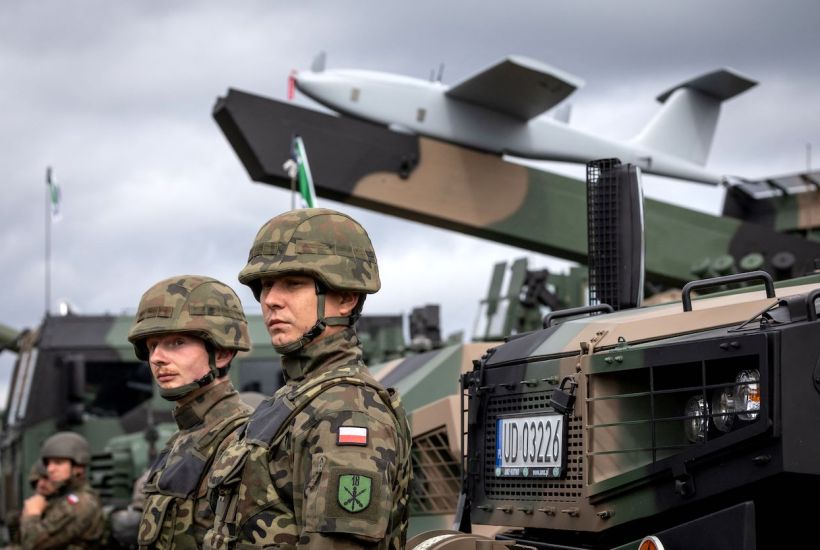
The arms race in Europe isn’t going to be between Europe and Russia. It’s going to be among France, Germany, Italy and the other European powers. Poland is building a truly formidable military capability, and Ukraine will likely emerge from the current war with the most serious war-fighting force in Europe.
We can see the European institutions fracturing. The examples abound: France is actively and deliberately exporting illegal immigrants from the Muslim world to the UK, generating serious social unrest. Spain is granting citizenship – and freedom of Schengen Zone travel and rights to work – to massive numbers of recent migrants in order to bend their local politics, and in defiance of what it has historically meant to be a nation-state or a citizen. There is no way to maintain Schengen freedom of movement, when nationalist EU governments resist the import of Muslim migrants and progressive ones welcome them with open arms. Other states will look askance at allowing these newly minted Spanish citizens full rights under the relevant treaties. These subnational political issues are beginning to impinge on the survival of the EU; this will be an accelerating trend in the coming years.
The Europeans, other than the front-line states, aren’t all that afraid of Russia. China is too distant to be anything other than an economic threat. Domestic political opposition in the United States precludes seizing Greenland. As much as the leaders in the EU would like to generate social solidarity through casting the US as an enemy, it doesn’t work all that well. The progressive elites, who clearly run the show in the EU, are not even all that afraid of the massive immigrant populations they’ve imported from the Middle East and North Africa. European leaders are hoping that treating the United States as an enemy will help them unify, rather than compete for military power. And they’re desperately hoping that the United States will continue to guarantee the integrity of their borders for another generation or two.
Consciously or subconsciously, the European elites know that an arms race is coming, and it’s an intra-European one. The United States gave them three generations to figure out how to avoid going to war with one another, by being the ultimate guarantee – first in western Europe and then more broadly – that European states would settle their differences at the bargaining table in Brussels and not on the battlefield. As the United States now turns its attention elsewhere, that guarantee is – perhaps – coming to an end. And the leaders of Europe are rightly terrified that the European experiment will collapse under the pressure of the old grievances and conflicts bubbling back to the surface, once again with guns and bombs as the final argument.
Some of them still read history. And they’re desperately, wildly afraid of one another.