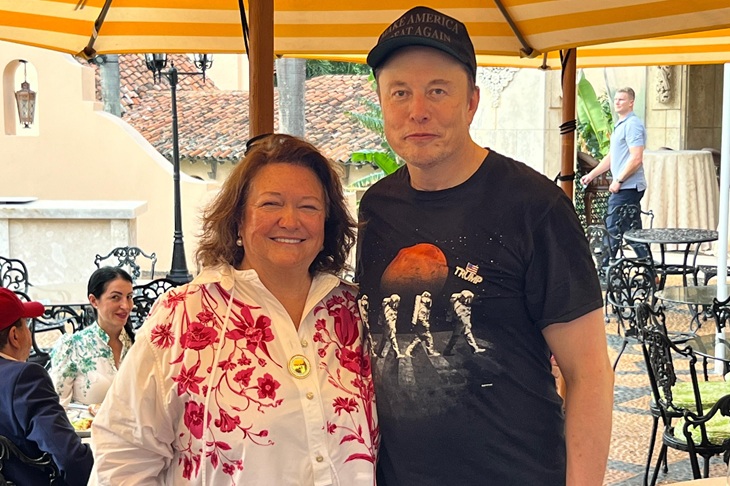
At News Corp’s Bush Summit in Townsville this week, Australia’s richest woman proposed offering Elon Musk’s SpaceX sparsely populated Queensland islands from which to launch satellites.
The reaction from much of the media was predictable.
But Rinehart’s proposal deserves serious consideration, not necessarily because of what it contains, but because of who is making it.
Australia already possesses most of the ingredients required for a world-class launch industry. Building launch facilities on remote islands presents obvious logistical challenges, but the broader idea of a Queensland space industry is entirely plausible.
North Queensland sits between 10 and 20 degrees latitude, offering strong advantages for low Earth orbit launches through higher effective rotational velocity and improved payload efficiency. Beyond launches themselves, a Queensland space hub would embed Australian industry into global aerospace supply chains, capturing spillovers in advanced manufacturing, logistics and high-value technical services.
The existence of Gilmour Space’s orbital spaceport at Abbot Point near Bowen demonstrates that infrastructure can be built and regulatory hurdles overcome.
Earlier this year, however, Gilmour’s maiden Eris rocket launch went up in a plume of smoke.
Them’s the breaks in the space industry.
Liftoff completed, launch tower cleared, stage 1 tested.
Awesome result for a first test launch. pic.twitter.com/EYbNbGDz3l— Gilmour Space (@GilmourSpace) July 30, 2025
But that is precisely the point: the expensive, iterative process of proving launch systems, absorbing failures, and refining capability has already been done elsewhere at enormous scale by companies like SpaceX. The question is therefore not whether Australia can replicate that process, but why it would attempt to.
It is like Victoria trying to build Myki from scratch when a functioning system is already operating elsewhere.
The National Reconstruction Fund, Future Fund, and several Australian superannuation funds have already invested millions in seeding Gilmour.
In my view, Australia does not need another government-funded moonshot. It needs someone capable of picking up the phone and convincing Elon Musk to build here.
As Rinehart noted, Musk requires alternative launch locations in allied countries to support an increasingly demanding global launch cadence, often constrained by weather and scheduling at existing sites. Australian launch windows would complement, rather than compete with, those in North America.
Rinehart also possesses something Canberra does not: a direct business relationship with the world’s richest man through Hancock Prospecting’s billion-dollar investment in SpaceX.
Starlink has become the default alternative to NBN’s troubled Sky Muster satellites.
So why not, as part of a broader diplomatic signal of alignment with Musk’s commercial ecosystem, have the Australian government make Starlink NBN Co.’s supplier over Amazon?
Such a shift would not only improve service delivery but also signal a willingness by government to engage constructively with Musk and align more closely with the company already delivering the next generation of global satellite infrastructure.
Speaking of wasteful government initiatives, why not rethink Aukus and weigh up SpAukus – a strategic partnership between SpaceX/Musk, Australia and the United States?
Under Aukus, Australia is committing more than $350 billion to three used submarines, with delivery timelines stretching into the 2040s and five new submarines that will, let’s be honest, probably never be built.
By the time they arrive, it is far from clear they will represent cutting-edge capability. It’s worth asking what that capital could buy elsewhere.
Modern warfare is increasingly shaped by drones, autonomous systems and space-based intelligence networks. Drones are rapidly improving submarine detection, steadily eroding one of their core strategic advantages: stealth.
The legal foundation for a SpaceX-style pivot already exists: in 2024, the Australia-US Technology Safeguards Agreement entered into force, establishing the framework for American companies to conduct commercial space launches from Australian territory.
So, the geography is in place. The regulatory framework exists. Gilmour has demonstrated the pathway is viable.
What has been missing is not capability, but capital, scale, and an anchor tenant capable of operating at global launch frequency.
Cape York could function as Australia’s Cape Canaveral, attracting both industry investment and public interest in a new space economy.
It ultimately comes down to convincing one person – and leveraging Ms Rinehart’s relationship with Musk isn’t rocket science.