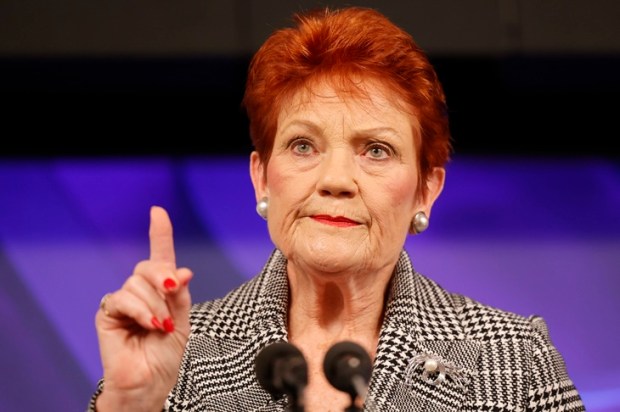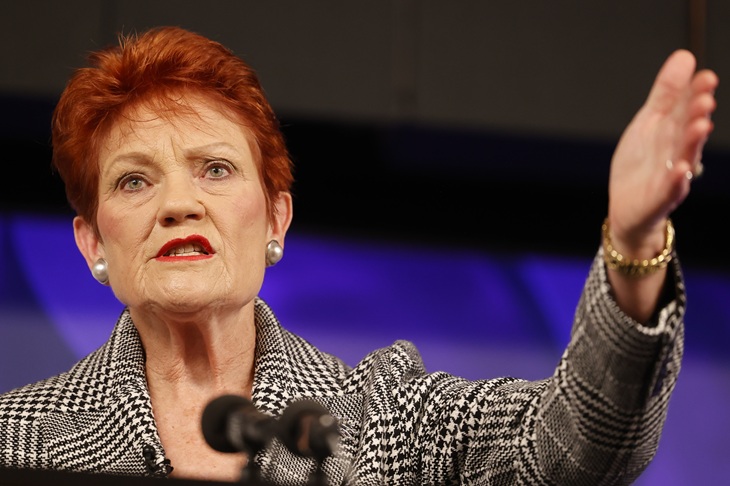
It is a shame Pauline Hanson did not walk up to the podium at the National Press Club and announce: ‘I am Pauline Hanson, Leader of One Nation, last hope for Australia’s forgotten people … ask your questions.’
I say this not only because the Q&A session is where the populist leader came alive, but more particularly as we have entered the theatrical stage of revolution.
Westminster systems handle political upheaval a little differently to France or the Middle East. No one wants a guillotine erected in the sheep paddock near Canberra or civil wars to pop up along state boundaries. It’s not the way revolutions are done in our neck of the woods.
The current momentum of the One Nation movement, which has seen polls return Pauline Hanson as preferred Prime Minister and her party outpolling both Labor and the Coalition, can be likened to Brexit or Maga. These are ideological contagions that spread through cafes, office chats, and social media. Every person carries a collection of micro grievances which are collected into a coherent pattern of opposition to major party failure.
Plenty of commentators have tried to paint One Nation as a protest party in the past. To them I say, no, this is a protest party. True protest parties are a proxy for revolution. They convert public frustration into campaign war chests and topple sitting MPs just because it feels good to watch them lose.
The biggest danger to this sort of movement is not opposing political parties or the constant smear campaigns of a hostile press, it is the timing of the rise. One Nation may be peaking too early, although having successive state elections in the lead up to the next federal election will surely help top-up the orange enthusiasm.
Labor and the Coalition needed Pauline Hanson to fail in the serious ‘grown up’ setting of the National Press Club. And let’s be honest, it’s a task that experienced political figures often struggle with. Former Liberal Leader Sussan Ley gave a rather unsteady performance while Jim Chalmers and Anthony Albanese are particularly poor at answering audience questions. Their evasive attitude toward detail does them no favours.
Even if Pauline Hanson had only given a slightly too long, rather unassuming speech, it would not have been enough to fail her or damage her. The experience would have been swiftly lost in a news cycle that’s far more interested in her Fire the Liar! campaign. GetUp!’s stunt, which may land them in very real trouble, cheered the speech up immensely and turned Pauline into a warrior against her opponents on the Left. It spoke to the unfair way in which she is targeted compared to other leaders. A double-standard at the heart of populist grievance.
Then came the Q&A…
Pauline Hanson broke all the rules. Not the printed rules. The unspoken cultural rules, including the fine print where conservatives are meant to be terrified of the media and pander to their unfair framing with non-answers or muted apologies.
Suffice to say, that is not Pauline Hanson’s style.
The best way I can describe the experience of the Australian viewer is one of catharsis.
We are finally watching the left-wing mainstream press treated with a dose of contempt. Some of the answers dished out by Senator Hanson surely rank high on the list of fantasy answers that other conservative politicians have thought – but never dared voice.
You don’t have to be a One Nation voter, or even sympathetic to the populist movement, to recognise the benefit of cutting the media flock back down to a manageable level of sanity.
This is only possible because Pauline has been side-lined by the media for so long that she has no interest in their good opinion.
If nothing else, today was about the voice of the Australian people piggybacking on Pauline Hanson where it was able to make sharp criticism of policy positions that have been taken for granted by political parties despite never being tested at an election.
Imagine being the SBS journalist with a pre-pared question as Pauline Hanson stared down the camera and declared, ‘The SBS will be gone. There’s no need for it anymore. The internet has overtaken the need for it. The ABC will still exist, but in a very different form.’
Only for the Senator to add later, ‘Look, I can understand your question. You’re going to be without a job.’
The wider conversation was about the SBS trying to justify itself because of its foreign language coverage, and the Senator could have picked lots of different answers, including pointing out free automatic translation attachments on pretty much every browser … but the point was not the detail, it was deeper issue of taxpayer money.
This pattern of the Senator refusing to bicker over superficial detail and remaining focused on critical high-level ideas is what also derailed a journalist asking about Indigenous spending. As Pauline correctly identified, services do not need to be funded under the heading of Aboriginality. They can, and should, be allocated based on need. The journalist is correct in suggesting that services based upon identity will vanish from the budget, but Pauline is also correct in arguing that no one will lose a service based upon need.
Allocating tens of billions of dollars in public money primarily tied to identity has not closed any ‘gaps’. Distributing welfare to Australians on their genetic heritage has opened up new gaps in the non-Aboriginal community.
‘If we want to be united as a nation and see ourselves as Australians, we have to stop this. That’s where you will move forward and give benefits and hope to our children.’
These answers from the Senator are the sort of aspirational, logical, and liberally-reasoned positions that should have been the bread and butter of the Coalition. Instead, you can find plenty of Coalition politicians, past and present, defending some of the worst race-based policy and historical revisionism.
You will no doubt read countless articles about Pauline Hanson’s appearance at the National Press Club, but one thing you may not read is this…
Pauline Hanson taught her political peers a lesson.
‘Gotcha!’ questions, favoured by click-bait media as a cheap way to grift off awkward ministers and unprepared policy, only work if a politician lacks moral resolve. If a politician believes in an idea and is prepared to defend it and wear the consequence, it is the person asking the gotcha who is left looking ridiculous and shallow. It is their view which is suddenly rendered questionable. When a politician is not embarrassed by their position, the viewer is no longer nervous about listening to it.
Half the game is confidence. The greatest politicians in recorded history all had their detractors. Their reputations were immortalised because the public ultimately endorsed them leaving their critics as outspoken.
This is not to pass judgement or support on everything that was said or advocated for in the National Press Club address.
It is to ask the commentariat to look more closely at the mechanisms of politics, many of which I have to say have been set aside and forgotten for the best part of a century, and try to understand that this populist approach is a return to traditional politics. This is how the game is meant to be played. The cold corporate over-educated credential class of inbred staffers and focus-group hive minds are the ones who let the system down.
Flat White is written by Alexandra Marshall. If you would like to support her work, shout her a coffee over at donor-box.