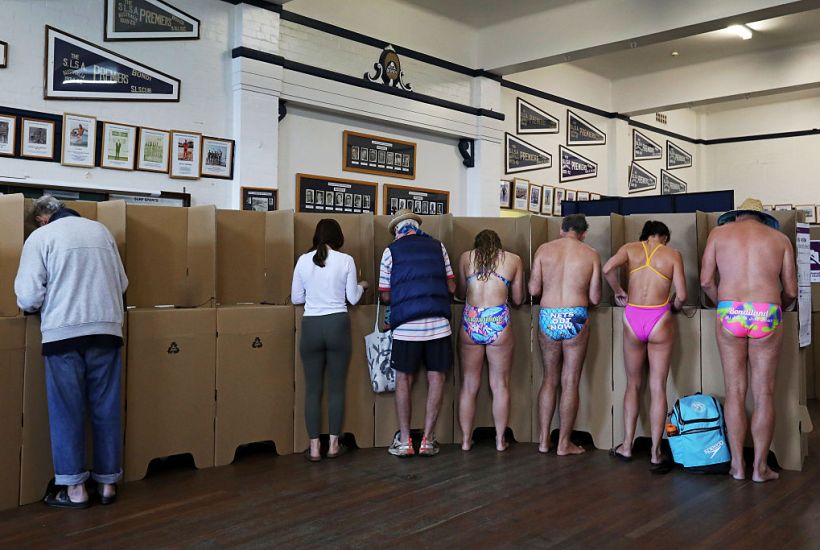
There is a peculiar Australian conceit that compulsory voting is part of the natural order, as fixed as the Constitution itself. It is not. Compulsory attendance at the ballot box was bolted onto the Commonwealth Electoral Act in 1924, ordinary legislation passed by an ordinary parliament, and it could be repealed by an ordinary parliament tomorrow. That it never will be tells you who benefits from it, and it isn’t the voter.
Australia is one of only a handful of democracies that still forces its citizens to the polls under threat of a fine. Most of the developed world – Britain, the United States, Canada, New Zealand, most of Europe – trusts its citizens to decide for themselves whether an election is worth their time. If a party wants your vote, it has to earn it: it has to give you a reason to leave the house. In Australia, no such courtship is required. The disengaged, the indifferent and the actively hostile are marched to the polling place regardless, and it is their votes – cast to avoid a fine, not from conviction – that increasingly decide who governs the country. This is the central perversity of the system, and it explains a great deal about the state of Australian political discourse.
Consider the incentive structure compulsory voting creates. In a voluntary system, a party’s task is to persuade people who care about politics to turn out in greater numbers than the other side’s supporters – which rewards clarity, because the people you’re trying to move are paying attention. In Australia’s system, the task is different. Every adult is coming to the polls regardless, including millions who have given the election five minutes’ thought. The winning strategy is not to persuade the engaged but to give the disengaged a visceral reason not to vote for the other lot. Fear beats argument, a slogan beats a policy, and because the low-information voter is the decisive one, the whole contest bends toward them.
Our political parties worked this out long ago. At recent elections we were told, with a straight face, that a vote for Labor was a vote to bring down your power bill – a claim overtaken almost immediately by events. We were told the Coalition’s nuclear proposal would cost ‘over $600 billion’, a figure built on contestable modelling, deployed less as analysis than to frighten. We were told Medicare alone would answer every anxiety about the cost of seeing a doctor, and that negative gearing and the capital gains discount were untouchable – commitments treated, in the heat of a campaign, as more solid than they later proved. None of this is the accidental noise of a rowdy democracy. It is a strategy aimed at voters who do not read the fine print, because those are exactly the voters compulsion delivers to the booth in their millions.
Defenders of compulsory voting insist it produces a parliament that reflects ‘the will of the people’ rather than the will of the motivated minority who would turn out voluntarily. This gets the problem backwards. A parliament elected by people dragged to the ballot box, many of whom donkey-vote or vote for whoever ran the loudest scare campaign, does not reflect anyone’s considered will – it reflects an advertising contest fought over the most persuadable, least informed slice of the electorate. A voluntary system would force parties to campaign on substance to people who chose to engage. It would shrink the electorate, yes – but raise, not lower, the average quality of the mandate that emerges.
The national numbers bear this out. Real per capita household disposable income — the OECD’s preferred measure of living standards, stripping out tax, mortgage costs and inflation – has fallen more than eight per cent since its mid-2022 peak, the steepest decline of any developed economy over that period. Living standards went backwards on the measure that actually matters to households while the government presiding over it was returned with an increased majority. That is not the verdict of an electorate carefully weighing the evidence. It is what happens when a large slab of voters would happily stay home, and compulsion drags them in anyway to cast a vote shaped by whichever party ran the sharper scare campaign that week.
Victoria supplies the starkest case study. Under successive Labor governments, net debt has ballooned from a manageable $22.3 billion in 2015 towards a forecast $200 billion, interest repayments are running close to a billion dollars a month, and the state has the lowest credit rating in the country. In the twelve months to March 2025, the recorded crime rate climbed to its highest level since 2017. None of this has been remotely close to fatal for the Allan government at the ballot box, because a compulsory electorate does not sift and punish poor governance the way a voluntary one would. A large bloc of voters turns up regardless, out of habit or indifference, and the government need only ensure its scare campaign about the alternative is louder than the case against its own record.
There is also a liberty argument Australians have stopped making, because compulsion has made abstention feel foreign. But the right not to vote is as legitimate as the right to vote. A citizen who concludes no party deserves their support is not derelict in some civic duty; they are exercising a form of consent, or the withholding of it, that the state has no business punishing.
None of this requires a referendum. Section 24 of the Constitution requires that members of the House of Representatives be ‘directly chosen by the people’; it says nothing about compelling those people to turn up. Compulsory attendance is a statutory choice, made by the Scullin-era parliament and never seriously revisited since. A parliament could vote to end it next sitting week, if enough MPs were honest about what the current system incentivises – and honest enough to admit that the parties who benefit most from a captive, low-information electorate are unlikely to volunteer for the change themselves.
Until that happens, Australian elections will keep being won not by the best argument, but by whoever most effectively frightens the least attentive voter in the country. That is not democracy at its best. It is democracy rigged, quietly and legally, in favour of whoever shouts loudest at the people paying least attention.
Got something to add? Join the discussion and comment below.
Peter Swan AO is at the UNSW-Sydney Business School.
You might disagree with half of it, but you’ll enjoy reading all of it. Try your first month for free, then just $2 a week for the remainder of your first year.