Carl von Clausewitz said that war was politics by other means, one method of advancing your interests among many. In a time of stultifying international alliances and nuclear weapons, other means proliferate. Tariffs by the US government; cyberwarfare by the CCP; international institutionalism; transnational advocacy groups; proxies in the Middle East; occasionally actual war, like Russia and Ukraine.
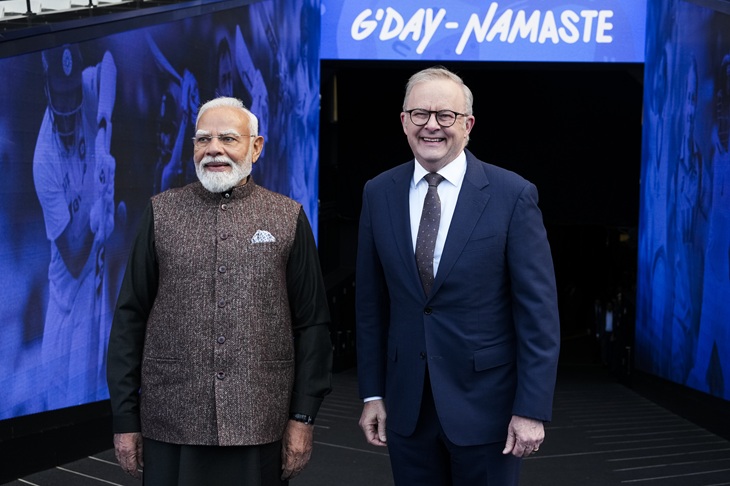
This is why Albanese’s meeting with Modi on home soil, very much acting the grateful party, felt off to many people. To others, it was simply the spirit of mid-20th Century internationalism making another triumphant appearance. The banners and long hair might have changed for suits and grey hair, but the animating spirit remains the same. This is how we iron out international conflict, the way we once ironed out intra-national conflict.
The germ of all internationalism was inside nationalism to begin with: the notion that we can construct ever larger polities. If you can melt millions of people into one identity, inevitably one supported by print media and state institutions, then why not do the same for the whole world? People today frequently forget that nationalism was a progressive notion in its time, because it was the enemy of localism and traditionalism; it provided an opposing pole of loyalty to older forms, such as monarchy and religion. Nationalism spread its wings to become what internationalism is today: a wholly universal creed, one open to all the world pending paperwork, and a creed before anything else.
Cheerleaders of universalist internationalism were quick to recognise the potential for evil within nationalism, well documented in the past two centuries. But they were blind to the same germ in internationalism. If nationalism can generate exclusion based on place and heritage, internationalism does the same, but without place and heritage. Nobody is privileged anywhere, least of all their historic home; and outsiders are identified along creedal lines rather than ethnic or geographical ones. The wicked are those insufficiently convinced that the old must burn so the new can rise. Internationalism, for all its promises, has proved destructive more than generative in recent decades. Look at the churches burned in Europe; the statues toppled; the towns and suburbs erased from historical identity. The institutionally invisible must die so the empirically verifiable – GDP, employment data, population pyramids, labour markets, housing portfolios – can live.
Some of the 20th Century’s most murderous regimes grounded legitimacy in universal political creeds rather than ethnic identity alone – the Soviet Union, Communist China – and put more of their people to death than any overtly nationalist state. The moral logic of caricatured nationalism is inverted: see the scenes in Spain this month, who is viewed fondly by elite opinion and who is not. Hatred without introspection is delicious, and better characterises the modern universalist than his adversary. It is easy to harm those you believe choose evil of their own volition.
Obviously, we did not iron out international conflict by mixing all the peoples of the world together. The irregularity of borders and the desire for people to live among their own is an old and ancient instinct, the amelioration of which by consumer product identity and mass re-education is by no means guaranteed. Before this idea was seriously proposed after the second world war, the tension between people and place contributed to the world wars. Serbian nationalists did not want to be governed by the Austro-Hungarians. The Sudetenland Germans cheered as Panzer Regiment 1 paraded through Karlsbad. Today Putin justifies annexing East Donbas because those living there are ethnic Russians. Confidently assuming primordial flesh-and-blood identities can be painlessly substituted for abstract universal ideas is the great coin toss of our time.
The presence of large and organised ethnic minorities in a sovereign state is dangerous because they provide casus belli to other states, regardless of paperwork. We might not worry so much about South Sudan – lacking the means – flexing itself via its émigré population. But the same is certainly not true of China and India. Émigré populations provide an avenue of influence for those with eyes to see.
Imagine Australia takes a nationalist turn – not nationalism as the universalist proto-internationalist legal membership variety, but the firmer sort. This is not impossible. A significant percentage of the people increasingly want this sort of thing. The elite class recoils in terror, because their authority rests partly on blindly administering precisely this international order. They sail the ship because they contend they are the only ones with the unique moral and mental capabilities to do so. About its direction of sail they do not seem bothered; instead they steer in circles with no vision of the future, for the sake of their own importance. If anyone wonders about consent of the governed – the old justification for legitimacy – they should cease wondering. Today’s elites govern in order to govern, and popular elections exist around this principle. Expect every stop and trick to be deployed to stop those outside the tent making meaningful inroads electorally, because elections are only one way to leverage power, in the same way war is only one way to promote interests.
But suppose it did happen. How would states with a diaspora of a million plus respond? Forget about the loyalty of those people – some, but not all, are likely to be dinky di – and consider the justifications this presents to other powers. India would have a vested interest in responding to the oppression, real or imagined, of Indians in Australia. Modi himself said that every emigrant ‘takes Bharat along with them’. A flowery turn of phrase implying extraterritorial sovereignty: the migrant has enduring obligations presumably returned by the homeland in kind. What are we to make of this against today’s popular universalist assumptions on the lightness and interchangeability of citizenship, migration, homeland? In sensible times, receiving nations would have considered this a threat.
A flotilla of naval ships departing from the Ganges is difficult to picture, but conventional war isn’t the likely option. We could look forward to dissent and umbrage in a nation once enviably high-trust, with powerful international backing: conflict externally economic, internally social and political. Imagine Australia before the UN, the subject of condemnation by the Global South. This is entirely possible in the future. The machinery of international governance – established after the second world war by Western nations – is entirely dependent on the hands it’s in. This machinery is unlikely to be friendly to historically European nations, with legacies of colonialism, when they only number around 10 per cent of the world’s population.
Clausewitz understood that politics concerns power before sentiment. Modern internationalism often assumes that increasing interconnectedness dissolves power politics; increasingly it seems to simply redistribute them. Demography, institutions and diasporas become the instruments through which states realise their interests once pursued by marching armies.