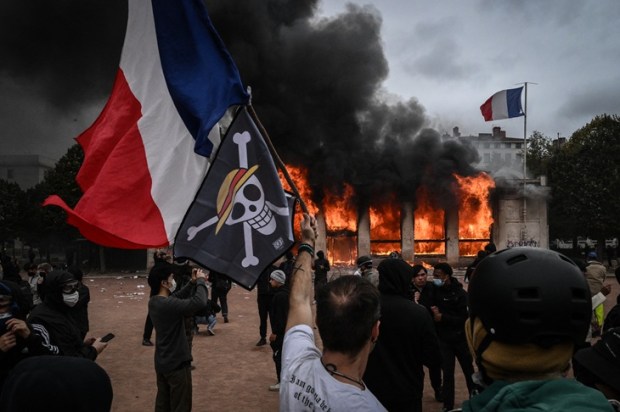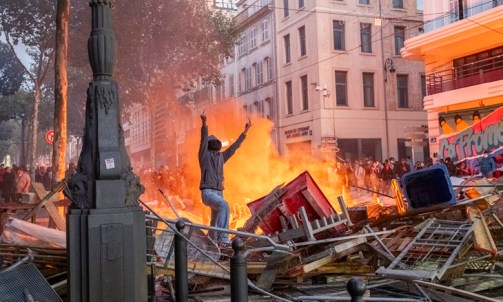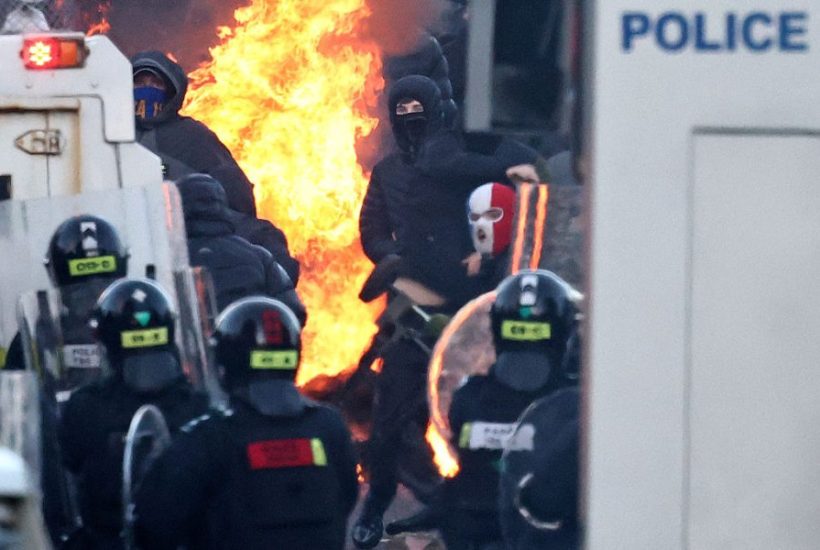
As is so often the case following riots, attention on symptoms drowns out discussion about the cause. This pattern has been evident this week, as unrest in Belfast erupted after a man was stabbed. The alleged attacker was arrested and charged but, following the news that he was allegedly an immigrant, mobs roamed Belfast for days, committing horrendous acts of violence and intimidation. This violence, while quite rightly widely condemned, has allowed politicians to avoid awkward questions raised by the immigration status of the alleged attacker. Having reportedly entered the island of Ireland via Dublin, the case has reopened questions about which border truly exercises control over migration for Northern Ireland.
The fact that the alleged attacker entered via the Republic of Ireland is challenging for Irish politicians. In 2024, Helen McEntee, then Minister for Justice, Home Affairs and Migration – Ireland’s equivalent to the Home Secretary – claimed that around 80 per cent of asylum applicants in Ireland came from the United Kingdom. This figure has been repeated by other politicians, and the Irish government maintain that a majority of asylum seekers enter from the UK.
No one in Britain is seriously advocating reopening the question of a hard border
This argument gave Irish politicians an easy answer over immigration questions – it’s Britain’s fault. It was also conveniently pro-nationalist, bolstering the case for Irish (re)unification and control over migration across the whole island. Yet it was the UK that forced Ireland to strengthen its immigration policies more broadly. When Home Secretary Shabana Mahmood announced her tightening of British immigration and asylum policy towards the end of last year, Jim O’Callaghan, Helen McEntee’s successor, acted swiftly to announce the Irish government would look to do similar. ‘I am committed to ensuring that Ireland is not viewed more favourably than the UK’, he said.
However, with no hard border on the island, the danger argument works both ways, and no government is infallible. Despite the number cited by McEntee, the truth is that both governments are unable to give reliable figures about asylum applications and immigration that relate to Northern Ireland. How many asylum applicants arrive via each state? How many cross the border?
The soft border is a legacy of the Troubles. It began with the Common Travel Area (CTA) between the UK and Ireland, which allows British and Irish citizens to study, work and live across both islands freely, and was built upon with the European Union’s single market and the Good Friday Agreement. The border was then far from the average Brit’s mind, before questions were raised following the vote in favour of Brexit. How do you ensure no hard border with an EU member, while simultaneously leaving the Union and wanting to tighten migration?
The immigration journey of the individual charged with the Belfast attack led some politicians to appear sceptical of the CTA. Democratic Unionist Party MP Carla Lockhart appeared to call for the CTA to be reviewed when speaking to the BBC this week: ‘That’s where this problem lies, and unless the government step up, I fear we will continue to see significant unrest within our communities,’ she said. At Prime Minister’s Questions this week, DUP leader Gavin Robinson asked Keir Starmer what he intended to do to ensure he ‘closes the open, porous border’ on the island. Over the weekend, Robinson said ‘nobody is proposing’ a hard border but argued there is ‘no effective people border’ on the island of Ireland.
Reviewing the CTA is clearly a fringe political position in Britain, yet Irish politicians seized on these comments to defend the agreement against what they framed as ‘rising British criticism’. The underlying immigration case went ignored. Responding to Northern Ireland Secretary Hilary Benn, who said that the Irish have questions to answer over the case, McEntee – now Minister for Foreign Affairs – linked the case to the historic Troubles and pushed for the UK government to continue to work on their joint framework for legacy.
For Irish nationalists, the case in Belfast exposes a weakness between two common arguments: that the border should matter less and less, and that control by the Irish state should matter more and more. The subsequent violence is also uncomfortable for those who advocate unification, as it is a salient reminder of the problems which still exist within Northern Ireland.
For what it’s worth, I don’t believe that most people – whether British or Irish – care about whether more asylum seekers and immigrants are arriving from the UK to Ireland or vice versa. I think they simply can’t comprehend how two island nations can appear to exercise such a lack of control over migration flows. The case of the alleged attacker in Belfast is just one more example of failure for those concerned about immigration. No one in Britain is seriously advocating reopening the question of a hard border in Northern Ireland but, as we approach the tenth anniversary of the Brexit vote, the question remains: how can the country seriously get a grip on numbers?