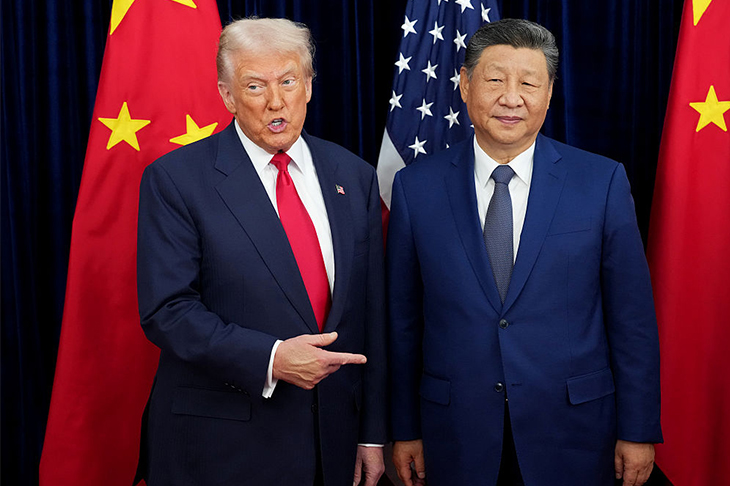
No less a commentator than Niall Ferguson insists the world has left behind the post-Cold War period and has now entered what he calls Cold War II. And obviously a new superpower rivalry, between the US and China, is underway. Just as it was in the actual Cold War there is only going to be one winner. Our global destiny, more than likely, will be a reconfigured Pax Americana or a newfangled Pax Sinica. Both Trump and Xi would hold this to be true. And yet neither of them, to their credit, wants a return to the ideological acrimony and brinkmanship of the post-second-world-war era. The two-day summit in Beijing appeared to confirm this trajectory.
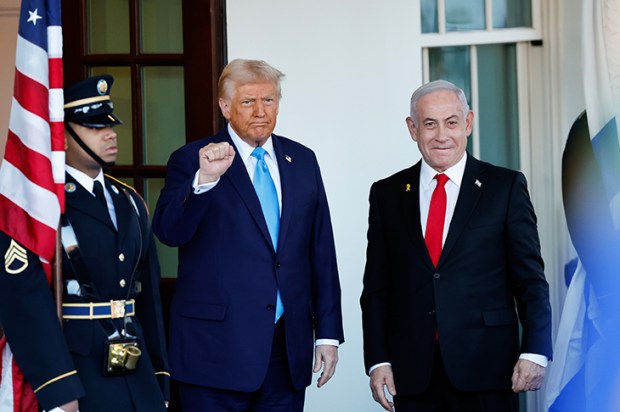
Trump detractors have always cited his generous praise for authoritarian leaders – Xi Jinping, Vladimir Putin, Kim Jong-un, Rodrigo Duterte, Recep Tayyip Erdoğan et al. – as proof that he himself has a ‘strongman’ complex; that he, too, would love to rule America without the Supreme Court or the Democrats on his case. According to this narrative, he envies the power of dictators to do exactly what they want in their own countries. Trump didn’t go out of his way to disabuse his critics of this fantasy with his generous tribute to Chairman Xi at the state banquet: ‘You’re a great leader, sometimes people don’t like me saying it, but I’m saying it anyway, because it’s true.’
The naysayers will knowingly point to Trump’s refusal to label Xi a ‘dictator’ in a press exchange on Air Force One on the return flight to Washington: ‘I don’t think about it…. He’s the ruler, he’s the ruler of China. You deal with what you have.’ Obama’s ambassador to Beijing (2012-14), Michael McFaul, asserted that Trump’s ‘asymmetry of praise’ for Xi and his refusal to call him out as a ‘dictator’ signalled weakness on the part of America. How come Xi never reciprocated the ‘great leader’ compliment? To add to ‘America’s humiliation’ – as others characterised the two-day state visit – no big trade deal was announced and Beijing made no official pledge to reduce its military support for the Islamic Republic of Iran or Putin’s Russia. Trump could not even get a promise out of Xi to release Pastor Ezra Jin Mingri, only a vague undertaking to give the matter ‘very serious consideration’.
The term ‘Trump Derangement Syndrome’ is getting a little worn-out by now but how else to respond to McFaul’s assertion that Xi did not treat Trump as a ‘great leader’ during his brief visit to Beijing? Did he not notice the extravagant welcoming ceremony at Beijing Capital Airport, the highly symbolic visit to the Temple of Heaven or President’s Xi’s public commendation for Trump’s Make America Great Again project. Surely any one of those things – let alone all three – constitutes an ‘asymmetry of praise’ albeit in President Trump’s favour. If nothing else, Mr Ambassador, it contrasted with the deliberate snubbing your boss, President Obama, received on his arrival in Hangzhou for the 2016 G7 meeting, when Xi arranged it so that the entire US delegation had to disembark through an emergency exit on Air Force One.
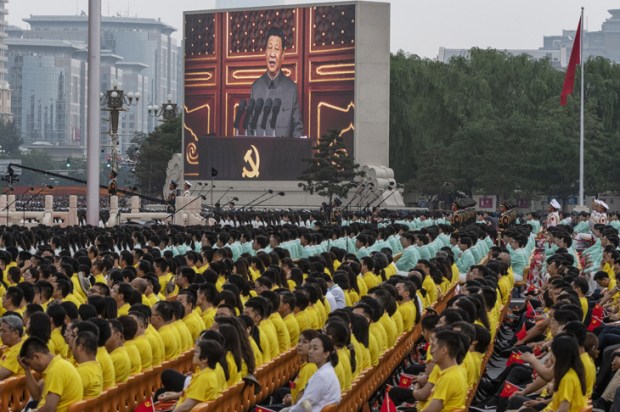
None of this is to suggest Trump is a good friend of Xi or vice versa or that either of them think the other a ‘great leader’ in the tradition of their respective countries. Trump probably puts George Washington, Henry Jackson and Ronald Reagan in that category while Xi doubtless sees Mao Zedong and Deng Xiaoping as his role models. Trump is aware that Beijing is working overtime to turn China into the Great Hegemon at the expense of the United States. Xi, in turn, would be aware that the Trump administration is doing everything in its power – covertly and not so covertly – to thwart that ambition.
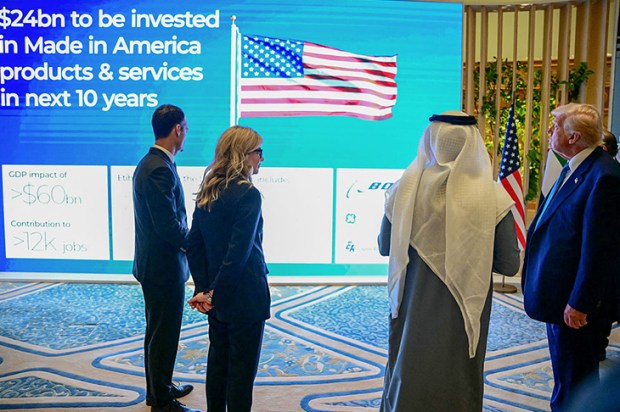
That said, it is in the interests of both these ‘great leaders’ to shore up their success on the home front. In the short term, at least, neither is thinking of a zero-sum game. So when Xi spoke of ‘the great rejuvenation of the Chinese nation’ going ‘hand-in-hand’ with ‘making America great again’ he was not telling a total lie. Let’s call it a half-lie. At the summit Xi got some assurance Trump would retain the current tariff truce between the two countries plus US approval for China’s main technology companies to purchase Nvidia’s H200 AI chip. Trump, for his part, could report Beijing’s commitment to buy 200 Boeing aircraft and increase its imports of US beef. Much of this, however, was already in the works and the on-going ‘de-risking’ – though not outright de-coupling – between the two superpowers gathers pace.
That is because the American Dream and the China Dream, ultimately, are incompatible. Trump acknowledged this as long ago as the 2016 presidential campaign: ‘We can’t continue to allow China to rape our country.’ Over the years, Trump has openly accused Beijing of every kind of nefarious activity from currency manipulation and predatory trading to de-industrialising America’s Rust Belt. And he did not stop there, explicitly blaming Beijing for orchestrating the smuggling of fentanyl into America, killing up to 100,000 people a year. Many of the victims, pointedly, would have been without gainful employment due to China’s weapon of mass jobs destruction.
This, then, is the context in which Trump acclaimed Xi as a ‘great leader’. We are in the midst of a twenty-first-century version of the Great Game in which both sides use whatever leverage available to foil and outwit the other without coming to blows. Who will be the winner? Xi made a passing reference to America being ‘in decline’ though that might be a case of hubris. Consider, for instance, America’s commandeering of Venezuela and the Strait of Hormuz and the leverage this brings against oil-dependent China.
Trump’s favourite moment might have been when Xi informed him Beijing was contemplating sending ships to Texas, Louisiana and Alaska to purchase American crude. That does not sound like Cold War II, let alone ‘America’s humiliation’. How could Xi’s regime contemplate attacking Taiwan, or any number of other ‘surprises’ such as cutting America’s underground cable network, if the US were to be a major source of China’s energy?
One of Xi’s high-end policy think tanks, assuredly, is already working its way through that one.
Got something to add? Join the discussion and comment below.
You might disagree with half of it, but you’ll enjoy reading all of it. Try your first month for free, then just $2 a week for the remainder of your first year.