I recently left an art display at the Art Gallery of Western Australia called Attachment Styles: Modes of Belonging in Modern and Contemporary Art with one very clear message: I don’t belong in any part of the story that Perth Institutions tell themselves about Western Australia.
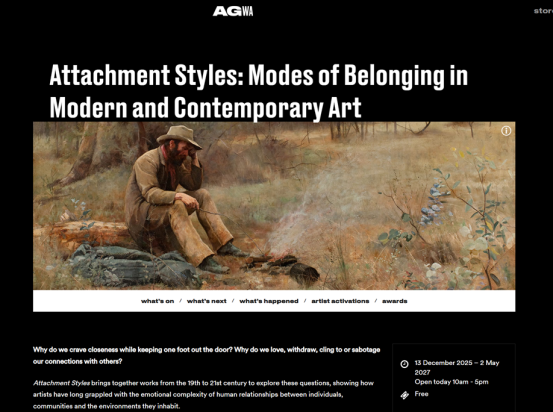
Screenshot: https://artgallery.wa.gov.au/whats-on/exhibitions/attachment-styles-modes-of-belonging-in-modern-and-contemporary-art/
I have never been backward in stating that I don’t care too much about what happens east of the Nullarbor, aside from what I am forced to care about in relation to taxes and legal impositions.
Likely similar to how most in the Pacific Southeast feel about everything from Darwin to Esperance, but I imagine each state has a solid warehouse of artworks that it owns. Western Australia is no different, in fact we own some truly remarkable old pieces steeped in legend and tradition.
One of these, for example, is The Foundation of Perth, by George Pitt Morrison. A truly beautiful painting of Helen Dance, a wife of one of the assembled sailors, about to make one of the first axe-blows after the colony’s inaugural governor, James Stirling, has read out a declaration from King George IV. That image used to be a permanent fixture in the Art Gallery. Today it seems to come and go and is these days adorned with Aboriginal place names, always first, and with assertions about the ‘impossibility of unifying the tranquillity of the naturalistic landscape setting with the violence against indigenous people…’
Likewise, Idleness, by Rupert Charles Wulsten Bunny, c 1909, or Down on His Luck, by Frederick McCubbin, painted in 1889. All overwritten now with statements like ‘born 1964 Naam/Melbourne…’ etc.
You get the picture.
Contemporary cultural institutions have a moral framework that treats European heritage primarily through the lens of guilt and non-European heritage primarily through the lens of victimhood or virtue.
It is my view that the same reason people complain about two-tiered policing in the Uk is why we are not allowed to celebrate our own history.
Instead, our history ends up being retold through the overwrought statements of a middle class that at once exaggerate and misunderstand the events of the age, while extending sanctification to basically everyone who isn’t of European descent. It’d be funny if it wasn’t deadly serious.
Second, as always, Perth thinks that Perth is Western Australia. Not the Albany whaling industry, the historic gold mining industry of Kalgoorlie and the Goldfields, not the ancient Kimberley civilisations (plural), and not the Pilbara where I grew up.
The only mention of the Pilbara was one kids exhibit, on The Drovers Strike, which seems to be getting renamed to the 1946 Pilbara Strike, and the story seems to be changing a bit. Old Don MacLeod, who I met in his dotage in the Jigalong Aboriginal community near Newman, and the author of How The West Was Lost, had been assigned a bit part in this retelling instead of the central role he played. Something I found quite amusing.
Lang Hancock and the story of iron ore is, by far, the most important West Australian story there is. Yet, there is regularly nothing at all about it in either the Art Gallery of Western Australia, or the WA Museum. Because, of course, once you mention Lang, you must mention Gina Rinehart, his daughter and inheritor of his fortune. A fortune she has turned into a far greater empire than Lang ever owned, and the urban middle class despise Gina Rinehart. Particularly after she gifted Pauline Hanson with an airplane.
As an aside, the West Australian Museum is named in using a word from the local Aboriginal tribe. A language that changes quite a bit throughout the southwest and is nothing like the languages of the Martu, Pintupi, or Wongi up in the north, to name but a few. Nothing at all is named after any of the northern tribes.
If the city wanted to fund and build a Perth Museum, I couldn’t care less, but this is the West Australian Museum. My state. Twice the size of Texas and a third of the Australian land mass.
Along with the success of Lang also comes one of the real tragedies of Western Australia. The blue asbestos mine at Wittenoom. More than 2,000 miners and residents have died directly from asbestos-related diseases contracted at Wittenoom, while total nationwide deaths linked to the site are estimated to be over 4,000 people. That’s not a cultural grievance. It’s an atrocity of omission with a body count.
A story that should be taught to every school kid across Australia is ignored. In fact, it is my opinion that their memory is being actively erased behind the renaming of the Wittenoom Gorges using Aboriginal place names. Here’s a tip for you also, just a local secret that people pretend they don’t know. The Aboriginals called these places ‘that big creek over beyond the old tree over there’, just like everyone does. It’s the middle class that run around naming things throughout history declaring ownership as they go. We just get to cop the blame for it like all the crimes Canberra commits that we have never had a vote on.
Alongside sidelining both the greatest industrial story in our nation’s history, and its greatest industrial tragedy, the exhibition does not appear to mention or have any references whatsoever to the Robe River dispute. An industrial dispute that started in Pannawonica and Wickham in 1986 and swept through all the Pilbara mining towns wiping away all the early settlers, their history, and the brutal lives they lived while erecting this industrial fortress that today, with Woodside as well, produces over 20 per cent of Western Australia’s entire Gross State Product (GSP).
So, between seeing all our historic artists described using place names they would never have encountered in their lives, watching all the other tribes of Western Australia, both black and white be ignored, from Albany to Kununurra, and my entire pioneering history and that of my Indian immigrant grandparents ignored; the message I took away from Attachment Styles: Modes of Belonging in Modern and Contemporary Art was that I definitely didn’t belong.