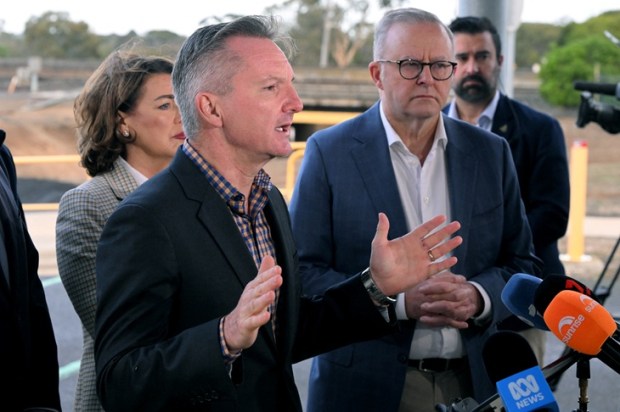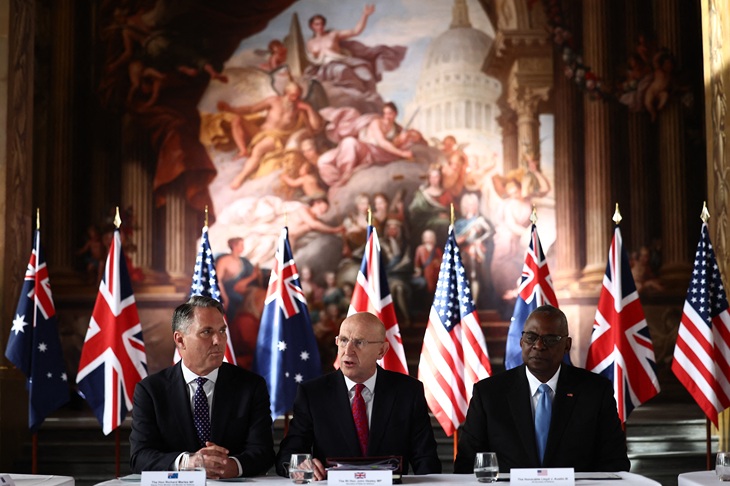
At the Shangri-La Dialogue last weekend, three defence ministers performed a quiet act of damage control and called it a triumph.
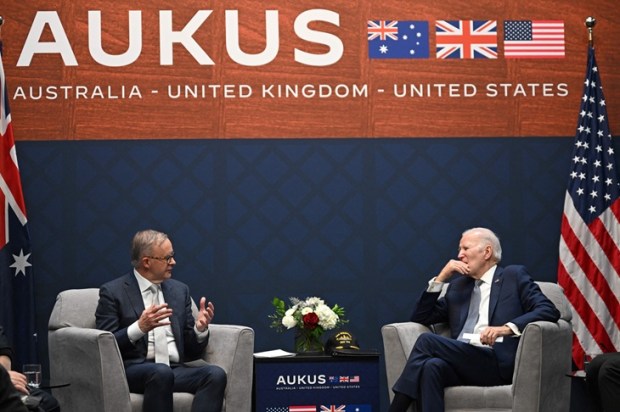
Richard Marles, Pete Hegseth, and John Healey announced that Australia would acquire three used Virginia class submarines from the United States rather than the previously agreed mix of two used and one newly built. The communiqué praised simplicity, efficiency, and cost savings. The headlines obliged. The truthful one-word summary is downgrade.
So, is the pact in disarray? On the surface, no. Three governments still nod at one another, instalments are paid, and paperwork is signed. Strip away the press releases, however, and what remains is an alliance whose two great power principals can no longer manage what they promised, and whose junior partner is being asked to accept the consequences and smile about it. Distress, more accurately, with disarray creeping in from the edges.
Consider the home front. Defence Secretary Meghan Quinn told a Senate estimates committee on Tuesday night that buying only second hand submarines had ‘always been the preference’. Pressed by senators, she conceded the existence of ‘two constrained optimal pathways’. It is the sort of formulation that would have earned Sir Humphrey Appleby a standing ovation. In ordinary English, a constrained optimal pathway is Plan B once Plan A has fallen over.
Defence Industry Minister Pat Conroy was more candid: Washington had changed its mind about which Virginia class boats it wished to keep, and Australia had adjusted accordingly. The largest defence procurement in Australian history is now timed to the Pentagon’s convenience.
Why? Because the United States cannot build the submarines it has promised itself, let alone the ones it has promised us. American shipyards are turning out Virginia class boats at roughly 1.13 per year against a Navy target of two, and the Pentagon does not expect to clear the backlog before 2028. Removing the new build boat from Australia’s allocation eases pressure on Groton and Newport News. It does nothing for HMAS Stirling.
The British half is no more reassuring. HMS Audacious sat at Devonport for some 22 months after a record-length 2023 deployment, waiting for a dry dock that had not been reconfigured in time. HMS Ambush has been partially stripped of parts to keep her sisters at sea. In April, the House of Commons Defence Committee warned that submarine availability was ‘critically low’ and that Britain could not meet its Aukus obligations and maintain its Euro Atlantic deterrent simultaneously without urgent investment. The report appeared four weeks before Marles flew to Singapore.
And then there is HMS Anson. The Astute class boat sailed from Faslane on January 10 and arrived at HMAS Stirling on February 22 for the inaugural maintenance period of a Royal Navy nuclear submarine on Australian soil. Trilateral workforce, Australian made components, ceremonial photographs, encouraging press releases. [Ironically, last week, I was swimming on my vacation from Dubai off Mount Wise, Plymouth when Anson suddenly appeared on her way into the yard.]
Twelve days later, she was gone.
When the United States and Israel began striking Iranian targets in early March, Anson was abruptly withdrawn and dispatched to the Arabian Sea, the only operational Astute class boat the Royal Navy had to send. The Defence Committee report cited the episode directly, concluding that Aukus had stretched the Astute fleet to or beyond its limits. The question, as The Diplomat observed, was not where Anson had gone, but why this particular submarine had to be pulled. The answer was that there was no other choice.
Aukus’s first rotational presence: present on Monday, gone by the second Friday, redirected to a different ocean by a contingency Britain could not refuse.
Marles can call it streamlined. What Australia has been handed is three used boats from a partner whose production line is broken, plus occasional visits from a UK boat liable to be recalled at any moment to some pressing matter east of Suez.
The 2023 framework allowed for up to five Virginia class submarines. Singapore mentioned ‘potential for up to two more later’. ASPI’s Malcolm Davis has asked the obvious thing: has the ceiling of five quietly become a ceiling of three? Three ageing Block IV Virginias across the 2030s, against a PLA Navy launching boats faster than the United States can build them, is a deterrent posture, not a deterrent.
None of this is an argument against Aukus in principle. China is real, geography is real, the Collins class is old. The pact should proceed.
But the gap between brochure and delivery is widening. The Albanese government won the Aukus debate by selling Australians a capability leap. What they bought is a place in the queue behind Washington’s industrial base problems and London’s maintenance backlog. The government did not lie. It simply allowed the public to assume that the partners were as capable of delivering as Canberra is of paying.
Is Aukus in disarray? The communiqués say no. The fleet says otherwise.
What it looks like at Shangri-La is choreography. What it looks like at HMAS Stirling is an empty berth.