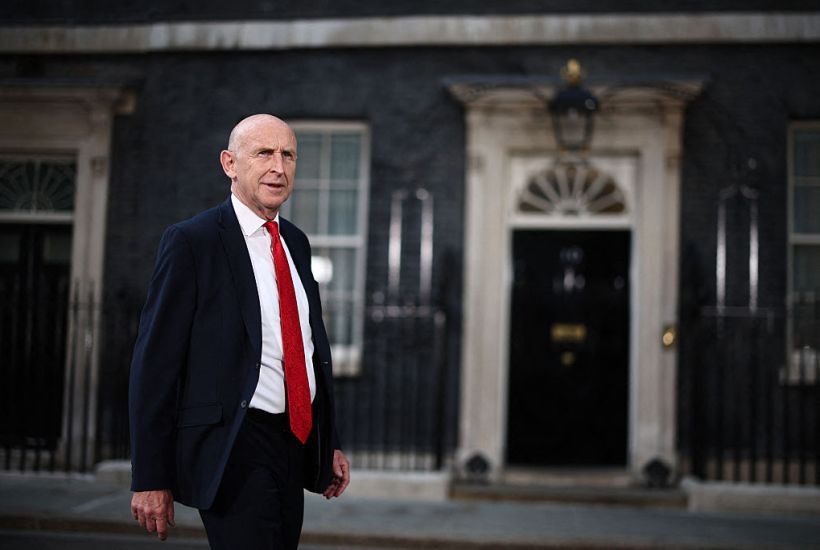
John Healey has been hit with a triple whammy on his first full day as Chancellor of the Exchequer. The Office for National Statistics (ONS) has just published the latest figures on jobs, public sector finances as well as an update on their troubled Labour Force Survey (LFS). There’s bad news, news that only looks good because it’s less bad than usual and truly disastrous news.
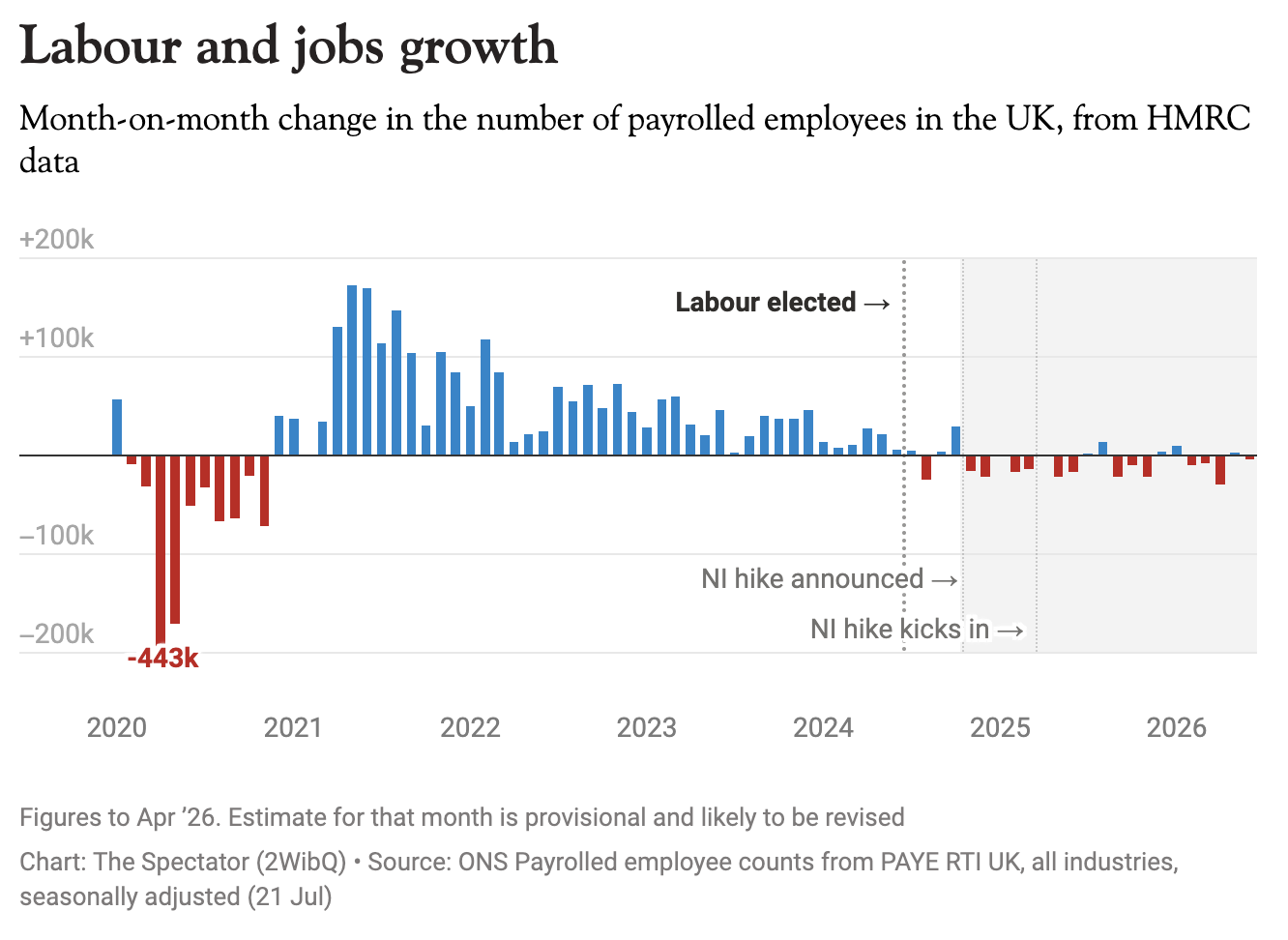
First of the three is the jobs destruction – kicked off by the previous Chancellor’s £25 National Insurance tax raid and hikes to the minimum wage. This has continued with 85,000 more employees disappearing from payrolls compared with a year ago, with the unemployment rate falling only slightly to 4.9 per cent.
But the jobs figures are really bad news when you split them out by age group. The unemployment rate for 18-24 year olds has climbed to 14.8 per cent – the highest of any age group. Reversing the trend of youth unemployment should be Healey – and Burnham’s – defining mission.
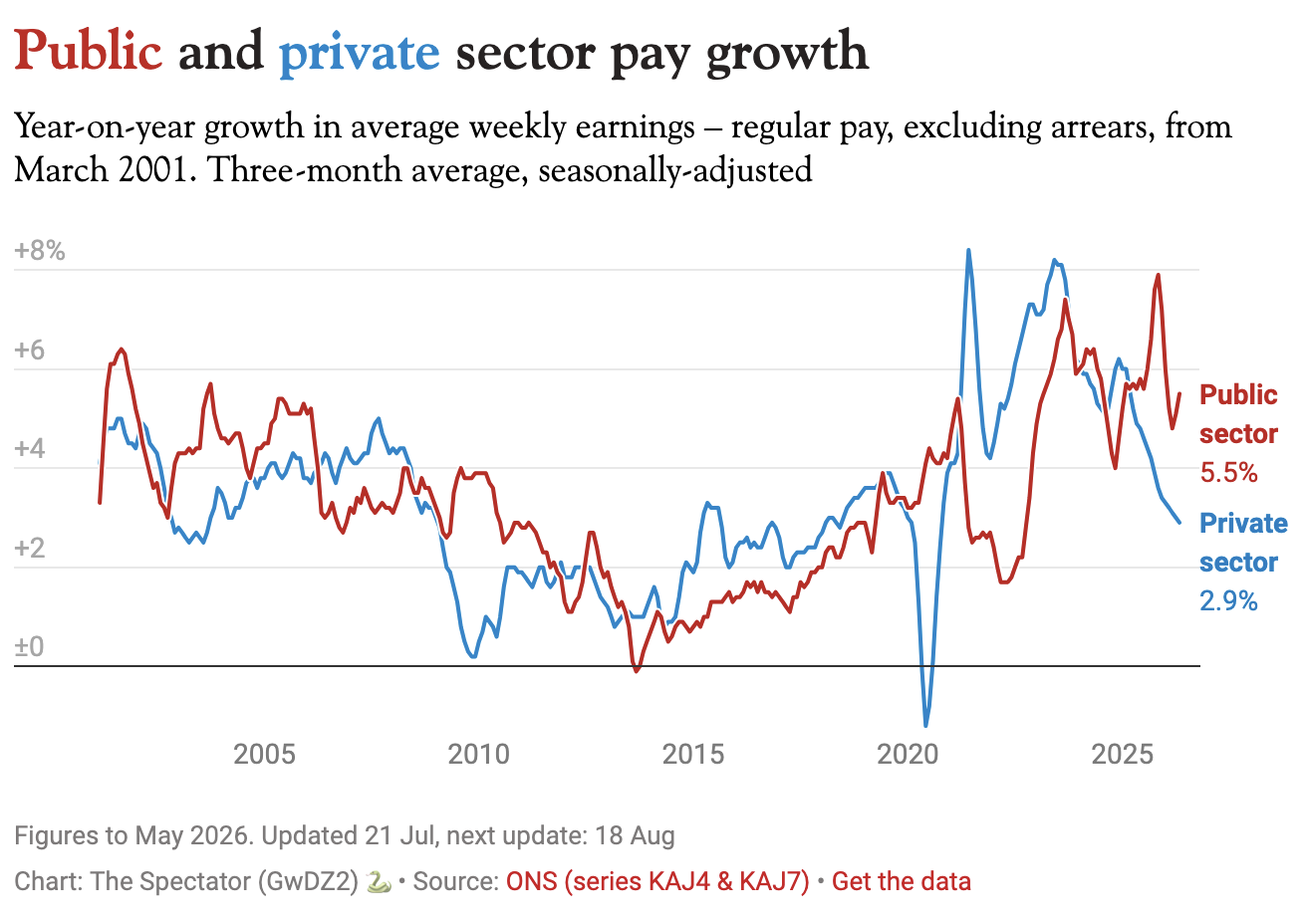
On wage growth, private sector pay rises slowed to 2.9 per cent while public sector ones sped up to 5.5 per cent. The ONS put the climbing public sector pay growth down to ‘base effects’ caused by NHS pay rises being paid earlier this year than in 2025. But the public won’t care about that – they’ll just see the direction of travel for our economy which the below graph suggests.
Second is the public finances. At first glance this morning’s news looks relieving for Healey: borrowing in June is down a third compared with the same month last year thanks to bumper tax receipts and reduced spending on inflation-linked debt interest. But zoom out and the picture is a lot less rosy.
Borrowing across the financial year so far is some £2.7 billion more than had been forecast by the Office for Budget Responsibility. That’s a gap Healey will have to fill in his first Budget later this year. And even though debt interest spending has fallen it was still the fourth largest amount we’ve had to spend on such things in the month of June since records began.
Third is the ONS itself, which has yet again confessed to a problem with the LFS which underpins some of the most important statistics about Britain’s economy. The survey had improved in recent months with increased response rates improving the accuracy of the data. But progress has stalled, with the ONS admitting today:
‘An operational error occurred in May 2026, which led to temporary under-resourcing in LFS telephone collection operations; our analysis to date indicates that the error had a minimal impact on the headline estimates, although, it does suggest there is a small but noticeable impact on the estimates of average hours and so the total actual hours worked.’
The ONS may say the impact to its data has been ‘minimal’ but the impact on its reputation should be terminal. For years now ministers, mandarins and economists have not been able to trust with confidence our jobs market data. The result is that there are months of labour market data where no one can really confidently say if employment went up or down.
Getting a grip on the malfunctioning ONS could be what makes or breaks this Chancellor. Depending on what data series you look at, the picture the numbers paint of Britain’s economy can switch from negative to positive. No government can decide what levers to pull if they’re doing it with a blindfold on.
Still, Healey’s first test is going to be cashing the cheques Burnham keeps writing. So far, the new PM has hinted at a rise in the income tax personal allowance, billions on social care, presumably increased defence spending and sticking to the triple lock. His removal on VAT on energy bills, announced this morning, appears to be totally unfunded too. At the same time, he has committed to sticking to the fiscal rules. And as the great Paul Johnson has put it: ‘either he can’t deliver this or we’re in for big tax hikes’.