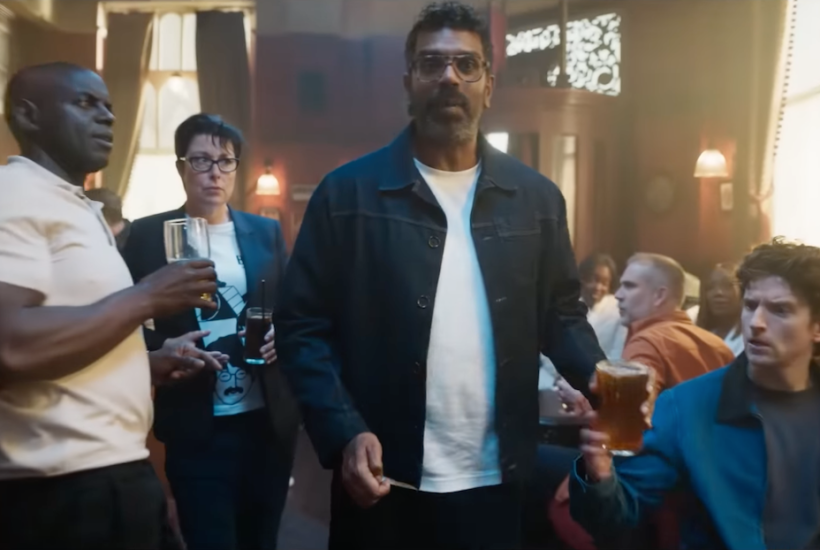
Unlike Argentina, the BBC went on the attack during the World Cup final on Sunday. During the half-time interval, a short, star-studded promotional film was aired. The film was a contemporary reimagining of a similar advert broadcast 40 years ago in which John Cleese props up a bar and bemoans the cost of the licence fee.
The film itself unintentionally shines a light on a range of programmes that have been poisoned by the progressive proselytising that has been the hallmark of so much of the BBC’s content in recent years
The 2026 version sees the ubiquitous comedian Romesh Ranganathan at the bar of the Queen Vic, the pub at the heart of the BBC soap opera EastEnders.
Looking up from a copy of the fictitious Walford Gazette, which is headlined with the question, ‘Is the BBC really worth it?’, Ranganathan asks, ‘What has the BBC ever done for me?’
We are then given an answer, as Ranganathan moves through the bar, accompanied by jaunty, theatrical singing and flanked by celebrities and actors who feature on flagship BBC shows, while he lists the corporation’s top programmes and other achievements.
As a piece of whimsical, high-production promotion, it is worthy of praise. The fundamental problem, however, is that it asks the wrong question.
Like many people who have turned from fierce advocates of the BBC to scornful critics, I recognise that it makes some great programmes. I also know it contributes significantly to the creative economy.
I enjoy a range of BBC programmes, from the Traitors to the Today programme. I remain in favour of well-run, balanced public service broadcasting. I work for the BBC for pity’s sake. So I know what it’s done for me.
But I do want to ask why those charged with safeguarding the BBC’s reputation have been permitted to do so much damage to trust in the broadcaster. In fact, I demand to know, given that I am one of the 23 million people who still bother to pay the licence fee, a number that is dwindling at an alarming rate.
With grim irony, the promotional film itself unintentionally shines a light on a range of programmes that have been poisoned by the progressive proselytising that has been the hallmark of so much of the BBC’s content in recent years.
Ranganathan begins on the set of EastEnders. Back in 2015, the BBC hired a transgender actor to play a transgender character in the soap, in what was a first for the UK. Viewers, most of whom probably wanted to see the usual Albert Square rollercoaster ride of family spats, drunken rows and illicit affairs, were instead treated to a storyline about the latest progressive cause. This deliberate act of identity casting was an early sign of the fervour with which the BBC would promote gender ideology, an issue that has caused untold damage to the corporation’s reputation for accuracy and impartiality.
After he leaves the Queen Vic, Ranganathan is seen being attacked by angry Daleks from Doctor Who. I recall watching this groundbreaking sci-fi show in the days when the irrepressible Tom Baker made the Time Lord’s role his own. Episodes were essentially morality tales, exploring concepts of totalitarianism, greed and corruption, embellished with a touch of gothic horror and some not-entirely-convincing aliens.
Fast-forward to more recent times and Doctor Who became the pulpit of identity politics, preaching woke ideology to the poor souls who persevered with it. Russell T Davies, who is known for creating LGBTQ+ themed series like Queer as Folk and It’s a Sin, cast the black, openly ‘queer’ actor Ncuti Gatwa and churned out plotlines featuring trans heroines and episodes centred on non-binary characters and drag queens. In the summer of 2024, the Doctor shared a same-sex kiss to coincide with Pride month, triggering a flurry of complaints. In January 2025, the controversial transgender writer Juno Dawson was hired in a vain bid to shore up flagging ratings. Four months later, the BBC wrote a gushing online article entitled ‘Doctor Who has “changed lives” of LGBT people’, a piece that featured a scriptwriter for the show who was also gay. A programme with legions of fans was turned into a vehicle for the shared ideology of a small group of men. Unsurprisingly, the future of Doctor Who is now uncertain after viewers switched off in their droves.
After he dodges the Daleks, Ranganathan is seen on a hospital trolley inside Casualty’s Holby General. It goes without saying that this drama hasn’t escaped the attention of the BBC’s woke ideologues. In 2021, an episode was shown that centred on a transphobic acid attack. The victim – a biological man identifying as a woman – was given further bad news: that the NHS might not fund surgery for fake breasts. The same year, a new paramedic character was announced, described as ‘transgender, non-binary, salty but fiercely compassionate.’ Two years later, the BBC came under fierce criticism for showing the character discussing ‘top surgery’ – the removal of healthy breast tissue to help women who identify as men look more male.
The BBC promo also highlights children’s television. CBBC gems like When Mum Becomes Dad are still available to watch on iPlayer. The blurb for the programme says: ‘Twelve-year-old Tilly’s mum came out as transgender when she was seven years old.’ Poor, poor Tilly is all I can say.
I could go on, but you get the picture. There is barely a scrap of BBC output that hasn’t been infused with identity politics or gender ideology. Licence fee payers are being forced to pay the wages of people who think it is their duty to convert the population into believing that the hard-won, sex-based rights of biological women should play second fiddle to the demands of any man who claims he is a woman, and that children should be indoctrinated from an early age into a belief system that might leave them convinced they have been ‘born in the wrong body’ and the only hope of happiness is to take puberty blockers, cross-sex hormones and perhaps progress to irreversible surgery.
So I’m not bothered about the ‘what’, I want to know the ‘why’. Why has the BBC strayed so far from its brief and betrayed so many of the people who pay for its upkeep and who value public service broadcasting? In the week we learned of the death of Edward Stourton, a titan of BBC broadcasting with the kind of gravitas and intellectual hinterland that seems to have fallen out of favour at the corporation, it is fitting that we remember what has been lost.
The 1986 advert featuring John Cleese was made at a time when the BBC was still held in high regard. Since then, the former Python has also grown frustrated with the political correctness of the broadcaster. And unless the BBC weeds out the woke warriors on the staff, the corporation will be as dead as the Norwegian Blue parrot he once so memorably complained about.