All Speccie readers know there is a particular kind of intellectual courage that costs nothing. It loves prudence, develops complexity from the ‘bleedin obvious’, and always concludes that more diplomacy, more patience, and more accommodation is the answer. It is the courage of the seminar room, the enterprise of the HR department, and the bravery of the man wearing the lanyard or running for pre-selection for the Uniparty.
I was reading a piece this Anzac weekend, by a serious and thoughtful guy, about Iran and the Strait of Hormuz. He argued that Tehran now possesses more leverage than before the recent strikes, that geography ensures Iran will always retain coercive power, that any realistic settlement will resemble but likely fall short of the Obama-era nuclear deal that Trump scrapped in 2017. He concluded, as the chattering class of this tradition tend to conclude, that the costs of a widening regional war or a shock to the global economy were too high a price to pay for forcing the Islamic Republic to its knees.
It is a reasonable argument, made by a reasonable man. It is also, I think, precisely the kind of reasoning that has brought us to where we are – and will bring us somewhere considerably worse, if we let it.
It opened a window in my mind: what I saw was not Iran, but 1933, it was Manchuria. It was the first domino, falling quietly, while serious men wrote careful articles about the cost of stopping it and the Americans were sanguine enough to let it ride.
Changi. The Burma Railway. Darwin.
In September 1931, the Japanese Kwantung Army staged a sabotage of its own railway near Mukden and used it as the pretext to invade Manchuria. The League of Nations deliberated while the Lytton Commission investigated. Condemnations were issued and Japan simply withdrew from the League and kept Manchuria (they needed the oil, surprise, surprise). The cost of stopping them and the diplomatic disruption would risk conflict and the economic consequences were judged too high.
That judgment cost the world more than anyone in 1931 could have imagined.
It cost Chiang Kai-shek’s Kuomintang government in China, which was ground down by eight years of Japanese occupation and never recovered its strength. When the war ended in 1945, Chiang’s army was hollowed out, his administration exhausted and corrupt, his popular legitimacy spent. The communists, who had spent the war years consolidating in the countryside rather than bleeding on the front lines, were waiting. Within four years of Japan’s surrender, Mao’s flag flew over Beijing. The failure to stop Japan in Manchuria in 1933 did not just cost China, it handed the world’s most populous nation to a communist dictatorship for the remainder of the 20th Century and, so far, the first quarter of the 21st Century.
History is not so much a series of isolated events it’s a chain where pulling the wrong lever can and almost certainly does end in a series of unintended consequences.
Twenty-five years before Japanese bombs fell on Darwin and Broome, well before Singapore fell in the most catastrophic British military defeat in history, and before 22,000 Australians were marched into Changi and onto the Burma Railway where a third would die of starvation, disease and systematic cruelty, Japan had escorted Australian troopships to Gallipoli. They were our allies integrated into the international order of the first couple of decades of the 20th Century.
Life can become very serious, very quickly.
The men who built the Burma Railway with their bare hands, who buried their mates in the jungle, who watched the living become indistinguishable from the dying, did not have the luxury of debating whether the cost of stopping Japanese imperial expansion was too high. That debate had been held in Geneva and London but the bill was paid at Changi.
The Americans, faced with a Japanese war machine running on the Bushido code, an ideology of death and honour that made surrender unthinkable, that drove pilots into ships, ultimately nuked two cities. History does not record it as a proud moment. But it ended the war, and it ended it on terms that eventually produced a democratic Japan who returned to the mainstream.
Now hold that thought. And consider this…
If rational, democratic, law-bound America was prepared to do that to stop the Bushido death cult, what do we imagine a theocratic Iranian leadership will do with a nuclear weapon? A leadership for whom death in God’s service is not a cost to be avoided but a glory to be embraced. For whom Allahu Akbar is not a battlefield cry but a decree about the meaning of existence and for whom the destruction of Israel is not a policy position but a divine obligation published, repeated and celebrated for nearly five decades.
The Bushido code was terrifying. But it was bounded by geography, by nationalism, by the logic of a state that wanted to survive and expand. What faces us now knows no such boundary, the scholasticism of their belief system is frighteningly eschatological.
Why are we still relying on Sisyphus for advice after 50 years?
The Western intelligentsia’s faith in diplomacy with Iran is not a new position. It has been the default position since 1979, and its record is unbroken and catastrophic.
Since the revolution we have watched this regime murder its own citizens for removing a hijab, for loving the wrong person, or for the crime of thinking aloud. We have watched it build Hezbollah from a militia into a state within a state. We have watched it construct Hamas into a force capable of October 7. We watched it arm the Houthis until they could hold the Red Sea to ransom and we watched it, with tacit approval, develop a nuclear program whose stated ambition, by its own supreme leadership, not by alarmists, is the elimination of Israel and the defeat of the Western order.
And at each stage, the response has been more dialogue and patience: perhaps if we understood their grievances better, offered the right incentives, they would change? Well, the 2015 nuclear deal did not moderate Iran, it capitalised it. The sanctions relief funded the very proxy infrastructure that made October 7 possible and the current conflict necessary.
Yet the chattering class, really the jibbers, are now quietly arguing we should return to something resembling that framework.
You’re welcome, Sisyphus!
A Soothsayer’s Vision
Let me tell you what I think I can see from here. Not as a foreign policy analyst but as someone who has read enough history to know that the unthinkable has a habit of becoming the inevitable, and that the people who saw it coming were rarely the ones listened to at the time.
Imagine waking up in ten years, not to a sudden catastrophe, as events rarely move as revolutions; but to something that evolved slowly. Yemen is no longer a failing state. It is a Persian suzerainty with its Houthi leadership integrated into a Persian strategic network that controls the southern entrance to the Red Sea.
Iraq’s government, such as it is, defers to Tehran on the questions that matter. The Popular Mobilisation Forces are the real army and Persian advisers continue to sit in the ministries. The American bases are gone, their departure negotiated under a formula that allowed everyone to claim they chose it. The oil flows, and a comfortable portion of it flows in directions that suit the Persian project.
Lebanon is a geography, not a country anymore. Hezbollah has rebuilt after the strikes, it always does because it is not just a militia, it is a social order, a welfare system, and the Lebanese state around it has continued its long collapse into irrelevance. The southern border with Israel is a permanent wound and no-man’s land like the Golan Heights.
And in the north and east of this picture, something older and stranger is stirring. Turkey has abandoned the Western family to a large degree and rediscovered its Ottoman belligerence, the instinct of a civilisation that once stretched from Vienna to the Persian Gulf and does not regard that as ancient history. Erdogan or his successor looks at Syria and the Arab world, at the vacuum left by American exhaustion, and sees an opportunity for renewed Satrapies. The neo-Ottoman project and the Persian project are not natural allies, but they share, for now, a common enemy and a common contempt for the liberal order that cannot decide whether it believes in itself.
Pakistan sits to the east of Iran with nuclear weapons and a military establishment that has always regarded Islamic solidarity as a more reliable currency than Western caprice and broken promises. The Taliban govern Afghanistan with a medieval certainty that makes them, paradoxically, stable, has become a known quantity that regional powers can work around and occasionally with. Russia’s Central Asian satellites, the ‘Stans’, provide resources and the geographic connective tissue between these moving parts.
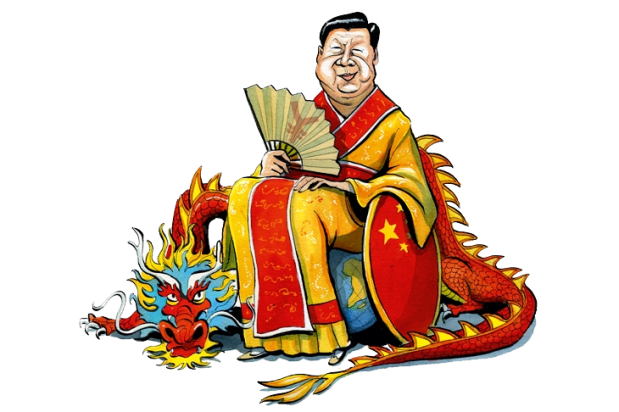
And threading through all of it, financing the ports, building the railways, supplying the technology, sitting patiently and quietly in the control tower is China, smiling that cheesy smile of President Xi.
Beijing does not need to control any of this directly. Control is expensive and messy and leaves fingerprints. What China needs is to be indispensable: as banker and builder, as the power that sits on the UN Security Council and ensures that no Western-sponsored resolution ever quite has the teeth to matter. The Belt and Road project is not a development program. It is a civilisational claim, drawn in concrete and fibre-optic cable, from Shanghai to Rotterdam, threading through every geography that the new Persian and Ottoman spheres occupy.
China thinks in dynasties. It watched America spend three trillion dollars in Afghanistan and Iraq and come home with nothing. It watched the European Union discover its obsolescence, crisis by crisis. It watched the post-Cold War liberal order lose faith in itself, and it drew the obvious conclusion: Sit. Let the obsessions of the democratic world rot the framework.
Now place Israel in this picture. A democracy of nine million people, surrounded on all sides by this architecture. The Persian suzerainty to the east and south, the neo-Ottoman influence to the north, the proxy forces that can be switched on and off like a current, the diplomatic isolation that deepens each year in international institutions that China and Russia have learned to use as instruments of attrition. How does it survive the slow, grinding, compounding pressure of encirclement? Through the exhaustion of a society that has been on a permanent war footing for three generations and can see no horizon where that ends.
And if Israel does not survive it, if the only liberal democracy in the Middle East, the living proof that the Enlightenment’s gifts are not exclusively Western property, is extinguished, what follows in its wake is a darkness that will not stay in the Middle East because the Western tradition is bankrupt.
The Anzac Lesson
The Anzac tradition, properly understood, is not about glorifying war. The men who came home from Changi and the Kokoda Track were broken in ways their families could never fully reach. The legend at its best is about something simpler and harder: the willingness to face the cost that reality demands, even when that cost is terrible, because the alternative is worse.
The 8th Division who surrendered at Singapore did not die on the Burma Railway because Australia chose confrontation. They died because the West had spent the 1930s choosing accommodation.
Those who write articles such as I cited at the beginning are by no means bad men. They are good men writing from within a tradition of Western liberal thought that has simply failed, repeatedly, and at great cost, to reckon with the nature of the adversary it keeps trying to negotiate with. The Islamic Republic of Iran is not a state with grievances that, properly heard, can be accommodated within the international order. It is a regime whose legitimacy rests on theological hostility to that order. You cannot negotiate a theocracy into liberalism. You can only limit its capacity to act on its convictions.
Every year we do not limit that capacity, the cost of eventually doing so increases. Every year the proxy network deepens, the nuclear threshold draws closer, the Persian architecture consolidates, and the Chinese patient investment in the surrounding geography compounds.
The Manchuria lesson is not complicated: the earlier you stop the first domino, the fewer dominoes fall. We are not in 1931. We are somewhere between 1935 and 1938, and the chattering class are still writing about the cost of intervention.
Lest we forget. Not best we forget.
The question is not whether there will be a price. There will be a price. The question is whether we pay it now, on terms we can still shape, or later – when the soothsayer’s map has become the morning news, and our grandchildren ask us what we were thinking.
Scott Heathwood is a Director of the Gallipoli Memorial Club