The many who don’t follow news from Hungary closely must have thought the landslide defeat of Prime Minister Viktor Orbán was like the end of the Franco or Marcos eras. Hillary Clinton welcomed the end of Orbán’s ‘autocratic regime’. Other leftists described Orbán as authoritarian and even a dictator. EU high priestess Ursula von der Leyen, fresh from screwing over Aussie farmers, idiotically likened Orbán’s defeat to Hungary’s 1956 uprising and the communist collapse in 1989.
No serious observer can claim that Hungary since 1989 has been anything but a thriving multi-party democracy, a fact confirmed by Orbán’s quick, gracious acceptance of his election loss – hardly behaviour associated with autocrats.
Orbán’s real crime in the eyes of the left was not only persuading Hungarians to vote him in five times, but leading the revolt against Angela Merkel, who in 2015 invited the Third World to relocate to Europe. He then compounded the heresy by being on the right side of history: European voters ever since have preferred Orbán’s strong borders to Merkel’s ‘welcome policy’ to Third World immigration.
But despite Orbán’s significant achievements, Hungarians were generally right not to re-elect him. Most importantly, his refusal to support Ukraine and his cosying up to Putin have been morally indefensible. Hungary with its history of Russian oppression should, like Poland and the Baltic States, have been at Europe’s forefront in showing solidarity with an innocent victim of vile Kremlin aggression – which could be repeated against others if Putin isn’t deterred.
Orbán’s soft Russia policies cost him support among conservatives who otherwise admired him. Hungary, like a number of other EU countries, hasn’t been able to wean itself off Russian oil and gas, but Orbán and his Foreign Minister Szijjártó were uniquely friendly with Putin. Despite Hungarians’ understandable liking for cheap Russian energy and legitimate questions about the rights of the 156,000-strong Hungarian minority in Ukraine, Hungarians didn’t buy Orbán’s campaign message that they would somehow be dragged into the Ukraine-Russia war if he wasn’t re-elected. The 1956 chant of ‘Russians go home’ featured at the opposition’s victory celebrations.
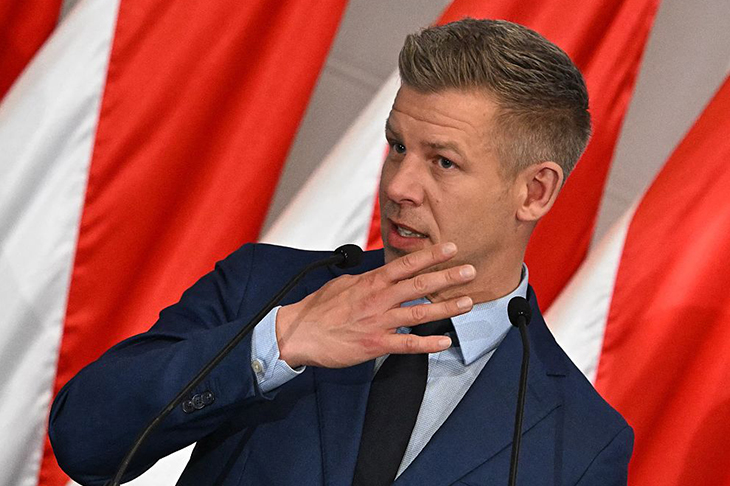
Orbán had previously won landslide victories because he was opposed by the left, who couldn’t dent his popularity, especially on strong borders. But he proved vulnerable to a rival from his own side of politics. Incoming Prime Minister Péter Magyar was a loyalist in Orbán’s Fidesz party for much of his life. Aided by a sluggish economy, perceptions of corruption, unpersuasive Fidesz campaign messages and a sense that after sixteen years Orbán had run out of steam, especially with younger Hungarians, Magyar’s victory was impressive. He won 141 of the parliament’s 199 seats – from zero previously. He also destroyed Hungary’s left. They backed Magyar on the basis that he could defeat Orbán and in the process lost all their seats. The new parliament remarkably will consist solely of conservatives.
During the campaign Magyar didn’t criticise Orbán’s border protection or other conservative policies and ignored favourite leftist issues like gender. He focussed squarely on attacking Fidesz for corruption, especially its control of public institutions, which, according to Magyar, extended to denying him airtime on state television during the campaign.
I witnessed Fidesz’s approach to political power over two years as an unpaid senior fellow at the Danube Institute, a think tank founded by the Orbán government. At the time I joined, the Institute had a staff of six, a shabby but workable headquarters and a budget of about US$570,000 a year. It hosted a steady stream of Hungarian and international speakers, often involving debates between conservatives and leftists. However, in 2020 all this changed dramatically when the Institute received a huge infusion of extra annual government funding, estimated at well into the millions. Dozens of new staff and fellows appeared, with, according to some reports, up to 200 people eventually on the payroll. It also received prestigious new accommodation in a grand villa overlooking Budapest. All this felt fine if the Institute were privately funded, but seemed extravagant in a country still struggling to establish a first-world health system. Management of the Institute was taken over by Fidesz apparatchiks who overruled the previous practice of occasionally inviting non-conservative speakers to participate in events. Unhappy with the new direction of the Institute, including sinister, opaque hiring and firing practices, I left in protest.
Another bigger government-friendly institute, the Mathias Corvinus Collegium, was expanded with even more Fidesz largesse – a staggering US$1.7 billion, nearly one per cent of Hungary’s GDP.
Magyar has made it clear since the election that in some key areas he’s more conservative than Orbán. He says he’ll reinforce Hungary’s border fence, will end the previous government’s admission of unskilled immigrants from outside the EU, and will strengthen Orbán’s population growth policies. He’s also reaffirmed his predecessor’s rejection of the EU’s migration pact, which provides for asylum seekers and refugees being shared around the member-states.
One of Magyar’s core promises was to unlock up to US$41 billion in funds earmarked for Hungary which the EU has blocked because of Orbán’s multiple heresies. On the face of it, Magyar’s tough border security policies suggest this could be difficult. And yet a deal seems likely. It would involve Magyar getting the money in return for lifting Hungary’s veto on the EU’s US$106-billion loan to Ukraine and accommodating some of Brussels’ anti-corruption and rule of law demands, plus committing to eventually joining the eurozone.
In one important area, Magyar has taken a disappointing direction. He’s reversed Orbán’s decision to leave the International Criminal Court and has made clear that if Benjamin Netanyahu enters Hungary he’d be arrested. Netanyahu will apparently not now be able to take up the invitation to visit Hungary for the 70th anniversary of the 1956 uprising later this year. Other than Trump, Israel had no greater Western friend than Orbán, but Magyar seems prepared to wreck this special relationship with a more hard-line policy on a Netanyahu arrest than a number of other EU countries including France, Germany and Italy. This will raise doubts that Magyar is the genuine conservative many commentators have been rushing to claim since his election victory.
Got something to add? Join the discussion and comment below.
Mark Higgie was Australia’s ambassador to Hungary 1998-2001 and was Senior Fellow at the Danube Institute 2019-20
You might disagree with half of it, but you’ll enjoy reading all of it. Try your first month for free, then just $2 a week for the remainder of your first year.