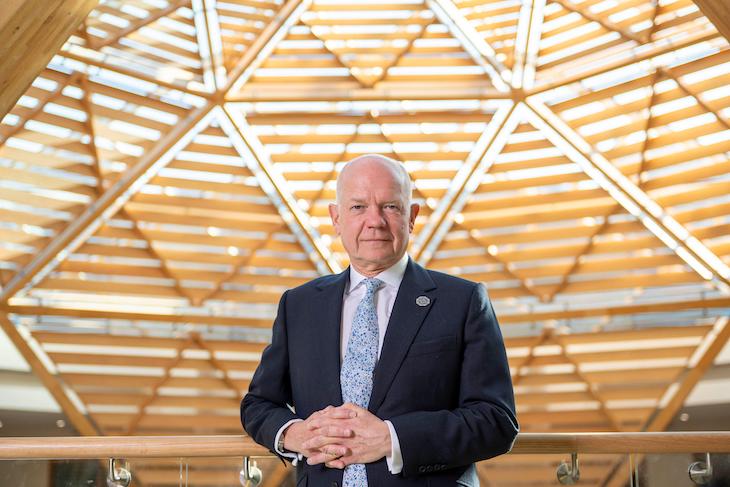
The Schwarzman Centre for the Humanities in Oxford is well and truly open; there was an Open Day this weekend. It’s the product of a big donation of £185 million from Stephen Schwarzman, CEO of the Blackstone Group. It’s an ambitious development close to the old Observatory on the Radcliffe site. There’s a large and airy central atrium with cafes. As well as libraries and lecture rooms, there’s a concert hall and theatre and cinema and high tech exhibition spaces. The place is designed with the University’s net zero carbon emissions policies in mind on the principles of Passivhaus; the building is ultra energy-efficient.
The project consolidates one of the ways in which Oxford went wrong in 2001
To quote the Centre’s website, “Here, academia’s hallowed halls take new forms…all in the name of new thinking and expression.” Plus, there’s a centre for Ethics and AI.
Where once there were 22 buildings for the seven humanities faculties – languages, history etc – they’re together, so that, in principle, different disciplines meet. And – farewell town and gown. Alexandra Vincent, the cheerful CEO, declared that where other institutions were about keeping people out this one “is about bringing people in”.
Yet there is a yet. My instinct is that it’s not actually necessary in a university like Oxford to bring disciplines together in one building. That’s what happens anyway. The college structure of the university, like that of Cambridge, means that academics meet already socially, where these encounters work best, in people’s colleges or in others’. At college top tables, academics can and do discuss their work with those from different backgrounds. Then there’s always the pubs, where most good talk happens.
I should say Alexandra Vincent says that there’s nothing about the Centre to take away from the colleges. We’ll see.
Further – and this is not to blame the Schwarzman Centre or its donor – the project consolidates one of the ways in which Oxford went wrong in 2001, when it combined the faculties of the universities into four academic divisions: social sciences, humanities, mathematical and life sciences and medicine. It made sense just for medicine. The effect was to diminish individual faculties and to place them under the aegis of the university’s administrators, lodged in Wellington Square. Before that, Oxford was essentially all about colleges and faculties. Ever since, there’s been a steady encroachment by the administrators on the bits of Oxford that matter for teaching and research. Since Mrs Thatcher’s day, that central bureaucracy has increased in size considerably. The Schwarzman Centre consolidates that restructuring.
The Centre belongs to the university and it’s typical of the bureaucracy that it has devoted so much of the money to the handsome building, which means it relies on normal sources for the running costs. You’d think that Mr Schwarzman, a businessman after all, might have anticipated the problem. That has a knock-on effect. One academic observed plaintively, “the wonderful new concert hall, which really is a huge plus is seriously expensive to hire, at so-called commercial rates only, with no discount at all for University members, charities, etc., with the result that it will be used less than we were expecting or hoping.”
That may of course change. Alexandra Vincent says that when it comes to students, academics and community groups, “we would want to have a conversation to establish how best we can work together”.
As for the buildings in the centre of Oxford that used to house the humanities faculties, what will happen to them? The prudent course would be to hang onto them for academic use in the future; the bad scenario is that the administration may take the sites over for more bureaucrats or sell them off for immediate gain.
The Schwarzman Centre is a striking building, but when we visited the upper floors, the effect was less light and airy. The libraries were well used; ditto the desks outside. But the teaching rooms are small on one side and dark and airless on the other. That’s probably to do with the Passivhaus principles on temperature regulation which eschew open windows, but it’s not an ideal teaching environment.
So, I feel only qualified rapture about the Centre. Not to be ungrateful, there are other things that £185 million could have been better spent on. A concert hall and theatre are very welcome but how about using the rest on making university more affordable for undergraduates? Students have never been so broke, especially now living costs are means-tested. You could endow an awful lot of bursaries and scholarships with those sums. And – a separate issue – there are too many students, many of them admitted on a basis of dud inclusivity, but will almost certainly leave with a 2:1 anyway, given the inflation in grades.
There’s an awful lot wrong with Oxford as it is now and much of it is to do with the priorities of the overmighty central administration. Instead of admitting so many Chinese graduates to one-year taught courses so that it can employ more superfluous bureaucrats, the University (and colleges) should be saving space, maintaining standards and sparing themselves housing problems by financing undergraduate places with Schwarzman money.
It’s too late now. But that’s what should have happened.