There is a temptation in Australia to treat the Ben Roberts-Smith affair as though it were, at heart, a simple appeal to the rule of law. On one side stands the rules of conduct, agreed and published in the arcane annals of the various conventions that have accumulated over time, the gold standard of how to wage violent conduct against another state politely. On the other stands a fallen hero, once celebrated, now exposed. It is the sort of narrative that flatters everyone who arrives late to the party
It allows institutions to look stern, the media to look brave, politicians to look serious, and the public to look mature.
But that story is a story for Disney and the kids.
Whatever one thinks of Roberts-Smith personally, and whatever ultimately happens in court, there is something deeply unsettling about the national ritual now underway, including the pantomime played out at the airport. It is not merely the question of guilt or innocence, nor even the unusually long delay between alleged acts and prosecution. It is the spectacle of a country that first glorified a war, then glorified a warrior, and now appears eager to purify itself by placing the ugliness of that war at the feet of one man and a handful of others.
I do not condone arbitrary violence. I do not celebrate cruelty. I do not believe that war abolishes all restraint. I don’t really even support war unless in self-defence. As a libertarian, I accept a basic truth: my freedom depends upon my willingness to accept the limits that also protect the freedom of others. If that principle does not apply in some form to war, then war collapses into mere license.
But it does not follow that a society can wage war on one moral register and judge it years later on another without acknowledging the contradiction. That is the problem at the heart of this affair. That is the gut feeling people are reacting to, whether they can articulate it or not.
The issue is not whether there can be any rules in war. The issue is whether the same political culture that sanctified the campaign in Afghanistan, and decorated the men who fought it, can now plausibly present itself as a detached and morally consistent arbiter of what occurred there.
War is always licensed by narrative before it is managed by law. Nations do not send young men into dangerous places by reciting criminal codes. They send them with stories. Stories of duty. Stories of alliance. Stories of civilisation. Stories of protecting the vulnerable. Stories of defeating evil. Stories of national honour. In the Afghan case, Australians were told over time that the mission was about terrorism, security, alliance solidarity, democracy and, eventually, liberation – especially the liberation of women from the Taliban. These were moral instruments that created public consent and legitimacy. They transformed organised violence into public virtue.
For me, I would never have gone to Afghanistan nor did I buy into the BS about Iraq but as a nation we did. The deputy Sheriff of the Pacific (Howard) was clear and resolute, we needed to support our ally and off we went into the cauldron.
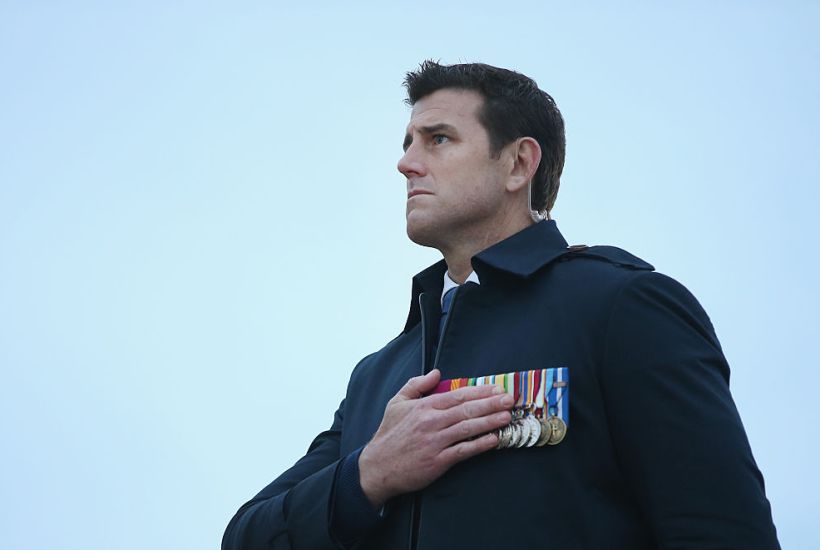
The logical extension of this process is for the state to create heroes. Roberts-Smith was not merely a soldier who received a decoration. He was turned into a national emblem. The war itself was remote, morally complex and strategically opaque to most Australians. But the decorated soldier made it visceral. He was courage made flesh. Through him, the chaos of Afghanistan could be imagined as sacrifice, honour and clean national purpose.
That is how war mythology works. It simplifies, elevates, and binds a public to a conflict through symbol and sentiment. A Noble Myth.
Years later, when the war has ended badly, the Sheriff retired, when the strategic rationale has decayed, when the Taliban are back, when public confidence has curdled, and when allegations of wrongdoing can no longer be contained, the story changes. It always changes. What was once presented as necessity becomes embarrassment. What was once called valour becomes subject to suspicion. What was once politically useful becomes institutionally costly.
And so the old story is not so much corrected as replaced.
As for the media, it would be naive to pretend ABC and Nine had no effect on the environment. The ABC’s current coverage openly frames the charges in the context of the earlier reporting and the long-running public controversy. Even if journalists did not make the charging decision, they plainly shaped the public narrative in which the case now sits.
This is where the chattering class is now making a category error. They speak as though the present process represents the arrival of moral clarity after a long darkness. It does not. It represents a shift in narrative. That is not the same thing.
One need not believe in conspiracy theories to see this. There need not have been a smoke-filled room in which generals, politicians, journalists, and prosecutors agreed on a common line. Human institutions are subtler than that. They move when incentives change. Defence begins to worry less about image and more about exposure. Politicians stop wrapping themselves in the glory of a campaign and begin shielding themselves from the wreckage of it. Journalists find that the hero story no longer sells as well as the betrayal story. Investigative bodies, once created, acquire their own momentum and logic. Former comrades, rivals and enemies begin to speak, whether out of conscience, resentment, self-preservation or all three at once.
None of this tells us whether any particular allegation is true. But it tells us a great deal about how national myths collapse.
The most dangerous feature of this collapse is that it allows a polity to disown its own authorship of the moral confusion. Australia did not stand outside the Afghanistan war as a spectator. It entered it. It sustained it. It narrativised it. It promoted it. It decorated it. It asked young men to do violent things in the name of causes it called just. That does not excuse criminal conduct. But it does make subsequent sanctimony hard to stomach.
There is another, deeper problem. We have become too comfortable speaking as though the rules of war were eternal truths, tablets brought down from a mountain, rather than contingent human conventions developed through history, politics, disgust, and power. They are not metaphysical imperatives. They are social products. They are intersubjective realities, to borrow Yuval Noah Harari’s term: shared norms sustained by collective belief and institutional repetition. That does not make them worthless. But it does mean they are authored, revised, and selectively enforced by human beings and states.
The West has become especially adept at telling itself two stories at once. The first is that war, when undertaken by respectable nations, can be noble, disciplined, and humane. The second is that any departures from that image are aberrations to be neatly isolated and morally condemned. In this way, the larger violence remains justified while its most embarrassing features are quarantined as exceptions.
This is comforting and is also self-serving but at its heart, it is absurd.
The contradiction is obvious. We are told that capital punishment is barbaric, yet we send young men into foreign deserts and mountains to kill and be killed for aims that are often geopolitical, strategic, and only selectively humanitarian. We are told that war is hell, yet also that it can be conducted with ‘the gloves on’, as though industrialised violence can be rendered morally acceptable by sufficient procedural language. We are told that courage in battle is our highest virtue, until the public story changes and those same acts are reinterpreted through a new set of priorities.
This does not mean that every wartime act is morally equal. It does not mean that everything can be excused by reference to fog, trauma, or comrades killed in action. It does mean that retrospective judgment must be honest about the context in which such acts were not merely possible, but produced.
And context here matters in a way civilian society barely understands.
A war zone is not a suburban murder scene. There are no careful cordons, no pristine ballistics, no fresh witness statements taken under calm conditions, no reliable forensics collected with chain-of-custody precision, no obvious motive separable from fear, revenge, loyalty, exhaustion, or the cumulative effects of violence. Fifteen years later, memories are degraded. Rivalries harden. Resentments grow. Public reputations intervene. Careers are at stake. Some witnesses may admire a man; others may loathe him. Some may be protecting themselves. Some may be telling the truth. Some may be doing both at once. The battlefield does not preserve facts.
That does not mean crimes cannot be proved, if we believe in crimes at all. The Japanese fought the second world war under the Bushido code. There were no crimes, only death without honour. So it means the burden of proving them, or whatever we believe should be understood as extraordinarily grave because the benchmark is an intersubjective reality that is, like Darwin’s evolution, subject to external forces.
The current appetite for retrospective purity often ignores this. It assumes that because war should have limits, any legal process that invokes those limits must be morally satisfying. But there is a difference between a genuine criminal trial and a national act of self-cleansing dressed in legal robes. The latter is especially likely when the same institutions that once promoted the myth of clean war now seek legitimacy by performing accountability.
That is why the question is not simply whether Roberts-Smith should be judged. It is who is doing the judging, from what position, and after what history of complicity.
A nation that sold the war, praised the war, and celebrated the warrior cannot pretend it has occupied one unbroken moral position all along. It has not and has shifted stories as circumstances changed. First came necessity, then came heroism, then came disillusion, then came exposure and then indignation and sanctimony.
And sanctimony is the easiest posture in public life because it demands so little self-knowledge.
If Australia wants to prosecute war crimes, it should do so with seriousness, restraint, and honesty. It should not pretend the process is untouched by politics, by media campaigns, by institutional weakness, or by the nation’s own need to distance itself from a failed war. It should not act as though delayed legal judgment wipes away the moral burden of those who sent men there in the first place, praised them when it was useful, and discovered their ambiguity only when the story collapsed.
Most of all, it should resist the urge to turn one man into a symbolic solution to a national problem.
The real scandal is not only what may or may not have happened in Afghan villages and compounds. The real scandal is the ease with which modern states manufacture meaning around war and then withdraw it. They create the myth of noble violence, then the myth of bounded violence, and finally the myth of redemptive accountability. In each phase, they tell themselves a story that serves the moment.
That is why this affair is about more than Ben Roberts-Smith. It is about the moral instability of the societies that wage war and then pretend to judge it from somewhere above history.
Roberts-Smith may be guilty, innocent, or impossible to convict according to the criminal standard. That is for the court. But Australia is not innocent in the making of the world that first required heroes like him, then glorified them, and now seeks relief in condemning what it once needed not to see.