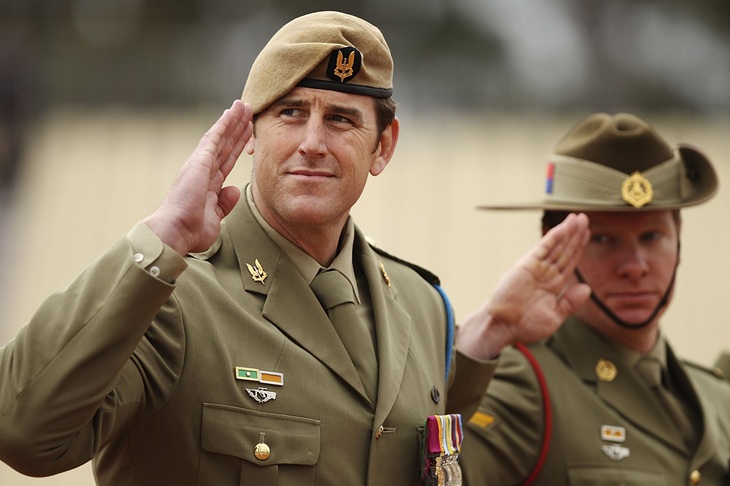
There is a particular kind of arrogance that only flourishes at a safe distance from danger, and the arrest of Ben Roberts-Smith, a recipient of Australia’s highest military honour, has once again brought it into full view.
Within hours, the familiar chorus assembled, commentators, analysts and above all, the professional moral class, each certain not only of the facts but of their authority to sit in judgment. At the centre of this performance sits the Australian Broadcasting Corporation, an institution that has moved well beyond reporting into something closer to prosecution by narrative, selecting, framing and repeating until a conclusion begins to feel indistinguishable from the truth.
And here is the question that is rarely asked, because it cuts too close to the credibility of those doing the judging. Who in those editorial rooms knows what it is to return fire? Who has operated in an environment where hesitation can mean death, not in theory but in seconds, where the enemy does not announce himself, where the line between combatant and civilian is not a legal definition but a judgment made under pressure with incomplete information. The ABC’s journalists work in studios and offices where risk is reputational, not physical. Their deadlines are real, but they are not fatal. Their mistakes are corrected in print, not carried for life or buried with the consequences. Yet from this position of safety emerges a striking confidence, not merely to report on war but to morally adjudicate it, as though conflict were a controlled exercise rather than the chaotic and disorienting reality it has always been.
War is not a seminar. It is not a panel discussion. It is not a carefully edited segment shaped to fit a narrative arc. It is violent, ambiguous and unforgiving. Decisions are made quickly and often without the luxury of certainty. The enemy adapts, disguises and deceives. The environment shifts without warning. Those who have never experienced this reality often compensate with abstraction, replacing complexity with clarity and uncertainty with conviction. From a distance, everything looks simpler. From a studio, everything appears knowable.
In places like Afghanistan, where Australian forces were deployed for years, the reality was even more unforgiving. Patrols moved through compounds where threats could emerge without warning, where a farmer in one moment could become a combatant in the next, where intelligence was incomplete and often wrong. Improvised explosive devices lay hidden on roads used by civilians. Insurgents discarded weapons and blended into local populations within seconds. Engagements unfolded quickly, often in confusion, with decisions made under pressure that cannot be recreated in a courtroom or a newsroom. These are not conditions that lend themselves to perfect judgment. They are conditions that demand action, often before clarity is available.
This is the modern Western contradiction. We celebrate soldiers in abstraction. We hand out medals. We speak of courage and sacrifice in solemn tones. We invoke honour when it suits us, and suspicion when it does not. But when the reality of war intrudes, when its moral complexity becomes visible, admiration can quickly turn to condemnation. We want warriors, but only if they behave like administrators. We ask men to enter environments defined by violence and then judge them as though they had spent their time in civics class. The further one is from danger, the clearer one’s moral vision appears to become, and the more confident the judgment.
And here lies the question that should concern anyone serious about national security. What does this do to morale? What does it do to a fighting force when one of its most decorated soldiers, honoured at the highest level for courage under fire, is not only subjected to due legal process, which is proper, but also to sustained narrative prosecution by those who have never shared that risk? What message does it send to those currently serving? What message does it send to those considering service? That you will be celebrated when it is easy, and dissected when it is not.
Western militaries are already struggling to recruit. Standards are being adjusted. Targets are being missed. Fewer young people are willing to accept the risks, discipline, and burden of service. And into that environment we project a clear cultural signal, that even the highest honour offers no insulation from retrospective judgment delivered from a position of complete safety. It is not difficult to see how that calculation begins to shift. Risk remains real. Support becomes conditional.
There is also a deeper asymmetry at work. The same institutions that demand relentless scrutiny of those who fight wars rarely apply equivalent scrutiny to themselves. Editorial choices shape reputations. Language frames perception. Repetition builds certainty. Yet there is no comparable reckoning for bias, omission or narrative construction. It is accountability in one direction and authority in the other, a system in which those furthest from consequence exercise the greatest influence over how consequence is understood.
History offers a more honest lens, if we are willing to look through it. Thucydides did not pretend that war was a moral exercise conducted under controlled conditions. Niccolò Machiavelli understood that survival in politics and war requires decisions that sit uneasily with moral theory. Alexander the Great did not build an empire through deliberation in safety, but through action in uncertainty. Across centuries, the lesson is consistent. War forces human beings into situations where clarity is scarce, consequences are immediate and perfection is impossible.
None of this resolves the specific questions surrounding Roberts-Smith, nor should it. Those matters belong in a court of law, not in a newsroom and not in a running commentary shaped by editorial preference. But if we are to have a serious process, it must be grounded in an understanding of what war actually is, not what it looks like when filtered through distance, safety and hindsight. Because what we are witnessing is not simply scrutiny. It is retrospective certainty applied to moments that were anything but certain when they occurred.
A society that becomes too eager to judge its warriors without understanding the conditions under which they operate risks more than injustice. It risks detaching itself from the reality that secures its safety. It risks creating a culture in which those who fight are mistrusted, those who observe are elevated, and those who have never faced danger feel entitled to define it.
So the question is not simply whether justice is being pursued. It is whether a country can continue to ask its young men and women to fight its wars while signalling, clearly and repeatedly, that those who do will be judged most harshly by those who never have.