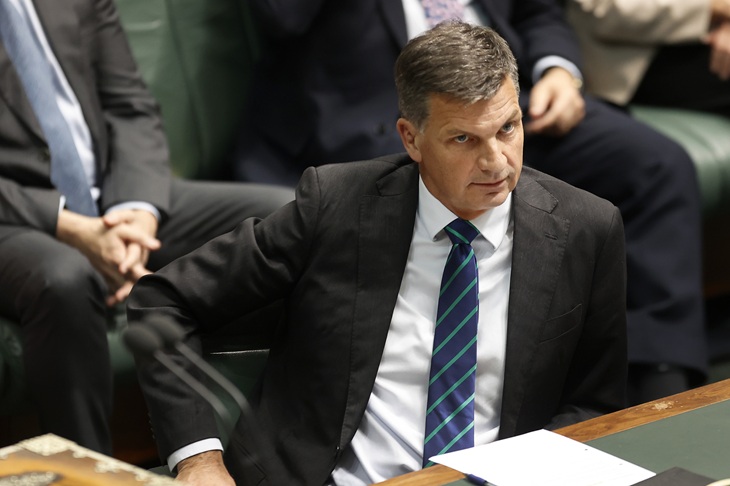
Watching Angus Taylor’s response to the Budget on Thursday night, many would have wondered why his policy framework of lowering immigration, cost reductions, paring of regulation, and income tax indexation policies haven’t been central to the Coalition’s agenda over the past 10 years.
Of course, the key reason for the change is the rise in One Nation’s popularity.
Immigration aside, the about-face is driven by a rejection of the renewable energy policies that have come to dominate the economy over the past quarter-century.
While less enthusiastic than the Greens, the Teals, and Labor about the inevitability of the ‘energy transition’ from fossil fuels, the Coalition had increasingly gone along with the fiction of fossil fuels creating dangerous climate change and the need to phase them out. The uniparty politicians have proven themselves unable to understand the importance of cheap, readily available energy in creating prosperity, and the impossibility of wind and solar to deliver it.
Green energy enthusiast Malcolm Turnbull is one reason for the Coalition’s embracing of fairy dust as a source of energy, but Liberal MPs voted him into office knowing his views and, in any case, the Coalition’s policy stance hardly improved during the eight years since his leadership was axed. In fact, it was only five years ago that Angus Taylor, as the Energy Minister, granted Major Project Status to a $19 billion phantasmagorical link that was to send solar-generated energy 4,600 kilometres from the Australian interior to Singapore – and make a profit in the process. At that time, the Coalition had no problem with renewables and, by embracing the Glasgow climate change emissions reduction target, went the Full Monty, ditching low-cost, reliable fossil fuels for high-cost, unreliable renewables.
Even in his Budget response, Angus Taylor said rooftop renewables would continue to play a role. But, as the highest-cost electricity source, any such role requires ongoing government support. And, in addressing the future of coal, Australia’s cheapest source of electricity, rather than foreshadowing new supplies, he confined his comments to keeping existing plants running as long and as hard as possible. Taylor’s approach to gas is, however, highly supportive, more so than the existing One Nation policy, which at times has opposed the fracking technology that has converted the US from an oil and gas importer to the world’s largest producer.
However, Taylor’s Budget reply contained no statement about closing down the two dozen agencies promoting the national energy debacle (still less about removing the tax advantages enjoyed by green climate agitator NGOs). And while the Coalition will abrogate the doubled carbon tax paid by large firms under the Safeguard Mechanism, there was no discussion on how to curtail the egregious green contracts already signed under the oxymoronically named Capacity Investment Scheme, or to cancel the subsidies of bodies like the Clean Energy Finance Corporation and the Australian Renewable Energy Agency with contingent liabilities similar in size to the bloated national debt racked up by the ALP incompetents.
Energy aside, the Coalition’s policy approach includes changes in limiting immigration, doing something – albeit largely unspecified – to rein in spending, to foster more housing, and to join the rest of the world in automatically indexing tax rate tiers to prevent bracket creep from covertly providing governments extra funding.
However, the indexation of taxation is being introduced painfully slowly, especially for the upper tiers, with the phase-in incomplete until 2032. Providing a $50,000 depreciation break for small businesses is welcome, but larger businesses also create wealth and employment, so why discriminate? And why not, in addition to indexing tax rates for inflation, ensure that depreciation in general is also indexed – after all, inflation increases the cost of a replacement pump, but the old unit can only be written off at its original cost?
Of course, the reason these punitive tax policies are not being addressed is the Coalition’s reticence to cut expenditures that, together with regulatory excesses, have been the root cause of the nation’s economic distress.
House price escalation is linked with excessive immigration. Though this is correct, the policy fails to consider why house prices 1950-70 were low in the face of similar shares of net immigration. The landmark plan is an attempt to reduce the Construction Code’s regulations (which are state-based, so good luck!) and to establish a $5 billion Infrastructure Fund that is claimed to reduce costs by $70,000 per new dwelling. Unacknowledged is land availability, the most important cost-enhancing regulatory factor. The tightening of this over the past 50 years has raised Australian house prices to twice those of high-population-growth jurisdictions like Texas and of low-population-growth Germany. Is this because the policy seeks to avoid aggrieving a constituency that does not want housing beyond the 0.26 per cent of Australia already urbanised? Or is it to placate inner-city communities opposed to densification? Probably both.
Angus Taylor’s apparent passion in calling for a reversal of the socialistic measures the Albanese government ghouls have foisted upon us is to be welcomed. But it lacks detail and falls short of Argentina’s President Javier Milei’s chainsaw approach or the cleansing of Democrat corruption that President Trump is pursuing.