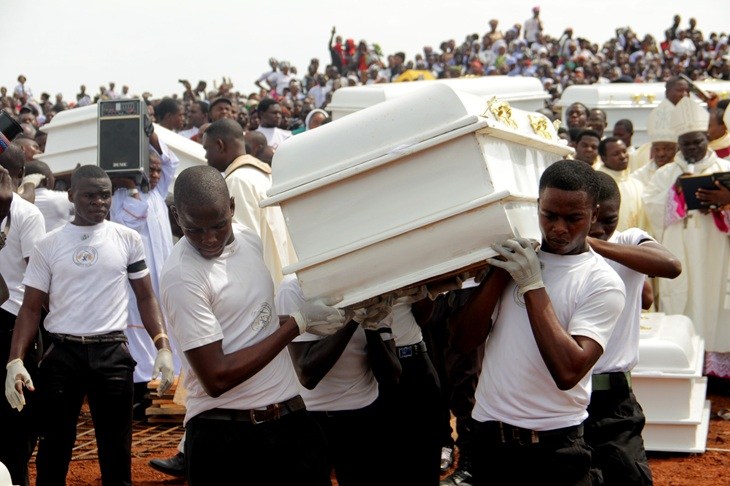
Solomon Ako’s captors wanted more than his obedience. They wanted his faith. Abducted when militants attacked his village in northern Nigeria, the Christian was beaten and chained. His captors demanded conversion. When their prisoners refused, they punished them. Ako’s testimony appears in Aid to the Church in Need’s new report, Persecuted and Forgotten? 2024-26. It confronts the reader with a question that diplomatic language can obscure.
What does a persecutor believe he has accomplished when he forces another person to profess a religion under threat?
The report, released October 27, examines 18 countries selected because of serious concerns about Christian persecution. Conditions deteriorated in ten. None recorded an overall improvement. Its accounts describe communities subjected to extremist violence, government repression, and religious nationalism. Behind each category are people trying to perform ordinary acts without punishment. Parents want to bring their children home. Congregations want to worship. Families want to remain in the villages where they have lived for generations.
Consider what the demand for conversion reveals. A man confident that his beliefs are true can explain them, defend them and invite another person to accept them. The captor demands a declaration he has made unsafe to refuse. He has deprived himself of any means of knowing whether the declaration expresses belief. His prisoner may say the required words simply to survive. What has been won? The persecutor has demonstrated his power to obtain an outward submission. Whatever spiritual language accompanies the act, that is the achievement the violence can establish.
The kidnapped girl makes this question still more terrible. In Pakistan, Christian girls face abduction, forced conversion, and forced marriage. United Nations experts warned in April 2024 that courts sometimes validated coerced marriages and conversions, leaving victims with their abductors. Police, they reported, sometimes dismissed the crimes as love marriages. The experts cited the alleged abduction of a 13-year-old Christian girl whose age was recorded as 18 on her marriage certificate. A document could thus be used to conceal the very fact that should have secured her protection.
Here the abuse acquires an institutional life. A family seeks help from the police. The police treat a disputed claim of consent as sufficient to dismiss the complaint. A court accepts the account advanced by those who control the girl. Each decision increases the difficulty of reaching her, hearing her safely, and establishing what happened. The machinery that should examine the abduction can become the machinery that gives its consequences permanence. The parents must then struggle against the authority of the state as well as the power of the abductor.
Religion cannot make this morally obscure. A child’s distress deserves investigation. Her age deserves verification. Her testimony deserves to be heard beyond the reach of anyone who might threaten her. Those requirements should be most urgent when a powerful adult claims that the child has willingly severed the ties that might protect her. To call for sensitivity toward the religious setting while neglecting those safeguards is to direct consideration toward the person already holding the advantage. What consideration reaches the girl?
The same ambition to control another person’s existence can operate across a whole district. ACN describes Islamist violence against Christian communities in Mozambique and the imposition of Islamic dress and social codes on some communities in Burkina Faso and Mali. Murder and displacement can alter who is able to remain. A family that flees may survive while losing its home, livelihood, and access to its church. Where enough families leave, an established community can become impossible to sustain.
Count the damage only in bodies and much of the persecutor’s accomplishment disappears from view. An empty church may record a victory obtained through threats. A school without Christian pupils may mark the departure of families who concluded that staying had become intolerable. The apparent quiet that follows can be mistaken for an improvement. The people who would have reported the next attack have gone. Any serious assessment must therefore ask whether the remaining Christians can live openly, recover their property and return safely to places from which they fled.
Poverty, struggles over land, and political instability can intersect with religious identity. ACN expressly recognises that complexity. Investigators need it to establish responsibility and understand how violence spreads. Yet a demand that a captive renounce Christianity supplies evidence of its own. The captor has identified the belief he means to extinguish. An explanation that overlooks his stated demand leaves something essential unexplained. Understanding the conditions that enable persecution should sharpen the account of the perpetrator’s choices.
This is also why the report’s accounts of repression beyond Islamist movements matter. It describes state controls in China, arrests in Iran, the persecution of clergy in Nicaragua and hostility toward Christians in India. The instruments and governing ideologies differ. The test of freedom remains whether a person can practice a faith without intimidation, imprisonment or expulsion. Condemnation should follow the evidence wherever it leads. A government’s claim to be secular provides no protection against scrutiny, just as a persecutor’s invocation of religion provides no excuse.
Article 18 of the Universal Declaration of Human Rights recognises freedom of thought, conscience, and religion, including the freedom to change one’s religion and to practice it publicly or privately. The principle places a limit on what governments and religious authorities may demand of the individual. A Christian must be free to remain Christian. A person who changes belief must be free to do so voluntarily. The decision belongs to the person whose conscience is at stake.
Governments that profess this principle should be asked to show what they have done when it is violated. Were abducted children recovered? Were threats investigated? Were officials disciplined for helping perpetrators evade accountability? Were displaced families given a practicable route home? Diplomatic concern should lead to questions that admit verifiable answers. Aid and security relationships deserve examination where authorities repeatedly fail to protect minorities. Those who finance or facilitate persecution should face consequences directed at their conduct. Victims need protection capable of surviving the next outbreak of violence.
For citizens abroad, the first responsibility is to see the victim clearly. The girl has a name, a family, and wishes of her own. The congregation has a history and a place it calls home. They should be heard before their suffering is converted into an abstraction convenient to someone else’s politics. Freedom of conscience becomes a hollow profession when its defenders grow hesitant at the moment a persecutor supplies a religious justification for violating it.
The man who needs a captive to repeat his creed has shown what his authority requires. He cannot tolerate the independent conscience before him. When police dismiss the captive’s suffering and courts endorse the result, they give that ambition the force of government. The ultimate question is whether the Christian can refuse and still go home alive. Until that answer is secure, every assurance of religious freedom remains subject to the persecutor’s permission.
Aaron J. Shuster is an award-winning cinematist, writer, philosopher and analyst who examines Middle Eastern politics, strategic culture, and the civilizational forces shaping our modern world.