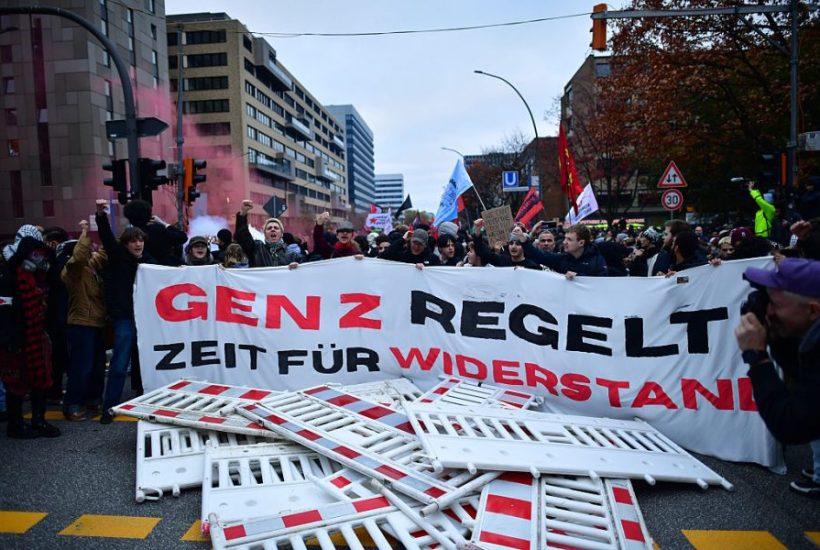
This afternoon, thousands of students across Britain are expected to walk out of class and take to the the streets in protest. They will be doing so as part of what has been called ‘International Youth Strike’ day, joining Gen Z counterparts across Europe to call on their governments to ‘fight for our future, not their wars’. Calls for better education, employment opportunities and an ease in the cost of living are all on the agenda, with London expected to become the epicentre of the demonstrations.
Supported by the group Socialist Students, the National Education Union and a number of pro-Palestine activists, Britain’s Gen Z protests are part of a trend seen in recent weeks right across Europe. Taking part simultaneously in Germany – and, in part, the inspiration for what the UK is bracing for today – are almost identical protests. From 2 p.m. local time, more than 20,000 German youths are expected to take to the streets of 40 towns and cities ‘for a nationwide protest by generation Z’. These demonstrations are being mobilised by ‘Gen Z regelt’ – ‘Gen Z takes charge’ – a six-week old youth movement itself inspired by the student protests that rocked France last month.
Gen Z regelt (GZR) says they are directly responsible for organising protests in four cities today – Berlin, Munich, Cologne and Frankfurt – and are expecting close to 8,000 attendees across them collectively. In the remaining 35 towns and cities, affiliated demonstrations are set to take place, but GZR is ‘not responsible for their content and organisation’.
GZR primarily mobilises through TikTok, Instagram and Telegram – a savvy move
GZR’s demands are summarised in a snappy six-point manifesto on their website. They want more funding for schools, youth addiction support and psychotherapy; ‘an affordable life’ in response to the high cost of living; an end to the ‘unfair distribution’ of economic burdens in society; an end to the military conscription introduced by the German government at the start of the year; the curtailment of ‘constantly expanding’ state surveillance apparatus; and ‘consistent climate protection now, so that we have a future’.
Remarkably, protestors are able to register their attendance at each city’s protest event via a link on GZR’s website. Clicking ‘count me in’ provides you, in appropriate Gen Z fashion, with the option to share your RSVP on social media as well as add you to a live count of other attendees.
The movement has adopted a somewhat twee cartoon of a bushy-tailed red squirrel as its logo. Asked in an interview with a German newspaper about this, Akram Selo, one of Gen Z regelt’s founders, replied:
The squirrel is very small and can’t achieve much on its own. But when many come together, they become louder and more easily noticed. Each of us is a squirrel.
Today won’t be the group’s first nationwide demonstration. On 31 October, an estimated 100,000 young people gathered in more than 30 cities across Germany to protest the same set of grievances. On that occasion, GZR organised protests in five key cities: according to the police, an estimated 8,000 people turned out on to the streets of Frankfurt; Berlin and Munich saw a reported 5,000 protestors each, while several thousand turned up in Cologne and Hamburg respectively. GZR claim nearly 185,000 pledged to attend nationally, although official figures from the day itself suggest just over half actually did so.
Despite their ability to galvanise a national protest force of more than 100,000, however, unsettlingly little is known about GZR itself – or its organisers. Selo claims to be an 18-year-old school graduate but refuses to say, supposedly on the basis of privacy, where in Germany he is from. The German tabloid press have dubbed him a ‘phantom’; the newspaper Bild has dug up just one picture claiming to depict him. Other than that, very little information exists online to verify his identity. The legal notice on GZR’s website gives a rented Swiss address.
According to Selo, GZR’s organising team is currently made up of five people, three of whom want to remain anonymous. They apparently all live in different cities, are aged between 18 and 28 and don’t all know each other personally, having met through social media. ‘We share the same worry: fear for our future.’
This fear for the future seems to have driven a large number of GZR’s supporters to donate to the cause. On GoFundMe alone, the group has collected more than €28,000 (£23,500), with several donations made of €1,000 (£834). Nevertheless, the group has, in its short existence, already attracted criticism for being insufficiently transparent about how the funds they receive are being handled – a concern Selo dismisses as being motivated by ‘racism’.
GZR primarily mobilises through TikTok, Instagram and Telegram – a savvy move: according to one survey, one in two German 14- to 29-year-olds follow the news primarily through social media. Nevertheless, it is hardly surprising, given the opacity of their operations, that some Germans have been suspicious of the group’s true aims for demonstrating.
The group claims to be apolitical, ‘criticising decisions, regardless of which party is behind them’. And yet they have spent the past week advertising stickers on their social media targeting Germany’s chancellor with the slogan ‘Protest until Merz’s end’. The movement already appears to be splintering, with unofficial demonstrations held under the GZR name in cities such as Berlin on 14 November. Chants of ‘Fire and flames to the Bundeswehr’ and ‘Fuck you Israel, viva Palestine’ could reportedly be heard as 1,200 people marched through the German capital. There were, reportedly, 22 arrests.
Many of GZR’s talking points appear to closely mirror those pushed, in particular, by German far-left parties such as Die Linke and the Bündnis Sahra Wagenknecht (BSW). This is particularly evident in GZR’s demands regarding conscription and surveillance: ‘We are being trained for wars we never had a say in’ is a phrase that would not seem out of place in either party’s campaign material.
That the issue of ‘state surveillance’ appears to stick in the craw even of Germany’s youngest generation is also testament to the strong cultural memory the country – and particularly the former East – still retains on the issue following 60-odd years spent enduring surveillance and repression first under Nazi and then GDR rule in the last century. (The Germans’ enduring love of using cash rather than digital forms of payment is another product of this legacy.)
The demonstrations and riots on the continent should serve as a warning to Burnham
Youth disillusionment in Germany has noticeably shot up in the 18 months since Friedrich Merz became chancellor. A survey published in collaboration with the University of Potsdam earlier this year showed that, of the 14- to 29-year-olds asked, a staggering 62 per cent cited the wars in Ukraine and the Middle East as one of their primary concerns. Half, meanwhile, cited inflation (currently at 2.8 per cent in Germany) and the expense and scarcity of housing as being among their main worries. Shockingly, more than two in five of those asked could see themselves moving away from Germany in the future. One in five said they already had concrete plans in place to do so.
It is, perhaps, no surprise to discover that the only two parties to grow their support base among Gen Z voters over the same time period have been the populist far-right Alternative für Deutschland (AfD) and Die Linke parties. A fifth of those surveyed said they would vote for the AfD at the next election, while one in four young people said they would support Die Linke.
GZR strongly advocate for peaceful protest. This, however, did little to stop their 31 October events from being overtaken by violent rioting as daytime demonstrations rolled on into the evening. In Berlin, police officers were reportedly pelted with bottles, eggs, and firecrackers. In Hamburg, following the end of the scheduled protest, rioters threw bottles, fireworks and even paving stones at police officers, leaving 12 injured. There were also reports of pro-Palestinian slogans being shouted.
In Cologne, riot police were called in to use water cannons on the crowds. Multiple bladed weapons, hammers, homemade pyrotechnics, Molotov cocktails, safety goggles and costume disguises were seized off those present; 23 officers were injured.
Worst of all, in Frankfurt, shops in the city centre were looted and 54 people between the ages of 13 and 29 were arrested. More than 100 police officers were injured. Hesse’s Interior Minister Roman Poseck stated that there had been up to 1,500 violent troublemakers taking part that evening. They were, he said, made up of left-wing extremists and young people, ‘especially those with a migration background’. According to figures from Hesse’s Interior Ministry, of those arrested that night, at least three quarters held foreign citizenship. The police, meanwhile, stated they could not establish a political motive for that evening’s rioting.
The violence and destruction of 31 October, however, doesn’t seem to have dampened the German public’s sympathy for GZR’s cause. According to a Forsa poll conducted in the days afterwards, 83 per cent of those asked supported the protests; just 16 per cent didn’t.
GZR openly took inspiration from the student demonstrations and riots that took place across Europe last month: ‘Young people are already taking to the streets in France, Belgium, and Spain,’ their website reads. ‘Now it’s our turn.’ Today is expected to see a repeat of such action – and, many fear, violence – internationally, including that planned in Britain.
With wages stagnant, rocketing living and housing costs and a general sense that the social contract has been broken for them, Britain’s youngest generation appear to share many of the grievances of their continental counterparts. According to a University of Glasgow survey conducted earlier this year, only a quarter of 16- to 29-year-olds think their generation has been treated fairly compared to those older than them. Support for the Green party – the closest British equivalent to Die Linke – rose by 23 per cent among this cohort this year alone. Military service and conscription may seem a long way from being introduced, but already half of those asked said they would never take up arms for Britain.
Prime Minister Andy Burnham pledged last week that he would reveal his ‘ten-year plan’ to address many of the country’s issues by Christmas, after previously hinting that it could be delayed to next year. He has also promised to ‘move quickly’ on the recommendations set out in Alan Milburn’s review on youth unemployment this week. The demonstrations and riots on the continent should serve as a warning to the Prime Minister of what could happen if he doesn’t: kick the can down the road for too long and watch the UK’s ‘squirrels’ take to the streets instead.