Blak Greens are seeing red over white Greens ‘incentivising’ members to become ‘fake’ Aborigines. All members have to do is click the ‘First Nations’ option on their applications, and their membership will be free or cost only a dollar a year. In these inflationary times, the Greens are doing their bit to make at least one thing in Australia more affordable: a new identity.
For a party that prides itself on diversity, the Greens are strikingly monochromatic. A 2015 study of their members and supporters found that, in addition to around 80 per cent being university graduates, with an average age of 53, and 65 per cent living in capital cities, there was very little ethnic diversity. Every survey since suggests nothing has changed. Faced with this embarrassing lack of diversity, the Greens have found a more economical solution than changing their membership: changing their members’ ancestry.
Studies show that Greens supporters are financially comfortable, with most supporters in the top two socioeconomic quintiles, but veteran Aboriginal activist Esther Montgomery thinks a lot of the ‘fakes’ wanted the discount and ‘word got around that you don’t have to prove it, just say it’. When she asked the national manager, ‘How do you know these people are Aboriginal?’ he replied, ‘Well, they ticked the box.’
That wasn’t enough for Montgomery, who resigned in protest at the infiltration of fakes into the Greens indigenous advisory council, the Blak Greens. When Aboriginal members demanded that suspected fakes prove their ancestry, other Greens denounced the demand as a ‘right-winged (sic) moral panic’.
Greens leader David Shoebridge said ‘members will have views about how we engage with First Nations members’ and ‘there’s a diversity of views amongst the First Nations members in the party ’, unlike the lack of diversity in party membership.
This is a party, after all, that champions the right of men to identify as women and calls anyone who refuses to call them a woman a bigot.
Blak Greens interim convener Tjanara Goreng Goreng, a Wakka Wakka woman, wasn’t having a bar of it. ‘We are over these pretend-ians,’ she said.
Suzanne Ingram, a Wiradjuri researcher and teaching fellow at the Department of Anthropology, University of Sydney, and a board member of the NSW Aboriginal Housing Office, wrote about ‘box tickers’ in the Australian in July 2021, fake Aborigines who ‘tick the box’ at census time. They are also known as ‘Johnny-come-latelies’ or ‘born-again blacks’.
The Aboriginal population increased by 25 per cent between the 2016 and 2021 censuses, compared with a 9.5 per cent rise in the non-Aboriginal population. Tellingly, the over-50 age bracket grew by 39 per cent. The ancestral calling seems to grow stronger as retirement approaches. The yearning was strongest of all not in the Northern Territory, where the Aboriginal population grew by a mere 4.9 per cent, but in the ACT, where it grew by 37.5 per cent. The eastern states and the ACT contributed 90 per cent of people in this age group who ticked the box for the first time.
Ingram points out that, ‘if you live somewhere along the Australian eastern seaboard, there’s a greater than one-in-10 chance that the next “proud elder” you encounter, perhaps doing a Welcome to Country or insisting that you please call them “Aunty”, is someone you recently knew to be white’. Indeed, if the census trajectory continues at the current rate, box tickers will outnumber Aborigines in 15 years.
The problem is not confined to Australia. In America, anthropologist Circe Sturm, who worked with American Cherokee Indians, coined the term ‘race shifters’ for those who began identifying as Indian in recent years. US Democratic Senator Elizabeth Warren, aka Pocahontas, is the most famous race shifter, claiming Native American ancestry without being recognised by any tribal nation. Harvard reported her as a Native American in its diversity statistics when it was criticised for its lack of diversity; a wonderfully economical way to increase diversity without the inconvenience of actually becoming more diverse.
This ‘self-indigenising’ movement has been going on for decades. In a chapter in a new book, Australian Apartheid: The Aboriginalisation of Nation, published by Quadrant Books (full disclosure: I am the publisher), Roger Karge traces a remarkable reversal in attitudes towards people accused of falsely claiming Aboriginal ancestry.
In the 1980s and 1990s, impostors risked public exposure, humiliation and disgrace. But after the 2011 Federal Court judgment against Andrew Bolt, those making questionable claims were emboldened, while those challenging them risked being branded racists and dragged through the courts. Today, he observes, allegations are often met with silence, while references to Aboriginal ancestry quietly disappear from university biographies.
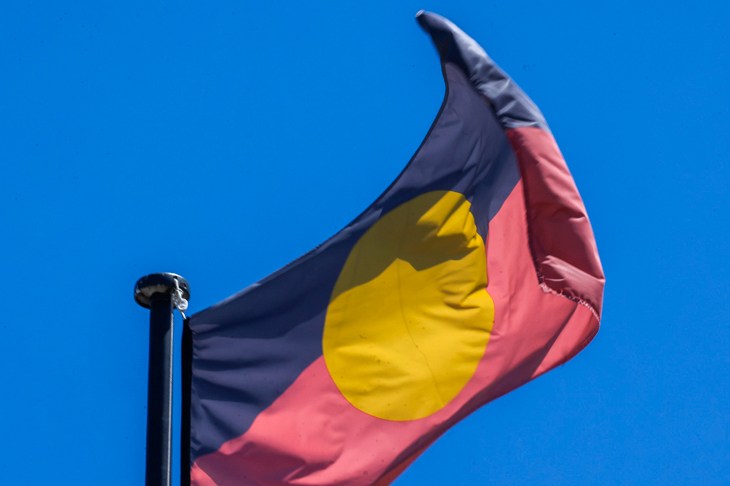
Ingram says there is more to it than just money: the box tickers ‘crave a sense of belonging. But do not let go of their sense of entitlement’. They often say they are on ‘a journey of discovery’, adopt words such as ‘deadly’ and call themselves Koo-ree ‘blissfully unaware of their clangers’. They also don costumes such as a bandana, a long, bushy beard, or a tattoo of the Aboriginal flag. It’s a new twist on cultural appropriation in which the appropriators insist that they are the culture being appropriated. ‘All that remains,’ she wrote, ‘is recognition from the non-Aboriginal world, and repeated refining of the performance’.
But for all the mystery and drama there is no mystery about the money. Nathan Moran, the CEO of a Metropolitan Local Aboriginal Land Council in Sydney, has called out ‘rampant fraud’: people pretending to be Aboriginal to get benefits or trade as Aboriginal businesses when they are not. He called for bodies to close the door on self-identification.
Dean Foley wrote in Indigenous News Australia in February 2025 about fraudulent applicants for university scholarships and job positions and ‘blak cladding’ in which non-Indigenous businesses masquerade as Indigenous-owned to secure lucrative contracts in an indigenous business sector valued at $16 billion.
‘It’s not easy being green,’ crooned Kermit the Frog on the set of Sesame Street. But it is easy to be a Blak Green. Too easy, say Aborigines. But it will be hard for a party wedded to playing ‘Let’s Pretend’ to admit it.
Got something to add? Join the discussion and comment below.
You might disagree with half of it, but you’ll enjoy reading all of it. Try your first month for free, then just $2 a week for the remainder of your first year.