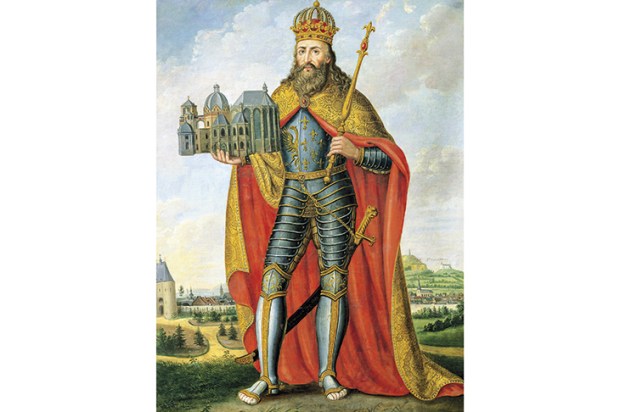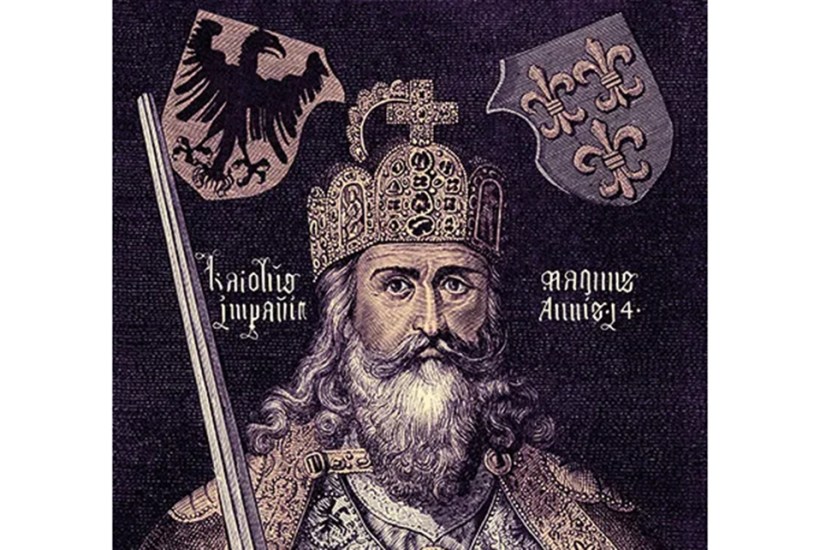
I don’t know if it is still the case, but there was a time in London when the ring of a doorbell on Saturday morning could only mean the Jehovah’s Witnesses and another copy of Watchtower. They all made for some pretty dotty reading in those days, but there was one article that has stuck in the memory – a piece that asked, and predictably answered, the question: ‘How Great was Charlemagne?’ The article concluded: ‘Though then known as Charles the Great, he was great neither in God’s eyes nor in the eyes of those whose standards are set by God’s Word.’
If it is not an attractive judgment, it is one that needs thinking about, because if anyone is equipped to enter into the mind of 8th- and 9th-century Man it is very possibly the Jehovah’s Witness. There are certainly aspects of the Carolingian age that seem only too familiar, but neither Putin nor even the imminent destruction of humanity at the hands of AI can inch most of us close to a world when Gog and Magog were on the horizon, the Last Days looming and the retributive hand of God seen in every plague, famine or Arab victory.
The Dark Ages might not have been quite as dark as was once thought, but they really were very, very strange. It was a period in which the corpse of the mighty Charles ‘the Hammer’ Martel might be found incinerated by a dragon in his St Denis sepulchre; a time of signs, warnings, omens and prophetic dreams. James Palmer writes of one such dream that came – or did not come – to the Emperor Charlemagne:
In it a mysterious man approached him with a sword engraved with four ominous and mostly untranslatable Germanic words; raht, radoleiba, nasg, and enti. The meaning seemed immediately clear to him because he was also a would-be philosopher… There would be four ages of his dynasty; one of abundance, one of sudden failure, one of great disorder, and then? Enti clearly meant either that the end of his line would come or the end of the world.
It didn’t quite work out like that – the Carolingians would stumble on deep into the 10th century and the world did not end – but it was close enough to give Palmer his title and his book its narrative trajectory. It falls naturally into three parts. The first is devoted to Charles Martel and the rise of Pippin the Short; the second to the extraordinary career of his son Charles; and the last and longest to the endless, internecine struggles of his warring successors.
While it might be argued that it was all something of a sideshow, that the important stuff was happening a long way to the east, what a sideshow it was! It is hard to think that anyone in the early 8th century would have given the last Merovingians the time of day; but within two generations that had all changed and the ‘backwater barbarian kingdom’ of the Franks had transformed into a ‘mighty cosmopolitan empire that stretched from northern Spain to the River Danube and from the rich ports of the North Sea to the eternal City of Rome’.
The central figure here is, inevitably, Charlemagne, and the one date everyone knows, Christmas Day 800, when he was crowned ‘Augustus’ by Pope Leo in Rome’s St Peter’s Basilica. There is no question that Charlemagne towers over his age in a way his great father never did, but Pippin deserves a due that he rarely gets; and if there is one other date we all ought to recognise it is 754, when another pope crossed the Alps to anoint Pippin king and cement a symbiotic compact of papacy and power that would rumble on through the succeeding centuries.
It was not the sole legacy of Carolingian rule either, because if Charlemagne can be hailed as ‘the Father of Europe’, his successors might well be branded the inadvertent fathers of Europe’s historic rivalries. On Charlemagne’s death in 814, Louis the Pious succeeded as sole emperor; but he would be the last of the line to do so and as son turned on father, brother on brother and half-brother, uncle on nephew, and east on west, Charlemagne’s empire broke up along faultlines all too familiar from many a future war.
It was an age when genuine piety could happily coexist with appalling brutality
If it seems a lot to pack into 270 pages of text, Palmer makes a terrific job of it. A week from now and half of it will probably be forgotten; but for the next few days at least, before Clement, Adelbert and their fellow heretics slip back into the darkness of the Dark Ages and all those Louis – the Pious, the German, the Younger, the Stammerer – once more blur into a single, composite Carolingian, this wonderful cast of saints, sinners, popes and ranting churchmen will make for hugely entertaining company.
Pitched somewhere between Janet Nelson’s King and Emperor and Simon Wilder’s Lotharingia, this is serious but popular history writing at its best. Palmer is more confident than Nelson that one can ‘know’ Charlemagne, and it is a convincing picture he presents. It was an age when genuine piety could happily coexist with appalling brutality, and renaissance stirrings with the darkest fears. The reformer and educator who brought the Anglo-Saxon scholar Alcuin to the Aachen court (a man who was as aware as any Jehovah’s Witness could wish of the coming judgment of God) was also the savage warlord who could have 4,500 Saxons beheaded in a day. To get some sense of that first Charlemagne, one should visit Aachen; to understand something of the whole man one could do a lot worse than take along Palmer’s Charlemagne’s Dream.
Got something to add? Join the discussion and comment below.
You might disagree with half of it, but you’ll enjoy reading all of it. Try your first month for free, then just $2 a week for the remainder of your first year.