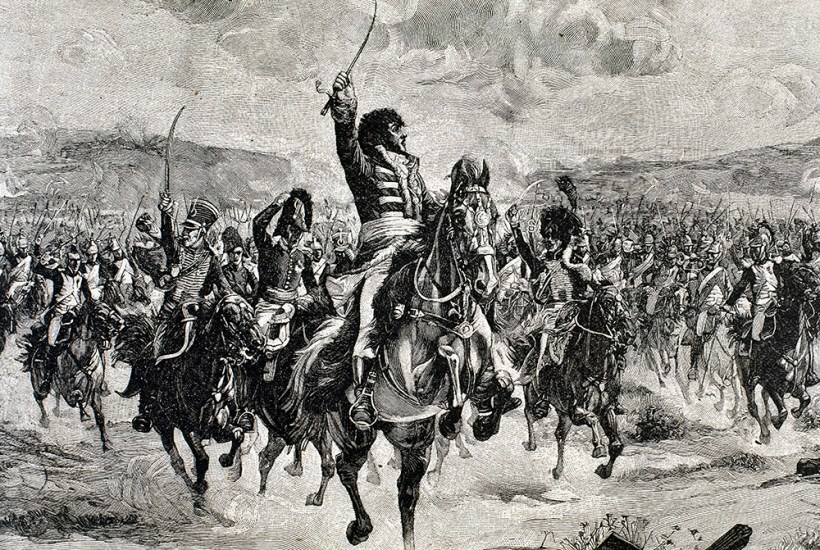
In his fourth book on Napoleon, after Napoleon and Wellington (2001), Waterloo (2005) and Napoleon the Great (2014), Andrew Roberts focuses on the emperor’s relations with his 26 marshals. Writing with the dash and vigour of a cavalry charge, having walked 53 of Napoleon’s 60 battlefields, Roberts analyses campaigns and battles from Italy in 1796, through Austerlitz, ‘the greatest victory in the history of France’, and the retreat from Moscow (ten marshals served in the Russian campaign) to Waterloo in 1815. Accounts of marches and battles are interspersed with frequent quotations from the emperor’s letters, sent day and night to his marshals to micromanage their campaigns, as well as from the marshals’ personal correspondence with each other.
Among these men, Napoleon’s brother-in-law Joachim Murat, ‘never knowingly underdressed’, was the finest cavalry leader of the day; Louis-Alexandre Berthier was a superb chief of staff; Michel Ney ‘the bravest of the brave’, inspired feats of heroism from his troops; Auguste de Marmont was a modernising governor-general of Illyria, building roads, schools and hospitals; and Jean-Baptiste Jules de Bernadotte, the most successful of all, through charm and political skill became crown prince, then king of Sweden, where his descendants still reign today. Louis-Nicolas Davout, Roberts’s particular hero (and one of five Napoleonic marshals who came from a pre-1789 noble family), was the greatest strategist after Napoleon himself. He reorganised the French army in the Hundred Days and, more Bonapartist than the emperor, would have liked him to fight on as military dictator after Waterloo. Showing the psychological force of frontier nationalism, eight marshals were born near France’s contested eastern frontier, while André Masséna was born in Nice when it was still outside France.
The marshals embodied ‘the most brilliant array of military talent ever found in a single army in one war’
The marshals were, Roberts writes, ‘excellent haters’ , undermining each other even when the enemy was at the gates of Paris. In 1815, five voted for the death of Ney, on trial for changing sides from Louis XVIII to Napoleon, although he should have been protected by the terms of the Convention of Paris and the common realisation that, as Talleyrand wrote, ‘treason is a question of date’. Only Marshal Macdonald, the son of a Jacobite who had fought at Culloden, never betrayed an oath of loyalty.
The poet Alfred de Vigny called the marshals ‘traitres et retraitres à tous leurs maitres’. Roberts, however, rehabilitates them. For him they embodied ‘the most brilliant array of military talent ever found in a single army in one war’. Often their advice was wiser than Napoleon’s decisions, for example over which route to take on the retreat from Moscow (the emperor chose the colder, northern route, thereby adding to French losses and misery), or how to organise the French army’s ‘central thrust’ at Waterloo.
In comparison, despite his military, administrative and legal genius, ‘Napoleon the Great’ appears here as not so great. Charming when he wished to be, he could also be mendacious, ‘callous’, ‘spiteful’ and ‘petty’, setting marshal against marshal (as he set courtier against courtier on Saint Helena). He weakened the marshals’ loyalty by his insults – calling Berthier useless and a coward. As Roberts notes, only four would serve him in the Hundred Days. He did not, however, assault them physically, as he did the 70-year-old Pope Pius VII at Fontaine-bleau in January 1813.
By that time Napoleon had become an incarnation of unreality, unwilling to listen when Berthier told him: ‘There is no army. The streets are strewn with corpses.’ His blunders included the imprisonment of the Pope, the annexation of the Netherlands and north-west Germany, the invasion of Portugal, Spain and Russia, his refusal to make peace, leaving thousands of French troops in outposts across Germany, and his failure – in the debacle of April 1814 – to secure his prize assets, the Empress Marie Louise and their son the King of Rome. Despite devoted soldiers, brilliant marshals, submissive subjects, incapable opponents (before 1812) and such charisma that his arrival on a battlefield sent an electric shock through his troops, Napoleon died a prisoner on an island in the mid-Atlantic. He had lost all French conquests since 1792, while his rivals had increased in power and territory.
Nevertheless, such was the power of French nationalism, of the emperor’s magnetism and of fear of counter-revolution, that in 1815, after 23 years of almost continuous warfare, half of France was ready to start again. National pride made many Frenchmen refuse to accept the reality of defeats, blaming them on ‘betrayal’.
Napoleon and his Marshals is great military history. Roberts understands battlefields, communications lines and the movements of corps and armies. Civilians are rarely mentioned. There are only a few tantalising glimpses of the marshals’ wives, palaces and art collections (some of Marshal Soult’s Murillos and Zurbarans, looted from the churches of Andalucia, are in the Louvre).
Marmont is blamed for ‘betraying’ Napoleon on 5 April 1814 by ordering his troops to enter Allied lines, thereby destroying ‘any hope of a Bonaparte dynasty’. But already on 31 March, Tsar Alexander I, much cheered on his entry into Paris and leading a highly effective charm offensive to win French opinion, had proclaimed his refusal to treat with Napoleon ‘or with any member of his family’. Furthermore, on 2 April, Napoleon had been deposed by a vote of the Senate which declared that ‘in a constitutional monarchy the monarch exists only by virtue of the constitution or the social pact’, and Napoleon had broken it. The vote was organised by Talleyrand, another recipient of imperial insults (‘shit in a silk stocking’, and more). The emperor had lost the political game. He was outwitted by Alexander I, Talleyrand and a boyhood rival from Corsica, Count Pozzo di Borgo, now the Tsar’s ADC and most trusted diplomat. With such leaders, Europe had the last laugh over the French empire.
Frenchwomen blamed Napoleon for causing more tears to be shed than any man in history
As senators’ and Parisians’ attitudes suggest, there was another France, civilian, liberal and loathing of despotism, for which the Napoleonic wars were not the road to glory but ‘la guillotine en permanence’. The great royalist writer Chateaubriand, in a bestselling pamphlet published on 5 April 1814, asked: ‘What good have they done us, these fatal victories?’ Another writer, Pierre Edouard Lemontey, called the military spirit ‘a leprosy eating and corrupting the substance of modern states’. The republican Marquis de Lafayette, in a lethal speech after Waterloo, helped turn the Chamber of Representatives against Napoleon by denouncing the lives lost in his wars, from ‘the sands of Egypt to the frozen wastes of Russia’. Around 900,000 Frenchmen died in these wars (and many more non-French), contributing to a disastrous decrease in the French birthrate. Frenchwomen, ‘the force behind the royalist party’, blamed Napoleon for the sacrifice of sons, brothers, husbands and lovers, and, as the wife of Louis Philippe said, for causing more tears to be shed than any man in history.
Readers will agree with Roberts that ‘national honour’ has been responsible for so much misery that it should be called ‘the fifth horseman of the apocalypse’. Some might also accept the verdict of Joseph Conrad, who wrote in 1905 that Napoleon was not an eagle but
a sort of vulture preying upon the body of a Europe which did indeed for some dozen of years resemble very much a corpse. The subtle and manifold influence for evil of the Napoleonic episode, as a school of violence, as a sower of national hatreds, as the direct provoker of obscurantism and reaction, of political tyranny and injustice, cannot well be exaggerated.
Got something to add? Join the discussion and comment below.
You might disagree with half of it, but you’ll enjoy reading all of it. Try your first month for free, then just $2 a week for the remainder of your first year.