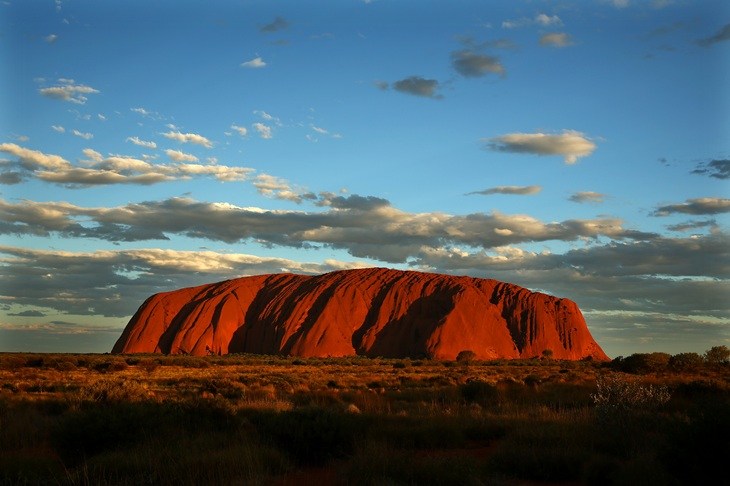
Growing up in Australia in the 1950s, I was inspired by the idea of climbing Ayers Rock, the largest sandstone monolith in the world. Also known as Uluru, this towering outcrop stands 348 metres high, with two-thirds of its immense mass hidden deep beneath the red sand.
Recognised as one of the wonders of the natural world, Ayers Rock is listed as a UNESCO World Heritage Site. Like Queensland’s Great Barrier Reef and the Sydney Opera House, it features prominently in international promotion of Australian tourism.
My aspiration to climb this colossus was kindled by Arthur Groom’s 1950 book I Saw a Strange Land. I felt my Australian identity was somehow linked to this iconic natural feature.
An Australian writer, conservationist, and photographer, Groom visited Central Australia in 1947. He climbed Ayers Rock, ably assisted by local Aboriginal man Tiger Tjalkalyirri, who acted as an early guide and climbing partner for visitors. At the summit he photographed Tiger and another Aboriginal man who accompanied them, to record the event for posterity.
During the 1930s to 60s, anthropologist Charles Mountford worked closely with local Aboriginal people while documenting the region’s culture and creation stories. He described the Aboriginals as ‘a nomadic people who spend their lives wandering over vast tracts of arid country in search of food and water’. He observed that ‘Ayers Rock is not a place of continuous habitation in the European sense, but a focal point in the desert where tribes gather when water is scarce elsewhere’.
Historical accounts confirm that Aboriginal men were entirely familiar with climbing the rock and with its geographical features. They happily guided occasional non-Aboriginal visitors who wanted to climb the rock, which provided an excellent vantage point for surveying the surrounding country.
When I moved with my family from Eastern Australia to Adelaide, I thought we were close enough to embark on a journey to Central Australia.
I was soon deterred, however, when I realised there were over 1,000 km of dirt road between Port Augusta and Ayers Rock. That situation remained unchanged until the mammoth task of sealing the Stuart Highway between Adelaide and Alice Springs was completed in 1987. Two years later we set out in our car and camper trailer for a pilgrimage to the heart of Australia to climb Ayers Rock.
Partway up the rock’s initial steep ascent, guided by a safety chain installed in the 1960s, our youngest daughter lost her nerve. She clung to the chain and refused to move – either up or down.
The rest of the family looked on helplessly until her older sister had a bright idea. ‘Hey, don’t forget that T-shirt you bought yesterday,’ she reminded her sibling. ‘It says, ‘I climbed Ayers Rock. You won’t be able to wear it if you give up now!’
With that encouragement, our youngest was convinced! We all moved on and reached the summit, where a fellow-climber kindly took a photo of our family as a memento of the happy occasion. My 30-year ambition was fulfilled.
Sadly, since 2019, climbing the rock is no longer allowed.
The ‘ownership’ of Uluru has a long and complicated history. Before British settlement, the Australian central desert peoples were nomadic hunter-gatherer societies. Small groups, often consisting of several related families, moved around their traditional lands to obtain food, water and other resources.
The central desert peoples included several related language groups, including the Pitjantjatjara, Yankunytjatjara, and Ngaanyatjarra mobs. Collectively known as Anangu, a word meaning ‘people’, they shared overlapping stories and cultural connections to Uluru. The Western concept of ‘ownership’ did not really apply.
That changed during the land-rights movement of the 1970s and early 1980s. A campaign by the Pitjantjatjara Council, and the Central Land Council established in 1977 by the Commonwealth as an independent statutory authority, sought Aboriginal control of Uluru and the surrounding area.
During mid-1980s parliamentary debates, the Federal Opposition led by Andrew Peacock and the Northern Territory government led by Paul Everingham, vigorously opposed transferring control of Ayers Rock to local Aboriginal groups.
They argued that race-based land grants undermined the principle of equality under a single legal system and stoked racial tensions. National parks belonged to the entire Australian public and should not be handed over to a specific ethnic group. They were also concerned that climbing the rock may be banned by future Aboriginal owners.
Sadly, their efforts were to no avail. The Hawke government’s amendments to the Aboriginal Land Rights Act and the companion National Parks and Wildlife Conservation Amendment Act passed the federal Parliament in August 1985. These changes paved the way for a transfer of ownership.
On October 26, 1985, the title deeds of the Uluru area were handed to the Uluru–Kata Tjuṯa Aboriginal Land Trust, subject to a 99-year lease of the land to the Commonwealth. The Trust receives from the Commonwealth (a) rent under the 99-year lease and (b) 25 per cent (increased this year to 50 per cent) of park entry fee revenue collected at the park gates.
The dollar amounts of these payments to the Trust are buried deep within the labyrinthian reports of the Australian Director of National Parks and the Central Land Council. According to the Central Land Council Annual Report 2024-25, the total ‘Uluru rent money’ (park lease plus a portion of entry fees) for that financial year was spent on community-benefit projects, largely for the small Mutitjulu community near the base of the rock, with some for Anangu people living elsewhere.
As anthropologist Mountford observed early last century, ‘Ayers Rock is not a place of continuous habitation.’ The modern Mutitjulu community is named after a waterhole at the base of Ayers Rock. Resident numbers fluctuate due to the semi-nomadic lifestyle of these desert peoples. The community typically comprises about 300 people, mostly Pitjantjatjara and Yankunytjatjara, which is only a small portion of roughly 5,000 Anangu living in remote communities.
Whether the funds received by the Land Trust are being applied in a fair and equitable manner is hard to know. Are they achieving better living standards and improved self-sufficiency for the Anangu communities? Pressure to honour kinship obligations above fairness and equity can be a problem. Traditional Aboriginal social structures prioritise the needs of extended family and clan lines as a fundamental moral and cultural duty.
It is my view that government oversight is preferable to guard against any potential misuse of such funds. Nepotism, factionalism, and administrative waste has been an issue with Indigenous funds in the past.
For these reasons, prominent Senator Jacinta Nampijinpa Price has made repeated calls for a comprehensive, forensic audit into government grant funding awarded to Aboriginal and Torres Strait Islander organisations. A detailed audit is needed to provide proper accountability.
Meanwhile, many Australians still harbour a desire to climb Ayers Rock.
Ahead of the 2019 decision to close the climb, the Sydney Mining Club challenged the arguments for closure, in a document titled Ayers Rock climbing myths.
In 2020, the general manager of Alice Springs airport called for the climb to be reopened. ‘The concept there is that the traditional owners would provide tours for paying climbers and have a safety harness system in place just like the Sydney Harbour Bridge,’ he said.
Similarly, the founder of Expedition Australia, has called for the climb to be reopened. ‘I’ve climbed the rock and walked around the base several times over the years and there is no way I would leave a visit to the rock off my NT road trip itinerary if time permits,’ he said. ‘I respect the traditional owners’ perspective but at the same time can see the benefits of a managed climb and would be happy to pay for the experience, as would many others.’
It is time for the Australian government to recognise this natural wonder as belonging to all Australians, both Indigenous and non-Indigenous. The government should work with the Uluru-Kata Tjuta Board of Management to reopen the climb for paying visitors, in a safe and respectful manner, and provide employment for local Anangu people as guides.
Dr David Phillips is a former research scientist and founder of FamilyVoice Australia