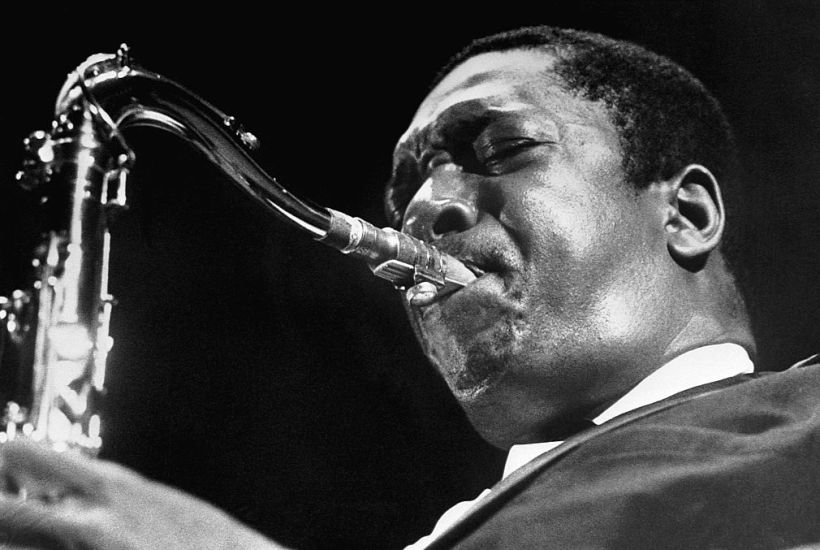
John Coltrane was born 100 years ago this week, and jazz lovers are in a sentimental mood. Coltrane, who died in 1967 at the age of 40, occupies an honoured place in their world. For many afficionados he hovers only slightly lower than the angels.
‘In a Sentimental Mood’ was one of Duke Ellington’s classic songs, and in 1962 Coltrane joined the Duke on a disc which bore that title. Their collaboration was designed to throw a rope across the generations, and the younger man was not shy in acknowledging the debt owed by younger musicians to the great bandleader, who wrote several chapters in the history of jazz.
To Larkin he was never the Trane. He was The Master ‘of rebarbative boredom’. Larkin referred to Coltrane’s ‘gigantic absurdity’, and his ‘insolence and ugliness’
Tuning in to Radio 3 this week, however, you might get the impression that improvised music began and ended with the man they call the Trane. The nightly ‘essay’ slot has been given over to five reflections on Coltrane’s life, and the programmes were prefaced by an odd feature on something called the St John Coltrane African Orthodox Church in San Francisco.
Yes, such a church exists. Worshippers gather each week, it seems, to genuflect before the image of a saxophonist who extended the vocabulary of music, though not necessarily in ways that delight all ears.
In the authorised history the first great tenor saxophonist was Coleman Hawkins. ‘The Hawk’ handed on the baton to Ben Webster, and after them came Lester ‘Prez’ Young, in his porkpie hat, who was perhaps the most lyrical player of all.
After Young there was a fork in the road. Stan Getz, anointed by Young when he was barely out of short pants, took the more melodic turning. Coltrane and Sonny Rollins, who died in May at the age of 95, opted for a more, shall we say, adventurous path, where crampons and tight ropes were obligatory.
Coltrane began on the nursery slopes, playing in bands led by famous players, not least Johnny Hodges, Ellington’s favoured alto saxophonist. In those prentice years he was known as Johnny Coltrane, and swiftly made a name for himself when he joined the Miles Davis Quintet in the mid-Fifties.
His talent was never in doubt, even if his tone sounded a bit sour to those brought up on Webster and Young. He could play the alto horn, too, and in 1961 he got out the soprano saxophone to embroider Richard Rodgers’s famous tune, ‘My Favourite Things’, which in his hands went on for 13 minutes. In live performances he could stretch it out longer, rendering audiences awestruck – or catatonic.
In the Sixties Coltrane broke free. Although he associated with Ellington, and made a fine record with the singer Johnny Hartman, he was now in a far from sentimental mood. In 1965, as leader of a superb quartet featuring drummer Elvin Jones, bassist Jimmy Garrison and pianist McCoy Tyner, he recorded ‘A Love Supreme.’
The following year, assisted by a larger group, he expanded his musical horizon with Ascension. It is fair to say not every listener followed him. Not every player, either. A punch-drunk Tyner admitted that all he could hear was noise.
Those who did follow are the ones flinging the bouquets this week. For them late Coltrane represents the peak of jazz, where the music was predestined to end up. This is Coltrane the visionary, indeed the prophet – as those fanatics in San Francisco would have us believe.
There was always another view, expressed most fluently by Philip Larkin. The great poet was also an engaging writer on jazz, though his scorching wit has not always found favour with other critics. Jazz writers have rarely been known for their humour, nor their willingness to share the stage with those who challenge approved opinion.
Larkin’s view was pretty straightforward. His heroes, like Louis Armstrong and King Oliver, ‘sang out’ to the audience. They were entertainers, who brought joy to listeners. Too many players in the bebop generation, thought Larkin, played for the admiration of their peers. Their music was cold, and to his ears Coltrane was the coldest fish of all.
To Larkin he was never the Trane. He was The Master ‘of rebarbative boredom’. Larkin referred to Coltrane’s ‘gigantic absurdity’, and his ‘insolence and ugliness’. In a particularly wounding review he made the now celebrated claim that he sounded like a club bore transformed by fellow members ‘into a pair of bagpipes’.
There are other views, and you’re going to hear them in the centenary celebrations. Yet, listening to those ghastly ‘sheets of sound’ that Coltrane-lovers go on about like daffodils in spring, you have to admit Larkin slotted the red ball into the middle pocket. Late Coltrane is not just ugly, it’s deliberately ugly. At time it’s tuneless honking.
Coltrane was a fine musician whose ambition outstripped his talent. But if you want to celebrate his life properly then cock an ear to the Hartman disc, or to ‘Flamenco Sketches’ from Kind of Blue, made with Miles Davis and friends in 1959.
That’s Johnny Coltrane at his best. It catches the restrained tenorist, surrounded by five others, no less gifted, making great music. It’s about listening. He should have done it more often.