‘I probably got a one or two seconds look at him before he delivered the first blow,’ recalls Sir Salman Rushdie. For the next 27 seconds, on 12 August 2022, the man whom Rushdie will refer to only as A. (‘for asinine’, he explains) tried to kill the writer on the stage of the Chautauqua Institution in upstate New York. A. slashed through the tendons of Rushdie’s right hand, cut his thigh, stomach and chest, incised a gaping wound in his neck and finally stabbed him in the right eye.
In Alex Gibney’s new documentary, Knife: The Attempted Murder of Salman Rushdie, composed principally from unflinching bedside footage at a Pennsylvanian hospital filmed by Rushdie’s fifth wife – the American poet Rachel Eliza Griffiths – the Mumbai-born British-American novelist says in voiceover: ‘Why didn’t I fight? Why didn’t I run? Was I so fatalistic that I was prepared to surrender to my murderer?’
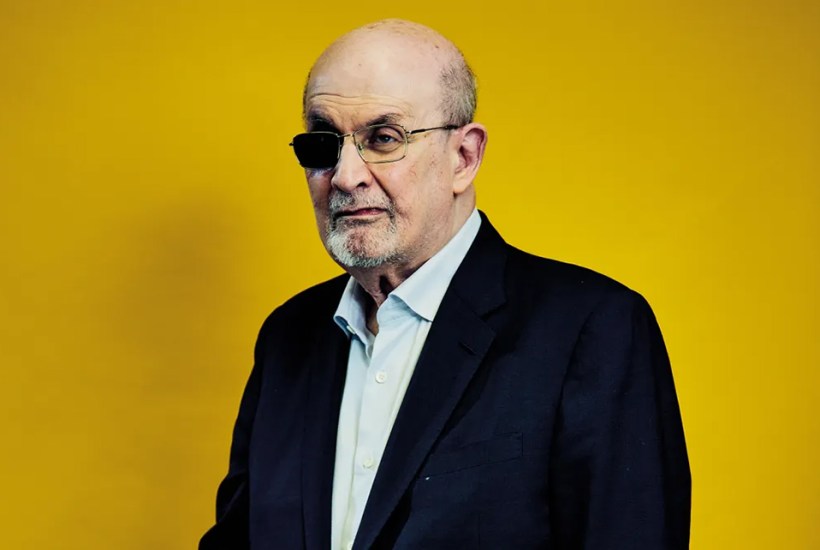
But that’s not what happened at all, I tell Rushdie. Having seen (and sobbed through) the footage of the attack by the then 24-year-old Hadi Matar – included in the documentary – what I witnessed was Rushdie attempting to flee his would-be killer as best he could. There was no fatalistic death wish at all. ‘It’s a false memory,’ admits Rushdie. ‘One of the things that I learned from seeing the footage was that there were various moments in that moment of the attack where I had quite misremembered how it actually went down. For instance, I had thought that I saw him coming. Actually I didn’t. He came up from behind me, and I didn’t see him until he was right at me,’ says the 79-year-old Rushdie over Zoom from a secret location in London, looking trim and smart in jacket and tie, one shaded spectacle lens covering his now useless right eye.
I’ve interviewed Rushdie twice before. The first time was at Temple Judea in suburban Miami in 2008. He had been reading from his then new novel The Enchantress of Florence as part of a 28-stop American book tour. While three police cruisers idled outside, Rushdie joked with the audience about the fatwa issued by Iran’s supreme ruler Ayatollah Khomeini on Valentine’s Day 1989 calling on the novelist to be killed for The Satanic Verses, which had been deemed hostile to Islam.
For 13 years, Rushdie was a member of an elite society. The Level One Club had three members
‘I don’t want to dispute with Ayatollah Khomeini, but I will point out that only one of us is dead,’ Rushdie told the Miami crowd. ‘That thing they say about the pen being mightier than the sword? Don’t mess with novelists.’ Edgy material, not least because by then there had been one failed attempt on his life, and his Japanese translator had been stabbed to death by, Rushdie believes, Iranian terrorists.
Still, he got a laugh that night which was kind of the point: nothing would slay his cheerfulness. ‘I’ve always refused the role of the victim,’ Rushdie tells me now. In the film, he tells us his fight is between ‘all the things I despise – fanaticism, bigotry’ and ‘all the things I love – art, love, imagination, beauty’. It turns out that the Palestinian-American critic Edward Said had been prophetic: he is quoted in the film suggesting that the greater risk to Rushdie was from a lone fanatic, not a state-sponsored terrorist.
Last year Matar was jailed for 25 years. Was that long enough for Rushdie? ‘He’s going to get more because he was found guilty of terrorism in the second trial.’ Would he have preferred him to be executed? ‘No, I don’t believe in the death penalty, but I believe he has to be gone for a really long time. He’s only 28 now. If he comes out in 20-odd years, he’ll only be 48 or 50.’
And yet Rushdie is hardly free of vengeful impulses. In Knife we see him standing outside the jail where A. is incarcerated. ‘I wanted, absurdly, to dance,’ says his voice-over. Then he addresses A. directly. ‘My life has resumed and it’s a life filled with love… I’m glad I have my life and not your life.’
Would he like to meet the man who tried to kill him? ‘No. He wouldn’t open his heart to me and tell me what makes him tick. I’d get a series of ideological slogans.’ Matar wasn’t born when the fatwa was pronounced. ‘Whatever this attack was about it wasn’t about The Satanic Verses,’ says Rushdie. In the film he comes up with explanations for the attempted murder – the ‘folly of ignorant youth’ or how ‘religion is the poison in the blood. It appears to give moral justification to immoral acts.’ For Eliza, however, what happened was more straightforward: ‘Some fucking monster illiterate piece of shit left his loser basement in New Jersey and drove to Chautauqua and chose violence,’ she says to camera. Perhaps, like trying to explain why Meursault murdered an Arab in Camus’s L’Étranger, accounting for Matar’s motive is futile.
The second time I met Rushdie was in London’s Bloomsbury in 2012 when we met to chat about Joseph Anton, his memoir of the 13 years he spent living under the fatwa. What did the title mean? Joseph was Conrad’s first name, Anton was Chekhov’s. Police minders had advised him to devise a pseudonym. ‘Probably better not to make it an Indian name,’ counselled his minder Stan. And so, Rushdie wrote, he became ‘an invisible man in a whiteface mask’.
He was Mr Anton until 27 March 2002, when the bulletproof police Jaguars that accompanied his every move from one safe house to another finally drove out of his life for the last time.
For 13 years, though, Rushdie had been a member of an elite society. The Level One Club had three members – the queen, the prime minister and a certain Mr Anton – all of whom required 24/7 protection: ‘Then in 2002,’ he had told me, ‘I dropped to level three or four, and basically then you look after yourself.’ After that interview I watched him stroll across Bedford Square and hail a cab to the book launch, complacently thinking him the very image of a free man.
Did he wish he’d remained a member of the Level One Club? He might well never have been attacked. ‘No, no, no, no. That’s a very good club to resign from. You can’t do anything spontaneously. In those days, if I was writing at home and there was police protection, and I wanted to go for a walk because I wanted to clear my head, they would say, “OK, well, just give us an hour to set things up, and then you could go for a walk.” And I thought, “No, but I want to go for a walk now because now is when my head needs clearing.” Not to be able to do anything spontaneously is a real loss.’
He cast off Anton’s whiteface mask in the early noughties and moved to New York City. For nearly two decades thereafter he says, ‘I’d led a perfectly ordinary writer’s life. I was doing the stuff that writers do: writing books, doing readings, doing signings, giving lectures here and there, teaching in universities, and there had never been the whiff of trouble. And then there was this.’
Two years ago, Rushdie wrote a memoir about ‘this’ called Knife: Meditations After an Attempted Murder. ‘Language was my knife, the tool I could use to fight back,’ he says. But the filmed footage of Rushdie’s 40-day recovery in hospital and early convalescence is more viscerally impactful than that book. ‘In hospital Eliza had arranged for mirrors to be removed, so I couldn’t see myself. Much later, when I was out of hospital, and I wasn’t fully recovered, Eliza said to me, “Are you ready to watch the footage that we shot?” I agreed. First of all, I thought I looked really like shit, much worse than I imagined. And secondly, I thought how well shot this is. I thought it could have a life as a film.’
In Knife, we see Rushdie drugged on fentanyl and morphine, learning he will never use his right eye again, not being able to shower or go to the toilet alone, struggling through physio and occupational therapy, battling to use his butchered hand, fighting against depression. All the while he manages to speak coherently and even programmatically. ‘I want to make a record because it’s not just about me. It’s about freedom,’ he says to Eliza’s camera from his sick bed. Even a few days after the attack he was clearly thinking about how he could use what she filmed.
Rushdie was 41 when he wrote The Satanic Verses. If he had his time again would he have withdrawn it from circulation and spared himself 40 years of misery? ‘NO. I’m very proud of that book. I have no desire to disown it in any way, but also it’s a really long time ago. That was my fifth published book, and I’m now in the process of finishing my 24th published book.’
Rushdie doubts that The Satanic Verses would be published today: in that sense we are less free than we were before the fatwa. ‘We all need to get thicker skins,’ he told me a few years ago. But in our cancel-culture age we have not.
‘My life has certainly shown me that I’m more resilient than I would have ever thought I would be’
He says at one point in the film ‘it didn’t occur to me that I wasn’t allowed to say these things’ by which he means to treat Islam with the roughhouse lack of solemnity with which he treats everything else. ‘That’s because I grew up in a very free-thinking, secularised, Indian-Muslim family, in which people would talk about everything. My father and his friends would sit around in the evening and talk about everything. They liked talking about philosophy. They would discuss the existence of God – and non-existence of God even. Some of his friends were communists and certainly didn’t believe in religion. Others were quite theological. But everybody argued about everything, and, eavesdropping on these conversations, 12-year-old me thought you could talk about whatever you want, and I still think that.’
Rushdie speaks of living a life of ‘wounded happiness’ since the attack. What does that mean? ‘What it means is that the shadow doesn’t go away entirely. I’m just about to finish a novel, so I’ve written three books in the last four years. What’s changed is that I have to be careful about public appearances. If you’ve come, as I’ve come, that close to death, and if the person who loves me has had to watch that happen, it’s like a shadow in the corner of the room that never goes away. Trauma doesn’t just happen to the person; it happens to the people who care about you as well.’
He tries not to think about his would-be killer A.? ‘I think the best revenge is indifference. I don’t forgive him and I don’t not forgive him. He’s just irrelevant. If I can just say, “OK, you had your Warholian 15 minutes of fame, and now you can spend the rest of your life in jail. Thanks a lot.”’
That, I submit, would be an extraordinary feat of detachment. And yet what is no less extraordinary is how the nerdy magical realist novelist who wrote The Satanic Verses became indomitable to the ordeal of what unfolded. ‘My life has certainly shown me that I’m more resilient than I would have ever thought I would be. If you had told me in 1989, “Here’s how it’s going to be. How do you think you’ll do?” I would have thought, well, I probably won’t do very well.’
That chimes with the injunction his Indian parents told little Salman decades ago. ‘They said what cannot be cured must be endured.’ Does he think he internalised that advice? ‘Perhaps. Many of us discover that we have inner resources that we never suspected ourselves of having. You actually do better in a situation of adversity than you would believe you would have.’
Got something to add? Join the discussion and comment below.
You might disagree with half of it, but you’ll enjoy reading all of it. Try your first month for free, then just $2 a week for the remainder of your first year.