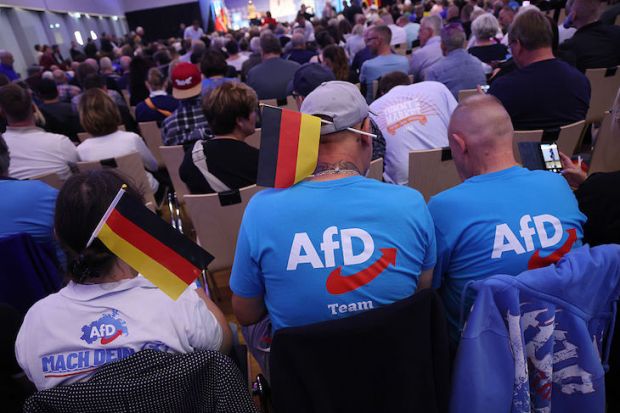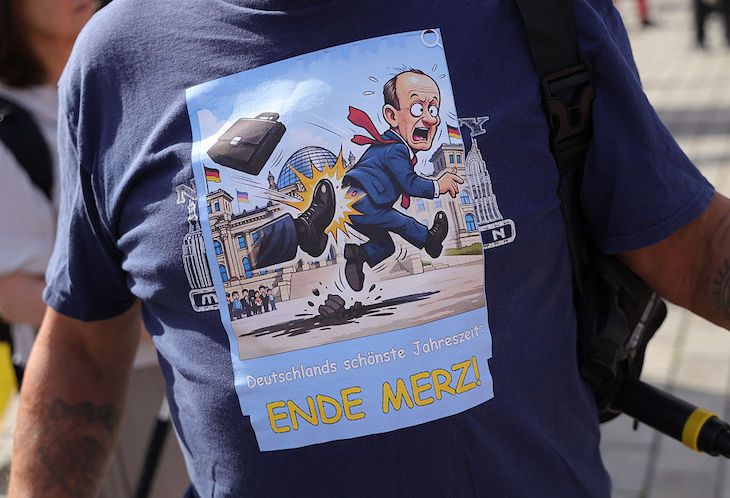
Friedrich Merz is the most tragic chancellor in the young history of the reunified Germany. It is time for him to step down. This was made very clear, when he faced the cameras after yet another election that was lost by his party, the CDU. After losing Saxony-Anhalt and then Mecklenburg-Vorpommern to the far-right Alternative for Germany (AfD) – while Berlin fell to the socialist far-left Die Linke – everyone here in Germany expected a speech with consequences. Would he declare the “Brandmauer” – the firewall, that would prevent the CDU from ever even getting majorities on bills through in parliament with the AfD – to be over? Would he step down and make way for a new chancellor? Painstakingly, nothing of the two happened: Friedrich Merz stated simply that he will stay. That he will push through reforms and get Germany back on track. His message, essentially, is to keep calm and carry on.
Yet even the staunchest Merz support must see that his chancellorship is over. The only one who doesn’t seem to get it is Friedrich Merz himself. The tragic figure, who became chancellor last year in February and has ever since stepped from one botched idea to the next. Merz ditched the sacred debt brake, which the CDU had campaigned and won on, under pressure from his coalition partner, the Social Democrats. And he has failed to crack down on illegal migration, choosing instead to hide behind the Brandmauer. Merz himself truly believes he is doing the best for Germany. Not so much the Germans themselves. On his first day as chancellor, he promised to halve the AfD in his tenure. Instead, support for his own party has halved and support for the AfD has doubled.
Friedrich Merz had the chance of his life to build a strong chancellorship that would go down in history. He failed
Ever since Angela Merkel, also from the CDU, came to power in 2005, the Conservatives always chose to form “grand coalitions” with their main rival, the Social Democrats. This left the opposition extremely weak, which allowed extreme parties on the left and right to gather a huge following, and basically hollowed out the CDU and killed the SPD. Now they are polling under 20 per cent, both parties cannot call themselves “Volksparteien”, national parties, anymore. So, the “grand coalition” has eaten its children alive, and this erosion of the classic political poles has, if we are honest, made the success of the far-right AfD possible. A conservative voter has always ended up with a social democratic government and a social left-wing voter always with a CDU-led government. So, according to the logic of the German voter, if you want conservative politics, you need to vote for the AfD. And the movement is growing rapidly.
Friedrich Merz had the chance of his life to build a strong chancellorship that would go down in history. After a disastrous government, led by the social democratic chancellor Olaf Scholz, Merz was voted in – mainly by conservative voters who believed they would get “CDU pure” with him. Finally, no lefty Merkel-like CDU government, supported by the SPD and forming policy that could have been written by the Green Party. Merz spoke in clear language, and his successful career as a Blackrock financier impressed much of the conservative vote. Here would be a chancellor who knows what’s right and isn’t cornered in by the establishment. How wrong they were.
After having won the election, Merz, still in opposition in the old sitting parliament, made a bold but right decision. Germany had just suffered a string of deadly terrorist attacks, mainly by immigrants that were not supposed to be in the country anymore, but still were thanks to the county’s lax border enforcement.
Merz stood in front of parliament after the attack in Aschaffenburg and proclaimed there would have to be a decisive change of the immigration laws, a “Migrationswende.” His plan would make sure that Aschaffenburg wouldn’t happen again and that no one who is seeking asylum but is a known criminal would be accepted to stay in Germany. This was a huge chance, yet, how he handled it, would define his new political personality. His action bill was only able to pass with votes of the, yes, you guessed it, AfD. According to common sense, this should not have been a problem – a bill written and put in motion solely by the CDU should not be less worthy just because the AfD supported it. But Merz bowed down to pressure from the left-wing, saying this was the “worst week of his life,” openly regretting what he had done.
Then, a few months later, he acknowledged on a TV-aired townhall meeting, that the “Stadtbild,” the way the everyday scene in towns looks like, had been radically changed by the huge number of immigrants from the Middle East, and many Germans were worried by this. Women would not feel safe anymore. This inevitably sparked outrage among the very well organized left-wing, who pushed huge crowds to gather in front of the CDU party HQ, making it look like the population disagreed with what Merz said. He caved in and backtracked.
A day later, a national poll showed that more than three quarters of the German population agreed with what he said. This should have been a warning sign to Merz and his team, that the noise of the left was not the sentiment of the population.
In such moments, Merz lost his authority. Yet while Merz has himself to blame for his dire situation, Germany itself faces deep structural problems that need fixing. The Brandmauer has metastasized from a tactical boundary into something closer to a linguistic one. It no longer just governs who the CDU may work with, but more precisely governs what the CDU may say. Migration, internal security, integration – precisely the issues moving voters in Germany – have become subjects the Chancellor can gesture at but never quite name, because to speak of them with any specificity invites the charge of breaching the wall. Instead Merz retreats into cliche – “Stärken und Schwächen” (“strengths and weaknesses”), “Freiheit, Sicherheit und Frieden” (“freedom, security and peace”) – phrases built to mean everything and therefore nothing. It is not that Merz lacks the vocabulary. It is that concrete language has become politically radioactive. A firewall raised to keep the AfD out has ended up blocking the governing party in, leaving its own chancellor speaking in a code even his supporters can no longer decipher.
The time has come for Friedrich Merz to step down. And I don’t say this light-heartedly. Germany is facing the biggest challenges of its recent history. We are at war with Russia and are facing hybrid attacks monthly. We need a strong and decisive government and can’t risk being ruled by the AfD. But a chancellor like Merz is only making the problems more grave and is making an AfD-led government more likely. He has lost all credibility with the German people, the faith of his own party and yet doesn’t see the grave situation he has put Germany in.
Merz must make way for a chancellor who is willing to push through reforms, even if these are supported by the AfD, and someone who is willing and able to stand up to the weak coalition partner, the SPD. If he stays on, Germany risks being not only eaten alive by its Brandmauer, but by the forces to the east that want to see it destabilized and broken.
Friedrich Merz waited for more than two decades to become chancellor, after Angela Merkel ruined his ambitions. He has failed to overcome the huge mistakes she made for Germany. What a tragic story.