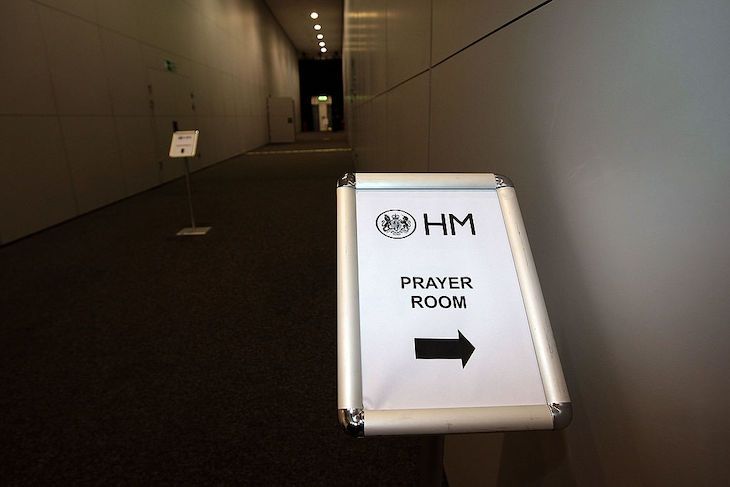
Waiting in the ITN greenroom before a television appearance recently, I spotted a sign in the corridor for the multi-faith prayer room, and asked a runner if I could pay a visit. He looked at me blankly. He had no idea such a room existed, and had to go and find a colleague who did – a young man who led me straight there. Inside, the room was arranged almost entirely around a wudu station, the low basin at which Muslims wash their feet before prayer. On the shelf: Qurans and prayer mats. Nothing else.
The room always tells the truth, even when the sign on the door does not
“Do you use this room?” I asked him as we left. He did – that was how he knew the way. “Do you mind me asking what religion you are?” He was Muslim. “It’s not really a multi-faith room, is it?” I said. “No,” he smiled, “What religion are you?” “I’m a Jew.”
I should confess that visiting multi-faith prayer rooms has become a peculiar hobby of mine. I never used to think about them until my partner, an immigrant to Britain, led me into one out of curiosity. Like CCTV cameras, once you notice one, you see them everywhere: in airports, hospitals and shopping centres, at Kew Gardens, behind an unmarked door on Level 4 of Tate Modern. At the ARC conference this year – four thousand people, a Christian prayer breakfast, much talk of restoring the West’s foundations – and when I asked where the multi-faith prayer room was, nobody knew. I eventually found it at the back of the main audience area, with a screen above the door announcing it as a “Quiet Room”. Inside, a solitary prayer mat, a sign showing the direction of Mecca, and little else. In the V&A I asked where it was and was told to “go to the second floor, pass through Buddhism and go right,” but if I preferred they’d lend me a rug and I could use their meeting room.
So it was a relief to discover I am not alone in this fascination. Dr Andrew Crompton is an architect and academic who has made probably the world’s most extensive study of these spaces, and recently sat down with me for an interview. (Regular readers may remember him as the professor of architecture who watched, aghast, as a police officer arrived at my door for having an opinion). In 2015, he counted 2,500 multi-faith rooms in Britain; today he estimates five or six thousand. At Heathrow, where a rather beautiful triple chapel – Anglican, Catholic, Nonconformist – was built in 1969, he counted 13 multi-faith spaces in 2015. Today he says there are 39, mostly airside for staff. Ask yourself where the greatest density of religious spaces in the United Kingdom is to be found. Oxford, perhaps, or the City of London with its forest of Wren steeples? It is Heathrow Airport. And nearly all of them, Crompton says, are in effect mosques.
The standard specimen is a plasterboard box with no window, a suspended ceiling, a carpet, and one piece of IKEA furniture. Its designers strive for perfect neutrality, and Crompton’s insight is that this is impossible. A multi-faith room, he says, is like a crime scene: however thoroughly you clear it up, there is always some indication of what went on. A Jew prays standing, a Christian sitting, a Muslim prostrate – so furniture shoved to the walls tells you who came last. Shoes by the door are a sign. So is the arrow on the wall pointing to Mecca, the bottles of scent, the washing facilities. At Bolton, the carpet sits at a slightly drunken angle to the walls, like a bad fitting job; it is aligned with Mecca. The room always tells the truth, even when the sign on the door does not.
Sometimes the results are pure comedy. He shows me his photos from the Trafford Centre, where a statue of Jesus stands in an alcove behind a curtain you can draw across him – vandals have snapped off his fingers, which poke through the fabric regardless – while the wudu station hides behind a screen at the other end, each faith politely concealable from the other. At Manchester Royal Infirmary an egg-shaped room, meant to gather us all in one embracing curve, is speared by a structural column containing the building’s soil pipe: worshippers commune with the eternal while the day’s effluent rushes past at head height. The architects boxed it in and disguised it as a tree. If you wanted a single image of modern Britain’s relationship with the sacred, there it is.
But beneath the comedy sits something genuinely strange. No law requires these rooms: when a Muslim pupil claimed the right to pray at Michaela School in Wembley, the High Court backed the school’s refusal. There is no multi-faith society, no theory of multi-faith, no minister mandating them. Such lobbying as exists consists of Muslims asking, reasonably enough, for somewhere to pray; ‘multi-faith’ is the institution’s nervous answer. Managers simply sense that they ought to have one, the way we know when to put our bins out – not from knowledge, but by looking at what the neighbours have done. Britain has produced, quite spontaneously, thousands of anonymous prayer rooms; and because almost the only people who use them are observant Muslims, it has in practice produced thousands of undeclared mosques. “Britain has built 5,000 mosques that you don’t know about,” Crompton told me. “That’s what it boils down to.” Blimey. Don’t tell Rupert Lowe.
Every generation builds its soul in architecture. The medievals raised Chartres, Crompton says. “We didn’t build St Paul’s. We did multi-faith spaces. This is us.”
So why not simply call them Islamic prayer rooms and be praised for providing a service? Because that would require saying so out loud. We are a nation embarrassed by prayer, and so we have tucked religion into a windowless closet next to the lavatories and the smoking room – the other things one doesn’t do in company. We no longer believe prayer is quite real, but many Muslims do. At Ben Gurion airport I have watched Jewish men wrap tefillin in groups of ten while Muslims unroll mats near passport control, everyone praying openly, nobody batting an eyelid. That is the honest version. Ours is the euphemism: rooms designed, in Crompton’s haunting phrase, to be meaningless “in the deep sense”.
He also told me it is “academic death” to write honestly about these places – and honesty would mean admitting what the rooms really reflect: not only a faith arriving, but a faith departing; as much Britain losing its soul as Muslims keeping theirs. Muslims still believe prayer is real, and there is something honourable in that seriousness. If a man’s religion calls him to pray five times a day, why on earth shouldn’t he? Tear out the prayer rooms tomorrow and we all know what follows: complaints that he is now doing it “in public”, in the square and on the station concourse – and I have defended that unease in these pages myself. A country cannot demand that prayer be neither public nor private. The only lie left is the label on the door.
Every generation builds its soul in architecture. The medievals raised Chartres, Crompton says. “We didn’t build St Paul’s. We did multi-faith spaces. This is us.” Quite so: the empty box is ours, and the prayer mat is the only thing in it that anyone actually believes in. So it is time we were honest about the little rooms we have built in virtually every court, every museum, every airport, every hospital – every everywhere. The praying isn’t the problem. The pretending is.