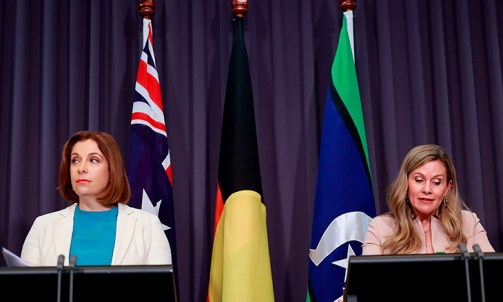
It’s bin night. Our local council is so broke, we have no green bin collection. They could afford drag queen story time at our local library and they have an Aboriginal flag that is bigger than the Australian flag for Australia Day. But that’s another story. For the first time ever, our tiny landfill bin had some space left in it. I had to think quick to see what I could discard in this rare bit of space.
Then it hit me. I have so many books they are becoming unmanageable. Even though the majority of them are covered with proper library contact film, classified using the Dewey Decimal System.
Needing some room, I noticed old textbooks. Books on femocrats and state feminism, green politics, Richard White’s Inventing Australia, endless volumes on colonisation and Aboriginal affairs. Books I thought I might use one day to learn the ways of my enemies. Books that collect dust and take up space I desperately need for my study and my mind.
It’s not spring, so it wasn’t spring cleaning. It was pure catharsis.
Books that had nested, for decades, in our collective ears and then our minds. Book after book went into the bin, and with it the pre-Wokerati nonsense that was dominating my study and holding not only too much dust, but too much nonsense.
Some might say the real colonial occupation in Western liberal democracies is not the one the textbooks denounce, but the ideological one they themselves carried. Ngũgĩ wa Thiong’o coined the phrase in a very different context. The irony is that the phrase now travels more easily in the opposite direction.
From the late 1970s and 1980s, imported theoretical apparatuses such as postcolonial theory, applied postmodernism, and critical approaches to identity, established themselves inside Australian universities and then cascaded into teacher training, curricula, and public discourse.
Much of it arrived via French high theory in the late 1970s and 1980s. Thatcher was alert to the broader cultural and educational dangers of the time. Australian universities largely were not.
The scholars Pluckrose and Lindsay demonstrated how French high theory hardened into ‘applied postmodernism’ and then into a reified social justice orthodoxy. This orthodoxy treats knowledge primarily as a product of power, Western reason as inherently colonial, and the individual as a mere node of identity categories. In the Australian context this produced the familiar suite of texts that pathologised settlement, national identity, and liberal institutions while elevating grievance as the central analytic category.
The ‘colony’ is therefore not a metaphor for historical empire. It is the self-reproducing educational and bureaucratic system that installs one particular, highly contested worldview as the default moral and intellectual frame.
In actual post-colonial societies, the language of decolonisation has a concrete political meaning. The evolution of the British Empire into the Commonwealth of Nations is a case in point. There are not many Commonwealth countries rushing away from this legacy.
But when the idea of colonisation is transplanted into Western liberal democracies, it becomes something else. It demands a purge of the Enlightenment inheritance itself. Universalism, evidence, the possibility of knowledge independent of the knower’s identity, and the individual as the best authority to look after their own welfare are all overturned. The goal is a form of identity-based collectivism that subordinates the individual to group grievance.
Knowledge is no longer something that one develops through the scientific method combined with a child-like sense of curiosity. Children under five constantly ask ‘why?’ because curiosity is a fundamental aspect of human knowledge development.
But the Woke Colony of the Mind racialises knowledge. It treats the Enlightenment tradition as having a permanent ‘white essence’. It demands a transformation of consciousness rather than the tried and tested scientific methods that brought us out of thinking that lightning was God’s punishment for our sins to the point where electricity became God’s gift to keep us alive.
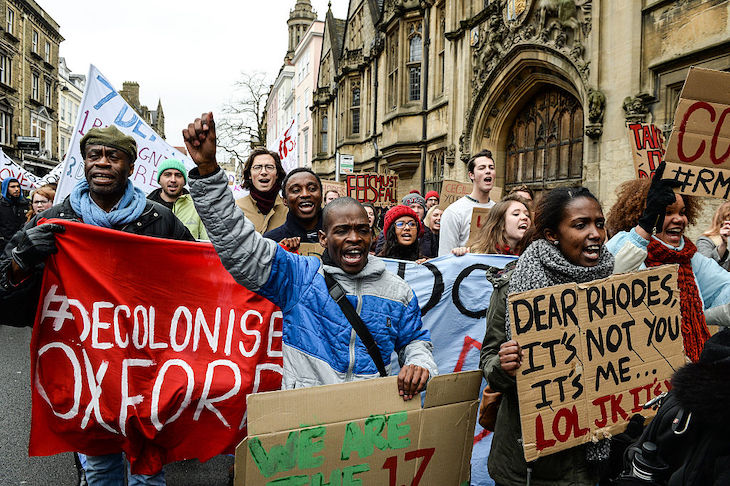
The decolonise-the-curriculum campaign re-racialises knowledge in a regressive way. It replaces the hard-won ideal of evaluating ideas by their content with crude judgements of the author’s group identity. The result is not liberation of the mind but a new orthodoxy that polices what may be thought and said. The alien colony is the one that insists every Australian student must first confess the original sin of settlement before they are permitted to think about anything else.
The occurrence of such apologies for whiteness and even maleness has been reported widely. I’ve seen things in the same vein occur routinely in the academy.
White’s Inventing Australia trained generations to treat national identity as mere invention in the service of power. The ‘black-armband’ framing (to use Geoffrey Blainey’s term) and the subsequent scholarly battles, including Keith Windschuttle’s evidentiary challenges, show how contested historical claims hardened into institutional dogma.
Femocratic literature and green-politics texts performed parallel work in other domains. They naturalised particular bureaucratic and activist projects as the only morally serious positions. The cumulative effect is an education system that produces citizens and public servants fluent in the language of permanent colonial guilt and comparatively ill-equipped for evidence-based argument about practical policy.
Correlation may not be causation, but you’ll never know because the same orthodoxy shapes what is considered legitimate research. That would require admitting the Wokerati are completely wrong.
It’s time you decolonised your mind. The physical act of throwing Woke artifacts into the bin is only the beginning.
Real decolonisation of the mind means recovering the liberal tools the contemporary orthodoxy has dismissed. We need to revisit the capacity to judge claims by evidence rather than identity, the willingness to treat Western achievements as human achievements rather than original sins, and the confidence that a free society can examine its past without being required to despise its inheritance.
The colony that nested in the ear and the mind is not the British one, it is the theoretical one that arrived later and declared itself the sole legitimate interpreter of everything that came before.
If you want to help the real decolonising project, throw it out. You won’t regret it.
Dr Michael de Percy @FlaneurPolitiq is the Spectator Australia’s Canberra Press Gallery Correspondent. If you would like to support his writing, or read more of Michael, please visit his website.