One Nation’s rise in the polls has prompted greater scrutiny of its policies. One common claim is that its plans to lower immigration will harm Australia’s economy. This idea is largely based on a misplaced focus on total GDP instead of GDP per person.
The Parliamentary Budget Office’s interactive model is often used to assess party policies. It shows that higher immigration boosts total GDP. It also shows that immigration – whether it is high or low – barely impacts GDP per person.
Australian voters should be aware of this distinction.
An example of this extra scrutiny was an in-depth analysis of One Nation’s immigration plans published last Friday in the Australian Financial Review. Using the PBO’s model, this analysis showed that the cuts in migration One Nation hopes to achieve would ‘shrink’ Australia’s economy by about 10 per cent by 2036-37, relative to where it would otherwise be under the Albanese government’s migration forecasts.
That is correct, but it is not the full story.
The PBO model does indeed show that the more people Australia adds to its population via immigration, the bigger the economy gets. More people equals more GDP. This is like using more ingredients to bake a bigger cake.
But that does not increase GDP per person. The cake gets bigger when you add ingredients to it, but the number of people who take a slice also gets bigger. That means the size of the average slice stays the same.
To improve living standards for Australians – to make the average slice bigger – the PBO model is very clear about what economic variable needs to change: productivity growth. If productivity growth does not change, it does not matter what the level of immigration is – GDP per person will stay basically the same.
This will be a very frequent attack line against One Nation: ‘Independent analysis shows lower immigration will shrink the economy.’ Australian voters need to look past the talking point and understand clearly what the economic model that underpins that analysis actually shows about the impact of immigration.
Lower immigration does not reduce GDP per person.
The AFR Analysis Is Correct but Incomplete
The AFR article begins with an extended discussion of the logistical challenges One Nation would face in lowering immigration. It then quotes an unnamed One Nation spokesman as saying that its policies would likely result in net overseas migration (NOM) of negative 100,000 each year.
The key quote in the article is as follows:
‘According to the Parliamentary Budget Office, net migration of negative 100,000 would cause population to flatline at 28 million and shrink the economy by 10 per cent after 10 years. (Labor’s budget forecasts the population to increase by 3.3 million in 10 years’ time.)’
The AFR article does not explain its methodology in detail, but its findings seem to be based on plugging the One Nation NOM numbers into the PBO model starting in 2027-28. The results are then compared with the baseline given by Labor’s NOM numbers in the Budget Papers. That baseline assumes NOM will average 232,000 per year over the 10-year period.
There are two key points to note.
First, the ‘shrinking’ in Australia’s economy is not from its current level. The economy under One Nation’s lower NOM numbers would still be much bigger in 2036-37 than it is now but would be smaller than it would be under Labor’s NOM numbers. By ‘shrink’ the article means a smaller increase, not an absolute decline. It could just as easily say Labor would ‘shrink’ the economy relative to some hypothetical party that wanted even higher immigration.
Second, this gap in total GDP does not mean that existing Australians would be any worse off under One Nation. The only reason total GDP under One Nation’s NOM numbers would be about 10 per cent lower than it would be under Labor’s NOM numbers is because Australia’s total population would also be about 10 per cent lower.
Total GDP and population both rise or fall in the PBO model when you adjust immigration higher or lower. GDP per person barely moves.
You can confirm this by checking out the PBO’s interactive model. That’s what I did.
Immigration Barely Impacts GDP Per Person in the PBO Model
The model is very user-friendly. You download a spreadsheet from the PBO website and there is a sheet that allows you to make changes to various parameters relative to what officials have assumed in the Budget Papers. When you do that, the model gives you GDP and population numbers that you can then compare with the baseline. That also allows you to calculate GDP per person.
I compared five scenarios, including the baseline. This was done by adjusting the NOM numbers for ten years, starting from next financial year, 2027-28. The scenarios are Low Migration, One Nation, Zero NOM, Labor, and High Migration. When you compare total GDP, population, and GDP per person under these five scenarios, the chart looks as follows.
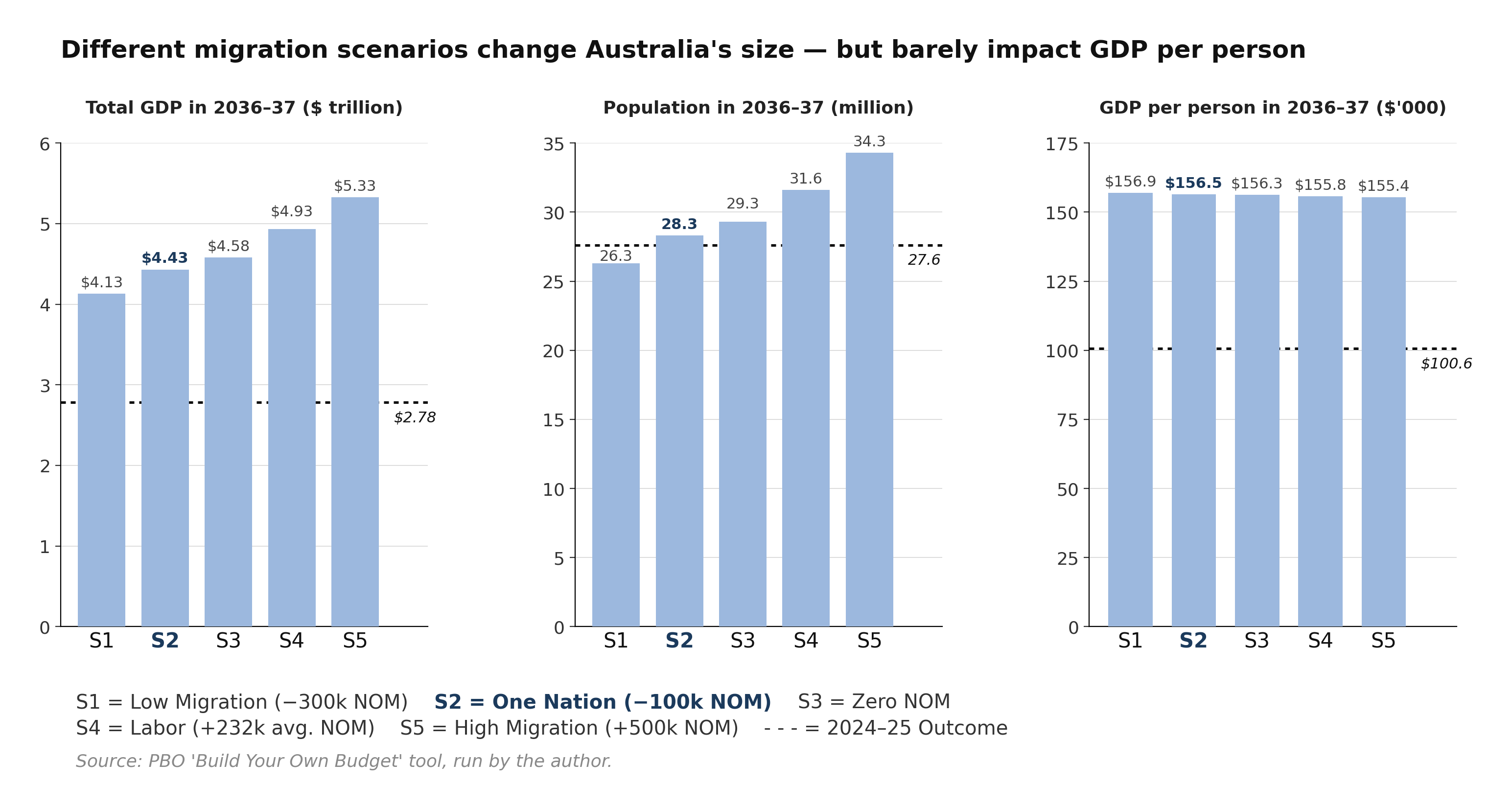
When people say that increasing immigration boosts GDP, that is usually correct. It boosts total GDP. The economy gets bigger because there are more people added to it. But this chart shows that the impact on GDP per person is very small.
The first panel shows that total GDP increases very substantially in every scenario. And the higher NOM is assumed to be, the higher total GDP will be in 2036-37. Under One Nation, it would increase to $4.43 trillion. Under Labor, it would increase to $4.93 trillion. That gap is the 10 per cent ‘shrink’ identified in the AFR article.
The second panel shows why this gap exists. Total GDP is higher when NOM increases because the population is higher. Under One Nation’s NOM numbers, Australia’s population would increase by about 3 per cent to 28.3 million in 2036-37, via natural increase. Under Labor’s NOM numbers, it would increase by about 15 per cent to 31.6 million, mainly via immigration.
The third panel shows that GDP per person is very similar across each scenario, no matter how high or low immigration is assumed to be. Labor’s NOM numbers deliver a bigger population and a bigger economy. However, they do not deliver bigger GDP per person.
This chart confirms that the attack line is, strictly speaking, accurate – One Nation’s immigration policy is, all else being equal, likely to lead to a lower total GDP in the future than Labor’s. It is my position that the attack line is misleading, because lower total GDP will not make Australians any worse off in terms of GDP per person. In the PBO model, it is productivity growth, not immigration or population size, that mainly determines Australians’ living standards.
That is the debate we should be having.
Let’s Focus on the Slice
It is very easy to increase the size of an economy by adding more people to it. And that is exactly what the Albanese government has done since it took office in mid-2022. Over this period, Australia’s population has increased by about 7 per cent, with inflation-adjusted total GDP increasing by a similar amount. That means inflation-adjusted GDP per person is about the same as it was when Albanese took office.
This is the problem with using total GDP as the key metric of economic performance – it measures the size of the cake, not the size of the slice. That says very little about living standards for the average Australian.
As One Nation’s policies come under greater scrutiny, its opponents and critics will likely focus on total GDP. They will try to convince voters that this metric should be used to assess the economic impact of policies. And many of them will likely cite the PBO model when they do this.
However, the PBO model is very clear. Higher immigration makes total GDP bigger, but not GDP per person. Australian voters can choose any feasible level of immigration – high, low, somewhere in between – and GDP per person will be basically the same.
Productivity is what determines GDP per person. Increasing productivity growth should be the focus, because that is what we need to do to make the average slice of the cake bigger.
Productivity growth depends on many factors, and the size and composition of our immigration intake are among those factors. The empirical evidence is mixed, but the experience of recent years certainly does not indicate that high levels of immigration are improving productivity growth in Australia.
Australian voters will be subjected to a scare campaign that says One Nation’s plans to lower immigration will damage the economy and make them poorer. However, the PBO model shows that we can lower immigration to further other objectives – such as easing pressure in the housing market – and still improve our living standards by finding ways to improve productivity.
So, get used to the talking point that ‘One Nation will shrink the economy’. But remember what it actually means – and what it doesn’t. We can vote for lower immigration and higher living standards at the same time.
The author is a registered member of One Nation but does not speak on behalf of the party. All opinions and any errors are his own.