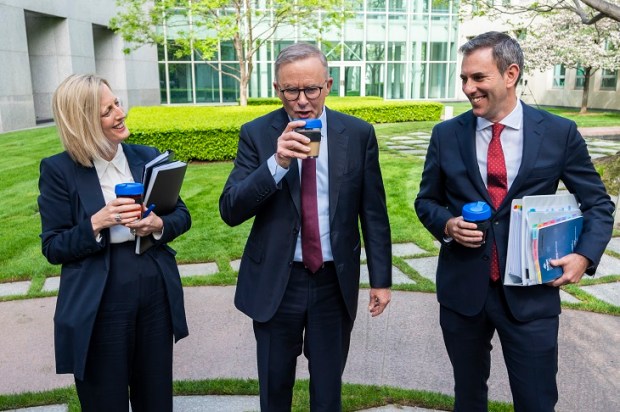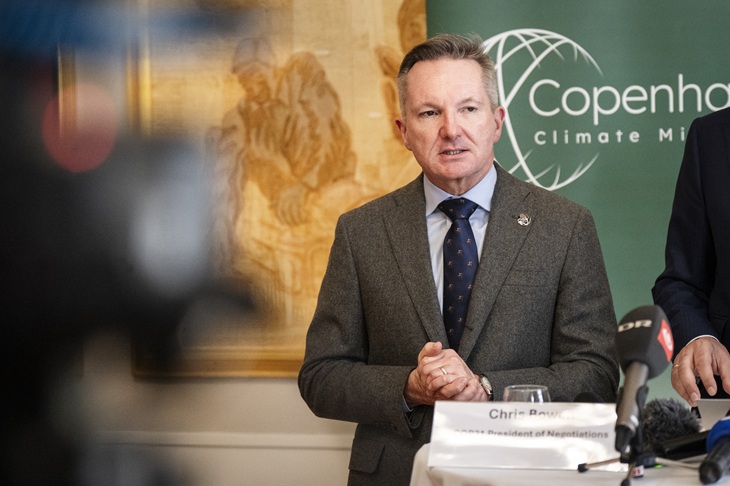
At a climate change conference in Germany in June, Minister for Climate Change and Energy Chris Bowen said, ‘We have to recognise that the world is committed to Net Zero – more than 80 per cent of our trading partners are committed to Net Zero. The world is changing. We can pretend that’s not happening, as some in Australian domestic politics do. Or we can prepare.’
The truth is that we can pretend that a shift to Net Zero is happening, or we can look at the facts.
The much-respected Statistical Review of World Energy, published every year since 1952, was released on June 30, 2026. It shows that while there was a modest growth in energy supply from intermittent renewables of 3.3 exajoules (EJ) in 2025, this was dwarfed by the 6 EJ of new energy supply from coal, oil, and gas. Nuclear provided 0.4 EJ of growth, and hydro just 0.1 EJ of growth.
The Review highlights that ‘Global CO2 emissions from the energy sector rose by 1.1 per cent to 35,806.2 million tonnes of CO2’. So much for Bowen’s claim that the world is changing. In fact, for all the money thrown at intermittent renewable energy – good after bad – consumption of coal, oil, and gas is high and rising.
Indeed, according to the Review, ‘Fossil fuels continued to expand in absolute terms and retained their dominant position, accounting for 86 per cent of TES [total energy supply].’
Australia’s total energy-related carbon emissions were 374.3 million tonnes, or 1 per cent of the global total. China’s emissions were 30-times greater than Australia’s, meaning that if Australia somehow drove emissions to zero, China would undo that in just 12 days.
Returning to Bowen’s comments in Germany, he was effusive about the role that Australia could play as a Global Renewable Superpower and Green Export Extraordinaire.
‘You can export green hydrogen, you can export electrons through cables, you can make things with that renewable energy, you can export green gigabytes, green artificial intelligence. You can have datacentres in Australia and export the AI to countries that maybe can’t do that,’ Bowen said.
Green hydrogen was all the rage among the Net Zero crowd, until it turned out it is not viable and major mining companies either cancelled or indefinitely delayed investments in the technology. More than half of the hydrogen projects monitored by the CSIRO have been ‘archived’.
So, the new craze is to talk about green-powered AI and data centres. But the countries that are leading the AI race, China and the United States, have not imposed the kind of anti-energy policies Australia has in an effort to cut carbon emissions.
US energy supply increased 2 per cent in 2025, driven mostly by burning more coal, but by increasing all kinds of energy. In China, energy supply was up 2.1 per cent, about half of which came from intermittent renewables and half from oil, gas, nuclear, and hydro.
Bowen is right that the world is changing. Just not in the way he would like. Net Zero increasingly appears to be a policy relic from the pre-pandemic era, and countries which are trying to grow their economies are embracing all kinds of energy, no matter how many carbon emissions they produce.
Cian Hussey is a Research Fellow at the Institute of Public Affairs and writes No Permanent Solutions on Substack.