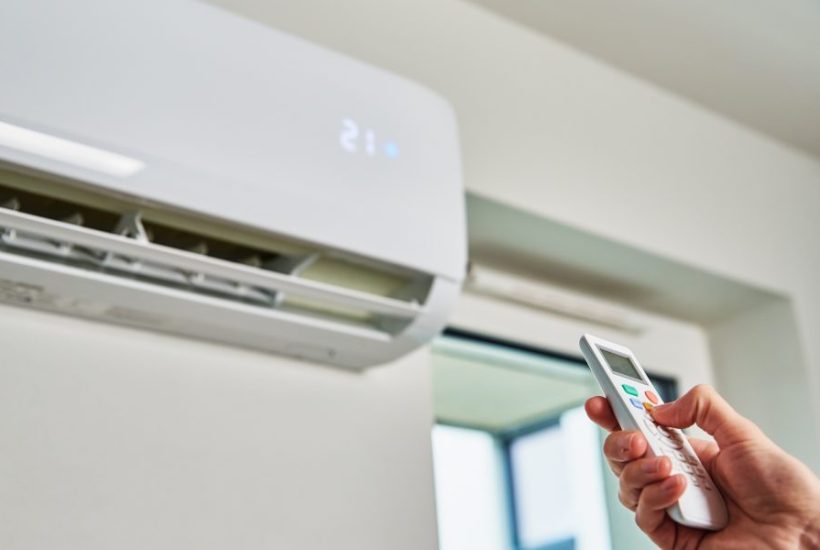
The Met Office has extended the heat warning as the heatwave continues into its fourth day – and yesterday saw a new record temperature for June, with a high of 35.7C recorded in Surrey. With a hot summer ahead, and more to come in the years ahead, surely air conditioning is an easy solution to keeping cool?
Apparently not, according to sustainability professor Lucelia Rodrigues, who told Channel 4 News that we can’t ‘air-condition our way out of the heatwave’. Her main reasons are the effects on the climate (because ‘we also often use fossil fuels to pump the air conditioning’) and the possible heating effect on the surrounding environment, which could make it perhaps ‘some ten, twelve degrees higher than when you don’t have air conditioning.’ We should instead focus on improving infrastructure and ‘designing for the future’. But how accurate are these claims?
The Climate Change Committee’s citizens’ panel says that air conditioning can be a useful ‘quick fix’, and that, in future, almost a quarter of homes will need some form of cooling. The UK has one of the oldest housing stocks in the world, with three-quarters of houses built before 1980 and two in five built before 1946. So when Professor Rodrigues says that British infrastructure was not built with cooling in mind, she is correct.
Even Zack Polanski and the Green Party are in favour of aircon
Needless to say, the risks of heatwaves are severe, particularly for older people. Globally, heat-related mortality among the over-65s has increased by 85 per cent since 2000, but aircon can cut heat-related deaths by as much as 75 per cent. Much of Europe, North America and Asia have been installing aircon in record numbers, and even the UK is catching up: it’s now in 4 million homes, double what it was three years ago.
With such risks in mind, even Zack Polanski and the Green Party are in favour of aircon, euphemistically calling for ‘cooling measures’ in ‘schools, hospitals and care homes’. The left-leaning IPPR thinktank, meanwhile, believes such measures ‘will both protect communities and strengthen public confidence in climate action.’ Whether they’ll extend that logic to people’s homes is another matter.
The claim that mass adoption of aircon could raise air temperatures in urban areas by as much as twelve degrees is incorrect. Most studies say the temperature rises are around 0.5-1.2 degrees Celsius, nowhere near as high as twelve. If that were true, the outdoor temperatures of Mediterranean or most US cities would be almost unliveable in summer.
So if we can’t use air conditioning, what’s the solution? Well, Professor Rodrigues tells us to use heat-management strategies such as ‘closing your windows’ during the day or ‘putting shutters on your houses’. And if you don’t have shutters, then use ‘the cardboard box from your front room and actually block the sun from coming into your house’. No air conditioning to make the summer comfortable – just cover your windows with bits of cardboard, pretend it’s the Blitz, and wait for the whole thing to blow over with a glass of iced tea.