You don’t have to tell me that most politicians and policymakers are out of touch with small businesses in regional Australia.
I know it for a fact.
This week, Labor’s policies created a Catch-22 for the people who hold regional communities together. For me, this time it’s personal.
Small business cafés in the regions are being forced to choose between two bad options. They can absorb the rising costs of running a business and keep providing the social glue that governments never fund. Or they can pass those costs on to customers who are already stretched, watch their trade collapse, and lose the very community role that makes the business viable in the first place.
Either way, the social fabric frays and the business is weakened. That is the bind Labor’s cost-of-living settings have created for regional Australia.
I saw it up close this week when I answered a call for staff at my local café. The owner is one of those quiet community stalwarts who keeps our RSL Chapter going on Anzac Day, hosts mothers’ groups, gives tradies somewhere to grab a pie, and lets the place act as an unofficial town hall.
She has kept the price of a medium coffee at $5 since 2020. Everything else has gone up: wages, rent, fuel, and coffee. The price on the board has not. That decision is not just good business. It is a deliberate choice to keep serving the town rather than pricing half of it out.
During the Great Depression, people turned their hands to whatever work they could get. The contemporary equivalent is the number of people reskilling or upskilling just to stay employable. In the time of the Luddites, steam power displaced manual labour. In its extreme form, the overuse of machinery contributed to the Great Dust Bowl.
The same pattern is playing out today with AI, except this time it is hitting the credentialed classes. I’m glad I left academia before I had to mark essays written by students who had outsourced the hard yards to ChatGPT.
That is why, after four decades of living in my head, I’ve spent the past year deliberately working in jobs that still require actual presence and skill. I have been driving trucks and buses in regional NSW, and this week I started working as a barista.
Rather than providing the advanced skills Australia needs, our higher education system has generated a class of white-collar workers who are conformist in their radical views while also becoming increasingly self-entitled. Regrettably, that class’s age of entitlement is fast approaching the end of its useful life.
In my own experience, after spending 35 years in the military and academia, the game has changed. For all my faults, I often tell people that the only advice I ever took was to stay in school. About 40 years of it, to be precise. While I believe that has been good for me, I am not so sure that it benefits others in any practical sense.
To be sure, self-driving trucks and buses will eventually arrive. But not yet. In the meantime, I’ve been driving a truck and a big school bus in regional NSW on a casual basis. Drivers are still very much in demand.
But it’s not cheap to get all the necessary licences and checks to do either job. It can bring in about $33-38 per hour for casuals, more on weekends and public holidays. (I remember calculating our actual hourly rate in the Army in the 1990s. It worked out to less than $2 per hour.)
My hourly rates will increase on 1 July because of the Albanese government’s minimum wage increases. That’s when the Catch-22 became personal.
Regional communities are not often the beneficiaries of competition. Competition is great where there is a large market. Providing choice is a luxury that lends itself to inner-city living. In the regions, however, you often take what you can get.
Market failure is a consequence of remote or smaller communities, but governments are less likely to provide the services communities need beyond the usual ambit of public provision. Thankfully, charlatans and carpetbaggers don’t last long in regional communities.
That’s where symbiotic local small businesses kick in.
Earlier this year, I met with One Nation’s Barnaby Joyce. He spoke about the importance of the local pub in regional communities.
Now things have changed. At over $8 a schooner at my local pub, many are turning to the local café as their preferred watering hole. It’s much cheaper to have a $5 coffee than an $8 schooner and you can still drive home if you have more than one.
It’s interesting that working as a barista earns about the same hourly rate as driving a truck. While there is no formal qualification for being a barista, courses cost about $300 and to go next-level with a food safety supervisor’s course costs about another $400 or so. To get a heavy rigid licence costs about $2,000. To drive a school bus will cost a further $400.
It doesn’t make sense to me that it costs a fraction as much to train as a barista as it does to get a heavy rigid licence. Yet both jobs pay roughly the same hourly rate.
But as my boss from the bus company said, ‘Making coffee is an art. Driving a truck or a bus is repetitive. Once you master it, job’s done. Making me a better coffee, however…’
What the Albanese government doesn’t get is that small businesses have a symbiotic relationship with their customers. Both benefit from the exchange, and not just economically. There are social benefits, too.
The real kicker? My boss at the café I now moonlight at as a barista posted on Facebook about how she is dealing with current economic impacts. In 2020, a medium coffee cost $5. In 2026, a medium coffee costs $5.
The café has absorbed wage increases and inflation, rent, transport, milk, and coffee beans that have nearly doubled. It has done so for one reason only.
The café is much more than simply a place where consumers choose to go because they like the coffee. It is a genuine public square.
It is a sanctuary for people who don’t have air conditioning when it’s over 40 degrees or heating when it’s minus 10. It is a place to work when you have no internet. It is a venue for mothers’ playgroups, staff meetings for local bus drivers, lunch for council workers, and somewhere for the butcher, the mechanic, and the shop assistant to grab a quiet moment.
The café is much more than simply a place where consumers choose to go because they like the coffee.
My boss posted so much on Facebook. Frustrated by trying to do the right thing by the community while also making a living. Frustrated by the experts who suggest passing on increased costs to consumers who will lose the ancillary benefits the government is incapable of providing. And wearing all of this on top of the endless stressors that go hand in hand with running a small business.
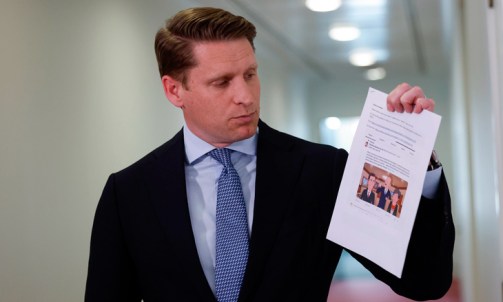
Nationals Leader, Senator Matt Canavan, noticed. He reposted my boss’s Facebook post about the current economic situation and how it is paralysing small businesses in regional Australia. Senator Canavan wrote:
‘This is a stark example of how inflation is putting a wrecking ball through small business and the cost of living.’
This is the Catch-22 in action. Do the right thing by the community and wear the losses yourself or do what the textbooks say and pass on every cost. And slowly dismantle the very places that make regional life workable.
I have asked Senator Canavan for comment on the current impact of the economy on small businesses in regional Australia. Tomorrow I’ll be asking my boss the same question, and I already know her answer will be the same one she has been living for the past six years.
She would rather keep the town’s living room open than put the prices up and watch half the town stay home. Your move, Mr Albanese.
Dr Michael de Percy @FlaneurPolitiq is the Spectator Australia’s Canberra Press Gallery Correspondent. If you would like to support his writing, or read more of Michael, please visit his website.