It’s odd, isn’t it, the uncanny relationship between success and achievement. Just the other night the Melbourne Theatre Company had the opening night of The Glass Menagerie with Alison Whyte in the leading role of Amanda, the mother besotted with the idea of finding a gentleman caller for her slightly lame daughter Laura and the whole action is narrated by Tom, the Tennessee figure who spends his nights going to the movies.
Tennessee Williams is with the Arthur Miller of Death of a Salesman and The Crucible the major playwright to follow in the wake of Eugene O’Neill. But his career is all too short in terms of hit plays. It begins with Menagerie in 1945 and it effectively ends with The Night of the Iguana done on Broadway by Bette Davis in 1961 and filmed in 1964 by John Huston with Ava Gardner, Richard Burton and Deborah Kerr. But Iguana is a terminus. It was followed by The Milk Train Doesn’t Stop Here Anymore which was filmed with Burton and Elizabeth Taylor by Joseph Losey as Boom! which bombed terribly and not only ended its stars’ ability to make anything decent but put a stop to Tennessee Williams’ magic success rate. When Zoe Caldwell opened in his next play – The Mutilated – it played only seven performances.
A playwright is only as good as the director who enables the play to come alive.
This was true with The Glass Menagerie and it was true with bells on of A Streetcar Named Desire in 1947, directed by Elia Kazan, first with Jessica Tandy and then on screen with Vivien Leigh – and it continued with Cat on a Hot Tin Roof with Paul Newman, Elizabeth Taylor, Burl Ives and Dame Judith Anderson. It may be less true with The Fugitive Kind (Orpheus Descending) and The Rose Tattoo but all the Tennessee Williams plays of his maturity are classics with a high place in the dramatic canon. That’s true of Sweet Bird of Youth filmed with Newman and Geraldine Page and it’s true of Suddenly, Last Summer filmed with Katharine Hepburn, Elizabeth Taylor and Montgomery Clift (and years later with Maggie Smith and Natasha Richardson).
A horror of Williams’ life was the fact that his sister had a lobotomy: it’s in the background of the isolation of Laurie with her glass animals in Menagerie and it is explicit in Suddenly, Last Summer.
But classic Tennessee Williams is part of us. On the Australian stage we have seen Kate Cherry direct Gillian Jones as Amanda in The Glass Menagerie with Pia Miranda as Laura and Ben Mendelsohn as a peerless Tom, the Tennessee self-portrait. Pamela Rabe did it at the Malthouse with Rose Riley as an unusually receptive Laura.
In the filmed Menagerie Katharine Hepburn is like Hecuba in Euripides’ The Trojan Women as she contemplates the ruination of her hopes – and Sam Waterson as the narrator Tom and Joanna Miles as Laura rise to meet her.
Cherry directed Sigrid Thornton in a Perth Black Swan Streetcar which was more flamingly alive than the very grand anthology of Blanches which Cate Blanchett created for the Sydney Theatre Company’s Streetcar directed by the great Liv Ullmann.
On the London stage in 2005 Jessica Lange as Amanda in The Glass Menagerie was a somewhat cold incarnation.
On the other hand the 2003 Broadway Cat on a Hot Tin Roof with Ashley Judd as Maggie and Jason Patric as Brick was superb with Ned Beatty as Big Daddy and Margo Martindale as Big Momma. The production by Anthony Page originally had Frances O’Connor as Maggie. There’s also the TV Cat on a Hot Tin Roof with Natalie Wood, Robert Wagner and Laurence Olivier as Big Daddy.
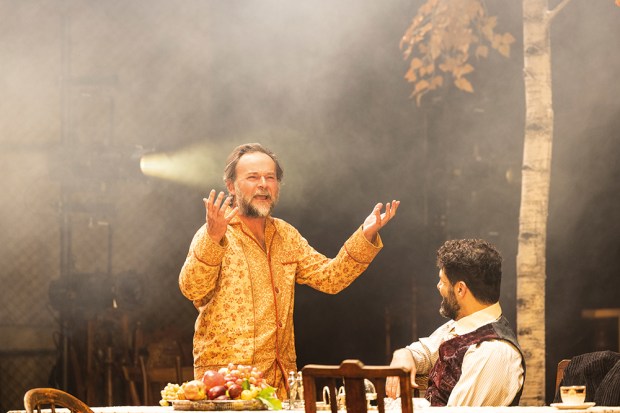
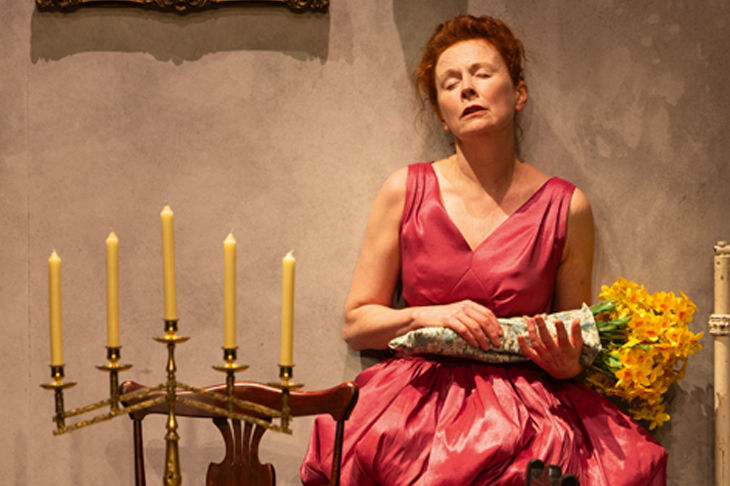
The production of The Glass Menagerie at the Melbourne Theatre Company’s Southbank Theatre is full of life and great thrilling riffs of emotion which should captivate all comers. It is overwhelmingly dominated by Alison Whyte’s Amanda and she milks to the hilt the predicament of a woman who sees her daughter’s physical disability as a potential tragedy only awaiting its full crucifying horror. It’s a performance of self-battering intensity and it dominates and transfigures everyone it touches. Alison Whyte is full of honeyed Southern charm and the ability to see hope – that desperate thing as the Greeks divined – in every happenstance.
It’s a magnificent mountainous performance and in its singular overpowering strength it turns this production of The Glass Menagerie into so many shape-changing dragons in the mirror of worldly salvation and it’s awful because of the ruined life Amanda refuses to accept as she wrangles with her son and drowns her daughter in the poison of pity.
It’s Alison Whyte’s swan song and it is the performance of her career. Everyone should see it for the range of its tone colours and its capacity to insinuate the abyss of pain – to the self and others – that a mother’s love can encompass.
Tim Draxl’s opening speech as Tom is from the front stalls an immensity of booming language which could be pulled back a little in the interests of subtlety and there are aspects of the direction which are a little bit misjudged. When the play becomes candlelit it gets a bit dim for dramatic coherence and the elaborate gowns which Amanda and Laura don are far too over the top even for St. Louis in the 1930s.
On the other hand, Harry McGee as Jim the Irish Catholic gentleman caller lifts the show and gives it a worldly reality.
You can argue that Millie Donaldson’s Laura should be a bit less ordinary and passive but there’s a poignancy in her ordinariness and the way she is swallowed by her situation.
It’s a thing of wonder to revisit Tennessee Williams’ ability to turn everyday language into a contemporary poetic idiom. The crypto-suitor knew Laura as ‘blue roses’. This comes from the same dramatic idiom as the phrase ‘gentleman caller’. They are each beautifully sculpted phrases from the man who taught us how sinister the kindness of strangers could be.
Got something to add? Join the discussion and comment below.
You might disagree with half of it, but you’ll enjoy reading all of it. Try your first month for free, then just $2 a week for the remainder of your first year.