Yasmina Reza is one of the most dazzling playwrights alive because she creates sweepingly funny bits of theatre (masterfully translated from the French by Christopher Hampton) which have audiences shrieking with laughter while also confronting them with potential self-portraits which the widest range of actors don like gloves. It can be said of Yasmina Reza’s work – as it was said of Il trovatore – that all you need is a handful of the greatest performers on earth. Well, Art has that unambiguously in the person of Richard Roxburgh.
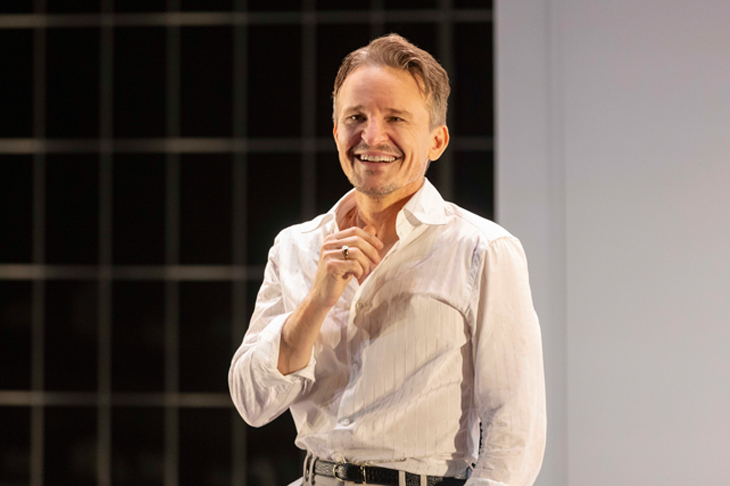
Richard Roxburgh plays Marc who is appalled when his close friend Serge (Damon Herriman) buys a plain white painting for 160,000 euros. Herriman defends his aesthetic decision with moody self-possession. Toby Schmitz plays Yvan who expresses tolerance for Serge’s exorbitant choice but is himself going to pieces because of the details of his oncoming marriage.
Some people may find Roxburgh’s performance a bit big but that wasn’t the impact from the second row. His Marc is an extraordinary feat of acting, as visually mesmerising as it is verbally assured. He gapes open mouthed at the folly he beholds, he writhes, he groans, he mocks and attempts to retract or at any rate modify his position but collapses in a quivering heap of beleaguered self-regard. Only a great actor could achieve the precision of the self-portraiture with the besotted lunacy and blind intensity. Roxburgh’s Marc makes the character a yo-yo from which he can negotiate the aspects of a self which is wildly out of control but the contradictions are absolutely inhabited by the breadth of the characterisation.
If you look at many actors who have done Art you find that they exhibit a range of typologies as various as a succession of Hamlets, as if each of the roles was a mirror for any histrionic persona.
Lee Lewis directs with a sense of the way the play can lunge and lurch but without dramatic or dramaturgic subtlety.
Damon Herriman, who plays Serge, the buyer of the painting, rarely exhibits the paroxysms of confusion the play invites. Herriman played Charles Manson in Tarantino’s Once Upon a Time in Hollywood but he doesn’t exactly sound the depths of his character. This is not to deny the skill of the characterisation but the trick with Yasmina Reza is to go deep and go hysterical so that the performance becomes a tour de force of self-discovery, a marshalling of the confetti of madness in which the text is never allowed to sound trite or neat. Roxburgh stops this from happening because his sense of the comedy is so rich and consistently surprising whereas Herriman is a bit too keen on being rational in a piece of drama that falls back on desperation.
Mercifully, this doesn’t happen with Toby Schmitz as Yvan who allows the pathos of his marriage hassle – not to mention what is happening to the three friends – to consume him in a cloud of utter bewildered poignancy. This is a very brave performance, nakedly at sea and with an innocent desperation that wrings the heart. It is a risk-ridden performance of some immensity: boyish, even babyish, and it takes this play of walking shadows somewhere else and Art is richer for the way Toby Schmitz turns it on its head. It’s worth adding that Art had the first-night audience absolutely in its grip and they howled with ecstatic pleasure as soon as the jokes started rolling.
Yasmina Reza is a farceur of a ravishing kind with a vast intellectual armature which she uses as a set of catchcries which the audience is delighted to decry.
David Malouf who died on 22 April was a writer of extraordinary grace and brilliance and a man of great kindness and intellectual verve. I remember the pure pleasure of reading Johnno the first of his works of fiction and gasping at the elegance and the formal intensity with which the Brisbane of the author’s childhood was evoked and the subtlety and the cunning with which his school-friend is recreated. Johnno calls him Dante and there is an aside in which he acknowledges the princely magnetism of the narrator who seems to have an affinity with Nick in Gatsby. I don’t know of a finer novella to come out of Australia. But David Malouf could do everything. In marked contrast to Johnno there’s An Imaginary Life, the story of Ovid and the wolf boy, an extraordinary exotic prose poem of a book that will bear comparison with Thomas Mann’s Death in Venice or Gide’s Strait is the Gate. I once had to lecture a group of university engineers on An Imaginary Life which was their obligatory cultural subject. I went fast, I went slow, I played every pedagogical trick to stop them rioting as they muttered vis-à-vis both the protagonist and the author in their assigned essay, ‘So, is he gay or what?’
David Malouf could conjure the stars. He wrote some of the greatest short stories in the history of this country. Try ‘Mrs Porter and the Rock’ if you want to see what fiction can achieve in the hands of a master. He wrote Harland’s Half Acre with its portrait of the artist, he wrote the brilliant novella about a cultivated Italian terrorist, Child’s Play.
David Malouf was a fine poet and a consummate critic. He reviewed Scripsi, which I edited with Michael Heyward, with a supple intensity. He also wrote criticism for it: a superb review of Terence Kilmartin’s version of Moncrieff’s Proust, a piece about Patrick White’s memoir Flaws in the Glass.
Peter Porter, the poet and fellow Queenslander, used to say Malouf was a genuinely cultivated Australian writer who knew his music and knew his languages. His Boyer Lectures emphasised the glory of the provincial city, and his Quarterly Essay explored how the link with the Timorese and the people of New Guinea was sacred because of the bonds of war. No other Australian writer had a more supple view of the imagination as the way we manage the world. I loved the way he brooded with wonder about the fact that there was no known source for Shakespeare’s A Midsummer Night’s Dream.
The day after he died I looked at Ransom, his restatement of Priam’s meeting with Achilles in The Iliad and was struck by how much David had wound his own dream round Homer’s.
Got something to add? Join the discussion and comment below.
You might disagree with half of it, but you’ll enjoy reading all of it. Try your first month for free, then just $2 a week for the remainder of your first year.