There is a seductive new idea doing the rounds on the political right. And like most seductive ideas, it should be treated with suspicion.
National conservatism offers conservatives something they once resisted. It gives permission to do what the left has long done: intervene in markets, pick winners, and direct capital while claiming the moral high ground. Economic nationalism rebranded as sovereignty.
The argument has surface appeal. Globalisation has produced winners and losers. Supply chains have proven fragile. China presents real strategic risks. From this comes a familiar prescription. Governments should subsidise domestic industry, steer investment into favoured sectors, and shield those sectors from foreign competition.
We are told this is not protectionism of old, but a modern, targeted, and strategic approach. It is none of those things. It is a familiar mistake dressed up in contemporary language.
The historical parallel is not exact, but the mechanism is well known. Juan Perón’s Argentina fused nationalism with state control over industry. Domestic firms were protected, foreign capital restricted, and policy framed as national renewal. Argentina began as one of the richest countries in the world, with living standards comparable to advanced economies. It ended up poorer, less productive and more politically distorted.
Capital was allocated not by markets, but by governments pursuing ideological and electoral goals. The result was stagnation, repeated crises, and a steady erosion of economic capacity.
Australia has seen a milder version of this experiment. The post-war settlement rested on a simple bargain. High wages were supported by high tariff barriers. Domestic industries were protected and expected to deliver prosperity. By the 1970s, the model was breaking down. Inflation rose, productivity stalled, and external shocks exposed deep weaknesses. What had once appeared stable was revealed to be fragile and unsustainable.
Recovery came not from doubling down on protection, but from dismantling it. Trade liberalisation, financial deregulation, and the floating of the dollar reshaped the economy.
These reforms were politically difficult and widely opposed. They worked nonetheless. Living standards rose because Australia opened itself to competition, allowing capital and labour to move toward more productive uses.
That lesson is now being forgotten. Under the banner of resilience and national security, governments are once again attempting to direct economic outcomes. The Albanese government’s ‘Future Made in Australia’ programme is the clearest example. It identifies preferred sectors such as renewable hydrogen, critical minerals processing, green metals, and low-carbon fuels, and directs public resources toward them.
There is a narrow case for intervention. Australia sits in critical mineral supply chains, and dependence on a single dominant trading partner carries risks. In a world of geopolitical tension, some diversification may be justified.
But that is not what is being proposed.
What we are seeing is a broad industrial policy built on speculative bets. Hydrogen remains uneconomic in most applications without heavy subsidy, and its commercial future is uncertain. Other targeted industries depend on uncertain technologies, volatile demand, and policy settings that may not survive the next election cycle. To present these sectors as matters of immediate necessity is not serious analysis but rather political marketing.
The politics are central. Programmes of this kind attract organised interests. Firms and industries that stand to benefit mobilise quickly, while taxpayers do not. Public money is directed toward sectors that align with fashionable priorities and well-connected constituencies, while the costs are dispersed and largely opaque. Nation-building becomes a convenient label for redistributing resources to those with the loudest voices.
Once governments assume the role of picking winners, the logic shifts. The question is no longer whether intervention is justified, but who should receive it and for how long. That is not a conservative principle. It is an invitation to permanent political allocation and rent-seeking.
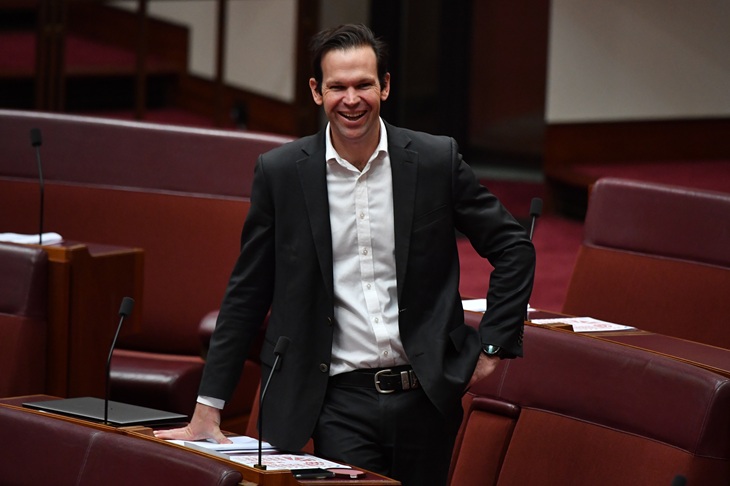
What is most striking is how little resistance this has met on the right. National conservatives have not merely tolerated this shift; many have embraced it. Calls by Matt Canavan for an ‘economic revolution’ echo with calls by Jim Chalmers for ‘values-based capitalism’.
The words may differ, but the premise is the same. Markets should be guided rather than trusted, and outcomes should be shaped rather than discovered.
This convergence should be alarming. When both sides of politics accept that economic outcomes should be managed, the space for genuine market discipline narrows. The risk is not just inefficiency. It is the steady expansion of political control over economic life.
Free markets are often dismissed as ideological slogans. They are nothing of the sort. They reflect a basic fact. When people are free to exchange, prices carry information, competition punishes failure, and resources tend to flow toward their most productive uses. That process is imperfect, but the alternative of political allocation is worse because it replaces dispersed knowledge with central judgment.
None of this means markets are flawless. There are limited cases for intervention. Defence, energy security, and access to critical inputs may justify departures from pure market logic.
The crucial point is that such interventions should remain narrow and clearly defined. What we are seeing instead is the opposite. The threshold for intervention is falling, while its scope is expanding.
The evidence is not ambiguous. Economies that open themselves to trade and competition tend to grow more quickly and sustain higher living standards. Those that attempt to manage outcomes tend to stagnate, often while entrenching privileged interests.
Australia’s prosperity has depended on being on the right side of that divide. It was not inevitable. It was the result of deliberate choices to dismantle protection and embrace openness.
There is an older conservative insight worth recalling. Concentrated power, whether exercised by corporations or governments, is dangerous. Markets disperse that power through voluntary exchange. Industrial policy concentrates it.
National conservatism points firmly in the wrong direction. It promises renewal but delivers control. The rhetoric is patriotic. The mechanism is familiar. And the results, if history is any guide, will be disappointing.
Australia has already abandoned this model once, and it would be a costly error to resurrect it under a more fashionable name. The American polemicist Charles Krauthammer cautioned that decline is a choice. Australia would do well to choose wisely.
Dimitri Burshtein is a Senior Director at Eminence Advisory. Peter Swan AO is professor of finance at the UNSW-Sydney Business School.