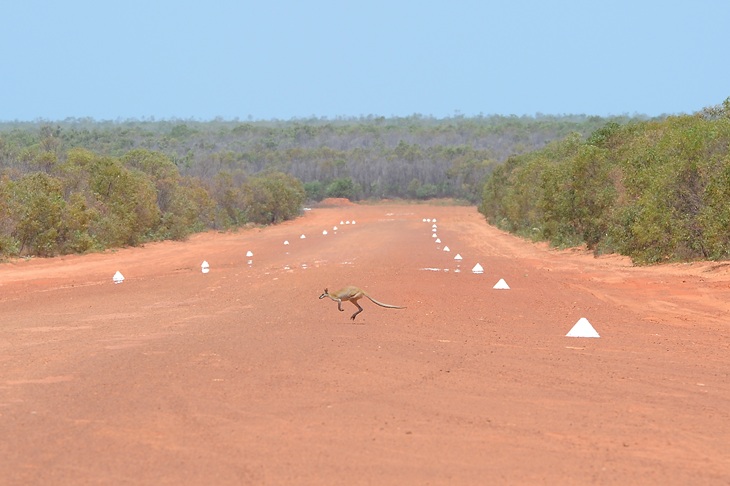
Australia is one of the largest countries on earth, yet most of its population and economic activity are concentrated in a narrow band along the south-eastern coast.
A continent-sized nation, living in a corner of itself.
This is often treated as a simple fact of geography. It is usually explained in terms of climate, distance, or historical settlement patterns. The north is hot, remote, and sparsely populated; the south-east is temperate, established, and economically dense. From this perspective, the distribution of population appears inevitable.
But inevitability is not the same as optimality.
The current pattern reflects history more than strategy. It is the accumulated result of colonial settlement, infrastructure decisions, and economic path dependence. It has never been subjected to sustained national reconsideration in light of Australia’s present position: a wealthy, stable, resource-rich country located at the edge of the Indo-Pacific.
Most nations are constrained by their geography. Australia is not.
Its challenge is different. It is not that the continent lacks usable land, energy, or strategic position. It is that these advantages have not been fully brought into the structure of the national economy.
The constraint is not geography, but how geography is used.
This matters because the costs of the current pattern are becoming increasingly visible. Economic activity concentrated in a small number of coastal cities produces congestion, housing pressure, and infrastructure strain. At the same time, large parts of the continent remain underutilised, not because they are without value, but because they have not been integrated into a coherent national development strategy.
This is not simply an economic inefficiency. It is a structural imbalance.
The underdevelopment of northern and western Australia represents a missed opportunity across multiple dimensions. Economically, it limits growth by failing to expand the frontier of productive activity. Strategically, it leaves Australia less anchored in the region that will define its future. In energy and resources, it separates extraction from higher-value processing and system control.
In effect, Australia operates with a truncated version of its own geography.
The north, in particular, is often framed in negative terms: too far, too hot, too difficult. These are real considerations, but they are not decisive constraints in the modern world. Countries with far more severe limitations – whether in land, climate, or resources – have built complex, high-functioning economies through deliberate strategy.
Australia, by contrast, begins with scale, resources, and stability. The question is not whether development is possible, but why it has not been pursued more systematically.
Part of the answer lies in the absence of a clear national framework for growth.
Australia has, over recent decades, built effective systems for distributing prosperity. Its institutions are stable, its public services are functional, and its social contract is broadly intact. But the same clarity of purpose has not always been applied to the question that precedes distribution: how the economy expands, diversifies, and positions itself over the long term.
Development has followed habit rather than design.
The population has continued to concentrate where it already exists. Infrastructure has reinforced existing centres. Economic activity has clustered in ways that reflect historical patterns rather than forward-looking strategy. The result is a country that manages what it has effectively, but does not consistently extend its economic and strategic footprint.
This is not a failure of capacity. Australia possesses the capital, institutional strength, and technical capability required to act differently.
It is a question of application.
A country that occupies a continent has options that smaller nations do not. It can develop multiple centres of activity. It can distribute risk across geography. It can align its economic structure with its strategic environment. It can build systems that reflect scale rather than inherit constraint.
Australia has begun to do this in limited ways, particularly in the resources sector. But these efforts have not been integrated into a broader national vision. Extraction has often been separated from processing. Regional development has been episodic rather than structural. The north has been treated as an adjunct to the national economy, rather than as a central component of it.
A different approach would begin by recognising that Australia’s geography is not a background condition, but a primary asset.
Northern Australia, in particular, sits closer to the growth centres of Asia than the country’s traditional economic core. It has access to energy resources, solar intensity, and land at scales that are difficult to replicate elsewhere. Properly developed, it could support energy production, industrial activity, logistics, and regional connectivity in ways that complement and extend the existing economy.
This does not require the creation of a single ‘new city’ or the transplantation of population at scale. It requires a more deliberate alignment of infrastructure, industry, and policy to support gradual but sustained development. It requires thinking in terms of systems rather than projects.
Darwin, for example, is already positioned as a northern gateway. Its role could be expanded as a logistics and energy hub, linking Australia more directly to regional flows of goods, fuel, and capital. On the western side, locations such as Broome could serve as anchors for Indian Ocean-facing activity, connecting resources, processing, and export pathways.
These are not speculative ideas. They are logical extensions of geography.
The broader point is that Australia does not lack opportunities for expansion. It lacks a consistent framework for acting on them.
This is where the contrast with other domains of national life becomes relevant.
In areas such as sport, Australia operates with a clear sense of competitive intent. It measures itself against the best, invests with discipline, and seeks to convert advantage into performance. The expectation is not merely to participate, but to compete.
In economic and strategic policy, the same mindset is less consistently applied.
Australia begins from positions of strength – scale, resources, stability – but does not always press those advantages to their full conclusion. It develops incrementally rather than deliberately. It optimises within existing structures rather than reshaping them.
The result is a recurring pattern: strong starting positions, partial conversion.
The geographic imbalance of the country is one expression of that pattern. It reflects not a lack of opportunity, but a lack of sustained strategic focus on how that opportunity should be used.
Australia does not need to discover new advantages. It needs to make fuller use of the ones it already possesses.
A country that occupies a continent should think at continental scale.
That does not mean ignoring constraints or attempting to force development where it is not viable. It means recognising that the current pattern is not the only possible one – and that a more balanced, more distributed, and more strategically aligned use of geography is both achievable and, increasingly, necessary.
Australia has reached a point where its historical settlement pattern and its future strategic environment are no longer perfectly aligned.
The question is whether it is prepared to adjust.
A continent-sized nation should not be content to live in a corner of itself.
Dr Thomas J. Ulahannan is a consultant endocrinologist based in Australia and the author of Britannia Unleashed (published under the name Dr Thomas John). He writes on national development, energy and security.