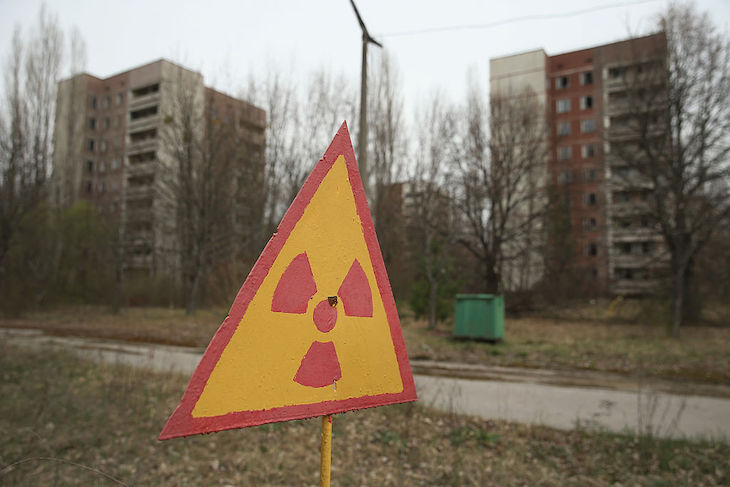
On the morning of the 28 April 1986, a worker at the Forsmark Nuclear Power Plant in Sweden set off the radiation alarm. The bottom of his shoe was contaminated. But the contamination hadn’t come from Forsmark. It had drifted from a reactor 780 miles to the south-east, still burning after it had exploded two days earlier: Unit Four at Chernobyl. The shoe was the first crack in the Soviet Union’s attempt to hide the worst nuclear accident the world has ever seen.
Europe’s coal hangover is one of the great energy-policy failures
Exactly forty years on, how bad was it really?
Thirty people died in the immediate aftermath: two from the explosion itself, the rest from acute radiation exposure. For context, more Brits fall to their deaths at work every year.
Thirty dead is grim, but containable. The fallout, however, settled over the entire northern hemisphere. Even so, the only detectable increase in cancer was that of the thyroid, confined to those who were children or adolescents in 1986 and drank milk contaminated with radioactive iodine-131. Best estimates put the number of deaths at a few hundred. The mythology surrounding Chernobyl might suggest low-level radiation silently poisoned millions of people across Europe. In reality, the damage was done by the Soviet authorities who were too busy attempting a cover-up to warn people about the milk.
So, in all, as many as 500 people died. Every one of them was avoidable, caused by reckless reactor operators and corrupt leadership – and a quirky reactor design – in the dying days of a communist dictatorship. But it wasn’t that bad considering what happened next.
The real fallout from Chernobyl was political. It effectively ended nuclear power expansion in Europe. We connected more reactors to the grid in the four years preceding Chernobyl than we have in the four decades since. Europe’s nuclear reactors – its biggest source of clean power for over 40 years – are almost all relics of the 1970s and 1980s.
For twenty years before Chernobyl, Europe’s nuclear output doubled every four years, from 20 terawatt-hours in 1965 to 638 terawatt-hours by 1985. That’s five doublings in two decades. And then the pace slackened to a crawl. It took until 2004 to reach a peak of 1,035 terawatt-hours, and it’s been falling ever since.
But electricity demand kept growing. Every terawatt-hour not generated by fissioning uranium had to be generated somehow, and we did it the old-fashioned way: by burning things. And burning things – especially coal – causes air pollution, which kills people. Lots of people. Air pollution from coal-fired power stations kills more Europeans every three weeks than Chernobyl will kill ever. On a per-terawatt-hour basis, coal power is over 800 times deadlier than nuclear. Splitting atoms in nuclear power stations is one of the safest things humanity does in the energy generation realm; it’s got the same fatality rate as wind turbines and solar panels.
If European nuclear generation had continued growing at even a quarter of its pre-Chernobyl rate, we’d have had enough electricity to replace every coal-fired terawatt-hour on the continent by 2009. Instead, we continued burning coal for another four decades, killing more than 300,000 people in the process. We continue burning it today. It kills thousands more each year.
We treated a rare nuclear accident as uniquely intolerable, and we quietly accepted the routine carnage of coal. Europe’s coal hangover is one of the great energy-policy failures of modern times: a victory of fear and aesthetics over reason and sound judgement.
Images of the gaping hole in Chernobyl’s Unit Four – like a gate to hell – are far more emotive than invisible air pollution. They make great TV, too (I’ve watched HBO’s Chernobyl mini-series three times). But, in the end, Chernobyl’s true impact was the lives cut short by avoidable air pollution. Fear of nuclear power killed more people than nuclear power ever has.