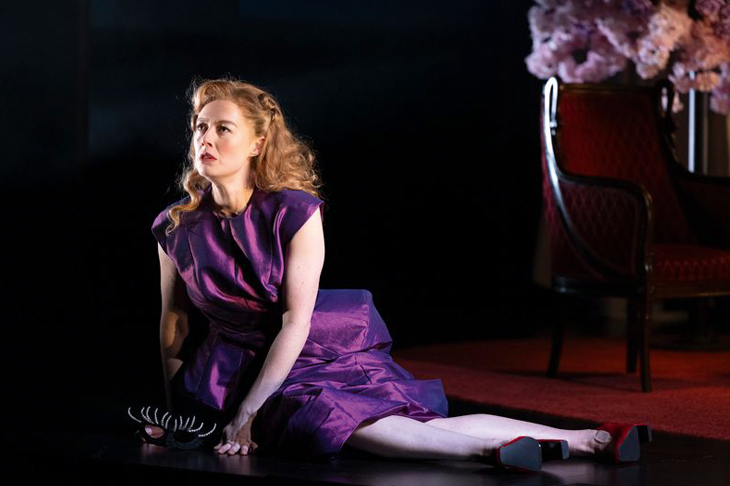
If ever there was gorgeous chocolate-box theatre it’s this magnificently staged production of Daphne Du Maurier’s Rebecca directed by Anne-Louise Sarks as if she were finding a new world in the plot of an old beloved movie and with Nikki Shiels soaring and stunning as the nameless heroine who dreams of Manderley, the grand country house that discloses all her nightmares and romantic dreams. Nikki Shiels has a dazzling authority and magnetism which is at least equal to her counterintuitive Blanche in last year’s Melbourne Theatre Company production of A Streetcar Named Desire and also has the advantage of being much closer to the spirit of the text which Hitchcock turned into a popular legend when he filmed it in 1940 with Joan Fontaine making her screen debut, Laurence Olivier as the haunted Max de Winter and Australia’s Dame Judith Anderson in one of the greatest performances in the history of cinema as the baleful housekeeper Mrs Danvers.
Hitchcock didn’t like to be tied down to a familiar plotline but he had no choice with Rebecca which was not only a bestseller in the dark velvet romance mode of Charlotte Brontë but had also been a stage hit with Celia Johnson – who went on to Brief Encounter – as the heroine.
Anne-Louise Sarks directs with a conscious magniloquence and the set by Tony Award-winner Marg Horwell is extraordinary with a huge egg-shaped mirror duplicating at an inflected distance the close-up intimacies that are transpiring at the front of the stage. The effect is breathtaking and has a sweeping drama that justifies the strategy and stops it from being meretricious.
And the same thing is true of the costumes. We begin with Nikki Shiels in a drab-coloured girly skirt – which is paradoxically very erotic in the way it kindles innocence and the experience that is to come. Before too long we see her mirroring the deep red of the dead Rebecca’s silken garments and miming her snarl and savagery.
This is a production that highlights the womanliness of Du Maurier’s conception. We see Pamela Rabe exhibit the glories of Rebecca’s underwear – from front stage to the echo of the glass dome – and we also get her attempt to get Nikki Shiels to throw herself to her doom.
Nothing can equal Judith Anderson’s deathly sapphic nihilism at this moment but Rabe (who also doubles as other dames: Mrs Van Hopper and Beatrice) remains formidable in this great vaulting character role that starts as a fire that cannot be stopped.
Anne-Louise Sarks takes the central elements of Du Maurier’s story and presents it with an abstract economy: naturalism is honoured in lightning sketches and gestures.
Is this a bit decoratively anthologising? Potentially, but it works. Still, this is Nikki Shiels’ show and she manages to present herself in relation to the Rebecca she dreads and the Rebecca she emulates out of whatever need for extremity. It’s a performance of grace as well as savagery, sumptuous in its beauty and with a concomitant cruelty that bespeaks supreme dramatic range. Nikki Shiels exhibits such versatility in Rebecca that it’s clear she can write her own tickets.
Everything from Shakespearean comedy to Eugene O’Neill is within this actor’s grasp: Cat on a Hot Tin Roof, the Greeks, the whole shebang.
None of which is to say this is a flawless transposition of book and movie (and there is a somewhat different plot twist from the familiar one).
At its edges this Rebecca can sometimes slide into ordinariness. Well, Stephen Phillips as Max de Winter is no Olivier and although he’s fine he lacks the dangerous glamour Du Maurier suggested and Hitchcock and Larry realised.
Nor is Toby Truslove especially effective as the cad played by George Sanders and nor is Pamela Rabe at her best in the Gladys Cooper role of Beatrice.
But if you want a dream/nightmare of a theatre show, assembled like a magical set of greatest dramatic hits – almost like a Meccano set of artfully integrated and vertiginously brilliant moments – the rustle of underwear here, the crackle of fire there – Rebecca will do the trick.
It is a monument to a legendary bit of popular culture and it is true to Anne-Louise Sarks’ shared background with Simon Stone as a tinkerer with other people’s masterpieces.
This Rebecca depends on the Du Maurier and Hitchcock version as a classic that can be drawn on – rather as Simon Stone used Lorca’s Yerma and is using Ibsen’s The Lady from the Sea in London. But the act of homage is also an ambition to transfigure and Anne-Louise Sarks indulges this risk like a child playing with a box of magic.
Does this mean she has produced something within cooee of being Rebecca: The Musical? Well, you can hardly object when an audience are so convincingly on their feet hoo-ing and hah-ing as they stand at the end of this one.
Nothing could be further from Rebecca than Bella Noonan doing stand-up at the Melbourne Fringe Festival. You Should See The Other Guy was staggering comedy, the kind that has jokes within jokes within jokes of the most bewitching and hair-raising kind and with the most inflammatory material (mental illness, self-hatred, bad sex) in a way that had the audience shrieking like drains.
Bella Noonan has an inexorable dramatic power. She is already a great comedienne with timing to die for.
Anyone with a strong impulse to retreat into the real world should have a look at Brian and Maggie on HBO Max in which Steve Coogan plays Birmingham’s interviewer Brian Walden to the Margaret Thatcher of the great Harriet Walter. Walter is the greatest of all Thatchers and this two-hour docudrama is directed by Stephen Frears who not only made The Queen with Helen Mirren but that extraordinary series A Very English Scandal in which Hugh Grant played the Liberal politician Jeremy Thorpe accused of conspiring to murder his sexual plaything Ben Wishaw. It’s the grandest performance Grant has given. Brian and Maggie is much quieter but it delineates the way in which a sympathetic interviewer could help bring down – like her or loathe her – the most significant British prime minister since Churchill and Attlee. This is a representation of political dialogue we never expect to see dramatised with such consummate skill and grace.
Got something to add? Join the discussion and comment below.
You might disagree with half of it, but you’ll enjoy reading all of it. Try your first month for free, then just $2 a week for the remainder of your first year.