The Australian Labor Party, in and outside government, has expressed its loathing for the US Republicans, in particular Donald Trump, whom Kevin Rudd famously called a ‘traitor to the West’, ‘the most destructive president in history’, and a ‘village idiot’. Albanese has also been less than complimentary to Trump.
Across the aisle, former Liberal Treasurer Josh Frydenberg commented that:
‘He’s a drop kick, Tony. I mean, his comments are totally offensive, you know, his comments about women … it’s beyond the pale for any politician, regardless of their political hue.’
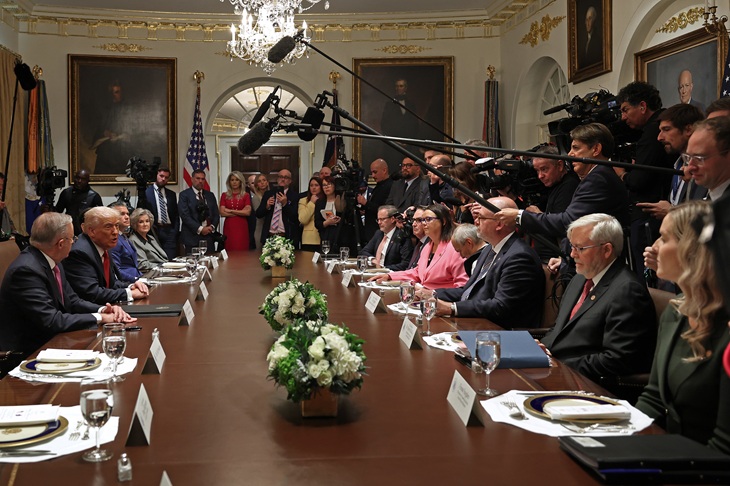
With this background, the Australian government emerged from the White House meeting to a triumphal roar of approval from the media and congratulations, albeit muted, from the Opposition.
Many aspects of the meeting are generally welcome, especially the fact that America reaffirmed its intent to protect Australia. This was a particular relief in a world featuring an increasingly hostile and powerful China, in which Australia has abandoned any intention of making sacrifices sufficient for its own defence and has pursued an energy policy that has hollowed out the nation’s manufacturing sector.
The acclaimed prize was the deal for the US to contribute some A$4.6 billion into rare earths investment in Australia. Globally, the annual value of rare earths is estimated between A$6-$9 billion, with this forecast to double by 2030.
Getting a share of this would be welcome but, in perspective, it is dwarfed by the value of existing mineral and agricultural exports. Australia’s gas and coal exports alone bring in $A160 billion per year and agricultural exports are worth about $A70 billion a year. And Australia’s public policy focus has been on suppressing energy production and, indeed, commercial agriculture by environmental regulation and higher taxes.
Moreover, an investment of $4.6 billion sounds large but it would be over many years. Department of Industry, Science and Resources reports some $A8-9 billion of spending up until 2025, ominously, with at least $3.2 billion contributed by Commonwealth and state governments.
And while we reflect on the value of the US rare earths investment – $4.6 billion over an unknown number of years – we should also place this in other contexts. For instance, we spend the $8 billion a year ‘targeted expenditure’ over and above general spending on Indigenous people and $50 billion a year on the NDIS. This and the plethora of other social programs together with the spending we require on environmental and other outlays explains why Australian governments are unable to find the funds for our own defence.
And on the subject of environmental costs, it is notable that a prominent rare earths miner in Australia was unable to get approvals to process its minerals in Australia and had to locate its plant overseas. This begs the question of how other projects will fare.
Most mining, by definition, involves the extraction of highly locally concentrated high-value resources. Even so, Australian mining has faced increasing restraints – epitomised 50 years ago when Western Mining discovered a fabulous nickel resource and, after requiring just two approvals, was preparing the mine within six months. Today, this would take a decade or more. It would require hundreds of separate approvals, would need to navigate an environmental industry that will scour the area for supposed endangered species and doubtless find some variations (or some ecologically unique combination of species) and will recruit opposition from local aborigines or hobby farmers.
We have been immensely successful in creating the conditions that thwart the wealth creation process – regulatory restraints are intensified everywhere except in productivity-damaging expenditures like wind and solar and their facilitating transmission lines that are so beloved by urban elites, climate idealogues and subsidy seekers.
Rare earths, unlike most mining, feature extensive land acreages because they are a scarce component of the mass of earth in which they are found. Refining them requires considerable low-cost energy (which Australia is banning). And post-mining, rectification of the land can be expensive, especially since it contains natural (but low-level) radioactivity.
The ALP has its new version of the ‘nature positive’ environmental laws up its sleeve to facilitate this. Being sold as a regulatory simplifying process, this actually will create a vast new regulatory agency. But in one respect it will entail truncating the regulatory process by allowing the Minister to override objections. Originally planned as a means of overcoming the intense objections of rural Australia to wind and solar farms and their ecologically destructive transmission lines, this will double as a ready application in abbreviating regulatory processes for rare earths.
While a diminution of regulatory excesses is to be welcomed, giving politicians scope to wave through approvals without due process adversely impinges on property rights. More importantly, it further opens the gates to corrupt decision-making – favours and support for the political party in power.
‘Winner picking’ in energy policy and over-regulation in mining and agriculture is already undermining the economy and now we have this being augmented by removing restraints to arbitrary policy overrides. Is this an economy writing its own death warrant?