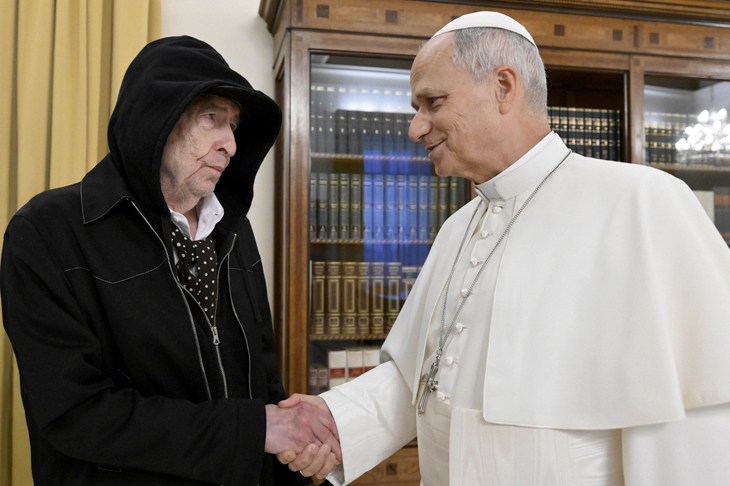
It was a funny moment when we heard that Bob Dylan had dropped in on His Holiness, Pope Leo XIV. The meeting was brief, but the pope gave him a rosary and Dylan returned the compliment with his memoir, Chronicles: Volume One. Leo had already quoted an unpublished Dylan protest song of 1963, ‘Go Away You Bomb’, in his book Disarmed and Disarming, warning against the race to rearm.
Dylan sang, in the very early Sixties, that ‘The country I come from is called the Mid-West’ – that’s the one with the confronting line ‘You’ll have to decide / Whether Judas Iscariot / Had God on his side’. Born Robert Zimmerman, he re-invented the idiom of song. Before Dylan there was blues and folk and the remnants of pop but after Dylan there was an abiding complexity and beauty that absolved the Sixties hipsters from the obligation to investigate classical music. They had him in ‘Desolation Row’ talking about ‘Ezra Pound and T.S. Eliot fighting in the captain’s tower’ and in Dylan we had a songman who seemed to re-create the world. And, yes, something like this is implicit in ‘Knockin’ on Heaven’s Door’, though Dylan’s greatest days were over by then and it’s a double irony that in Peckinpah’s Pat Garrett and Billy the Kid everyone can act, except for the singer who also writes the song. James Coburn as Garrett and Kris Kristofferson as Billy are fine and grand, but not Dylan.
Is it true that Kristofferson’s finest hour was when Janis Joplin recorded ‘Me and Bobby McGee’? Perhaps it’s also true that Pearl (1971), the album that gave us both it and ‘Oh Lord, won’t you buy me a Mercedes Benz?’, might constitute the greatest rock album of all time – though Cheap Thrills, with ‘Piece of My Heart’ and her version of Gershwin’s ‘Summertime’, runs it close. But then there is the brief staggering heyday of the Rolling Stones, the transfiguring quality of the Beatles, the whole shebang.
It flickered, that candle, but you can imagine how the pope from Chicago and the man from the Mid-West might have enthusiasms and worries to swap. Dylan had excavated the Judeo-Christian heritage, even if the greatest of his albums after John Wesley Harding – the one with ‘I Dreamed I Saw St. Augustine’ – Blood on the Tracks, is not a patch on what preceded it. It does have: ‘Relationships have all been bad. Mine’ve been like Verlaine’s and Rimbaud.’
The pope is worried about AI and there’s the fear that the machines could destroy the ghosts. Pope Leo gave a temporary bill of health to Anthropic – its co-founder Chris Olah spoke when Leo launched his encyclical on AI in May – and he has been instructed by an intellectual friar, Paolo Benanti, who knows what’s possible in every direction.
Meanwhile the leader of the world’s Catholics has had an extraordinarily warm reception in South America. It was fascinating to see Argentina’s President, Javier Milei, on television, weeping his heart out, so moved was he by the pontiff.
We live in strange times and AI makes them stranger still. Elton John hosted the very first ARIA Awards in 1987, when John Farnham took six trophies for Whispering Jack and ‘You’re the Voice’, Crowded House won with ‘Don’t Dream It’s Over’ and INXS were named best group. This year, for the fortieth, he sent a video message to say that although his own generation of singer-songwriters was secure, there was no guarantee young musicians would not have their work stolen from under their noses. On the night Tame Impala swept seven awards – Kevin Parker drawing level with Farnham’s record of twenty-two – Tim Minchin, never one to mince words, made a fiery case for human creativity against the machines.
All of this touches on the past we have nurtured and which has shaped us. We may have found some deep aspect of ourselves singing or playing cricket. We may have found it with a guitar in our hands or learning what it’s like to get inside Shakespeare as if all that blank verse was the language of our souls. We may have found it sipping wine or growing it. Some of us might have cottoned on to Visconti’s majestic representation of time in The Leopard and the different counterpointed voices and faces of Burt Lancaster as Prince Fabrizio with all his moody music or in the stunning, ironic beauty of Alain Delon as Tancredi or the gorgeousness of Claudia Cardinale as Angelica.
The modern translation of a classic like Lampedusa’s novel can preserve a literary quality even when its apparent intention is absolute clarity and modernity. Think of the way we continued in university departments to read Dante in the old Temple Classics edition with the Italian on one side of the page and the English on the other – Lasciate ogne speranza, voi ch’intrate (abandon hope, all ye who enter here) – or Francesca’s extraordinary poetry of statement La bocca mi basciò tutto tremante (He kissed my mouth all trembling). The pure music of Dante, so crammed full of the theology of the world, reminds some musical people of Italy’s singing quality: ‘Amor, ch’a nullo amato amar perdona’ (Love, which absolves no one beloved from loving).
No one ever forgets the fragments of a great language or of a great work of literature. A young friend – he sings bass-baritone in Masses in St Mary’s Cathedral – has just directed Equus, that nightmare story of a boy who blinds horses, a predicament that crushes the certitude of his psychiatrist in Peter Shaffer’s weird and wonderful play. Shaffer wrote The Royal Hunt of the Sun, which was filmed with Robert Shaw as Pizarro, the conquistador, and Christopher Plummer as the Inca Sun God Atahualpa. He also wrote Amadeus, which Miloš Forman filmed – not, alas, with the London Salieri Paul Scofield – but with F. Murray Abraham and with Tom Hulce as the giggling dill of a supreme genius. Genius, as Salieri discovered, turns up where it pleases – sometimes even at the Vatican in a black hooded sweatshirt.
Got something to add? Join the discussion and comment below.
You might disagree with half of it, but you’ll enjoy reading all of it. Try your first month for free, then just $2 a week for the remainder of your first year.