Any fan of Gerald Murnane would love to see him win the Nobel Prize for Literature. And if it’s never been likely, for a long time now it’s been possible, and the chances were a bit greater in the wake of celebratory critical appraisals of him by John Coetzee and Teju Cole (among others) in such elevated places as the New York Times and the New York Review of Books. Murnane’s rolling, minimalist diction, constantly recapitulating the previous clause, can sometimes come across as self-parodying, but it is also the clue to his music and the studied intensity of the lacrimae rerum, the ‘tears in things’, he invokes so powerfully, despite the manifest risk of monotony, which is deliberately courted, at once humorously and with great depth.
I remember an academic – schooled in Cambridge English and London advertising – saying he imagined Gerald had done some predictable degree with ‘a bit of English, a bit of history’ almost falling off his chair to learn that, no, he had majored in Classical Arabic.
But for once I was not put off patriotically by the choice of the Nobel Prize for Literature because it went to a poet I have revered for decades, Anne Carson. It’s a long time since Harold Bloom called her a wisdom poet but I remember him discussing her at his home in the hushed New Haven late afternoon. It must have been round the same period that I declared in print that she seemed to me the greatest poet writing in English.
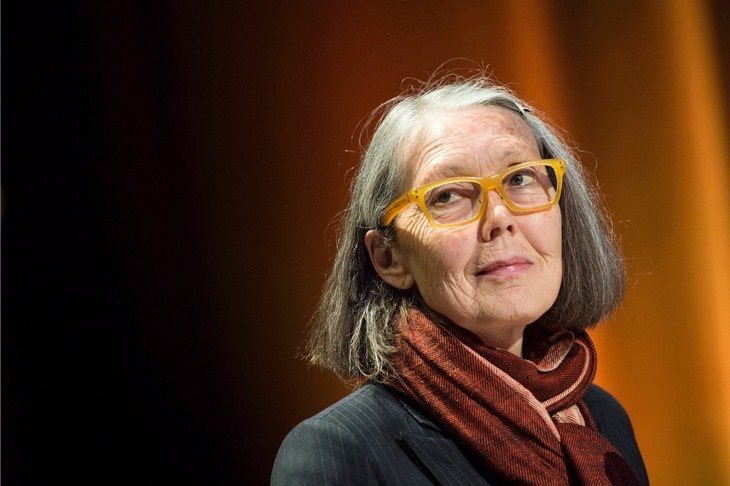
Carson was born in Canada but she has spent a significant fraction of her life teaching in America – Ann Arbor in Michigan is one place of tenure that comes to mind. There have been photos of Anne Carson in the last few days looking as if she’s aghast at the shipwreck of all her hopes. It’s certainly true that her essays can appal readers with conceptually cluttered, very theoretically dense formulations. I said to Harold Bloom that they were Lacanian – invoking one of the most difficult of the French theorists – and he hastened not to slander a mighty living talent. ‘I would not say Lacanian,’ he said gently and the discussion shifted to the grim magnificence of Shakespeare’s line, ‘The expense of spirit in a waste of shame.’
But Anne Carson is an extraordinary writer and her 1998 Autobiography of Red has a position in the recent history of poetry analogous to that of David Foster Wallace’s Infinite Jest in fiction. It’s a narrative poem with a spellbinding quality and it’s also a kind of mythopoeic Bildungsroman in which the hero doubles as the monster Geryon replete with folding red wings. It is a poem of travel and revelation and for all the exotic strangeness of its plotline this volcano of a book enthrals the reader with its exquisite beauty and its adolescent youthfulness and earthiness.
The matter of Autobiography of Red is metamorphosed and extended in Red Doc>, and then there is the many-windowed, ravishing suite of poems, the book-length The Beauty of the Husband, in which the tension and the interplay between woman and man are captured as a set of tangos – that most formalised and erotically charged of dances – and everything is presented in a manner at once graphic and stately with a set of quotations from that most tragic and most wise of Romantics, John Keats.
It’s poetry of stunning freshness and stunning strangeness. You feel it with each of Anne Carson’s works – stretching right through to the prose poems of Wrong Norma, in which Marilyn Monroe and Socrates share a soundstage and there is also the echo and the annotation of Gertrude Stein.
I interviewed Anne Carson back in 2001 when Autobiography of Red was turned into a performance piece for actors at Melbourne’s Malthouse brought together by Luke Mullins. She was by this stage the most famous translator of the Greeks in the world. If her translations of Sappho (that dazzling first voice of lyric poetry) are not as beguiling in a dramatic way as Guy Davenport’s, with their modernist carrying over of the gaps and silences, Anne Carson is liberated by the same problem of the fragments and creates something new and sparkling and somehow more girlish. In ways which can seem weird she is the inheritor of the many conflicting colours and tones of Greek tragedy.
In 2009 she published An Oresteia – toying with the fact that Aeschylus’s Oresteia is the one complete cycle we have. Anne Carson translates the Agamemnon with the great cry of maternal hatred coming from Clytemnestra’s throat bawling for vengeance but then she shifts to the other tragedians – the geometry and formal desolation of Sophocles and the Euripides Orestes which Anne Carson does so demotically, with such a command of adolescent idiom, that it sounds like a cousin of Foster Wallace.
A version of the same principle governs Grief Lessons (2006) which concentrates on the different stabs at tragedy by Euripides the man who didn’t like human beings very much though he had a lot of time for women.
Anne Carson has made Greek tragedy into a form in which she can scribble and expand. Back in 2023 Jane Montgomery Griffiths – a powerful interpreter of Sappho herself – used the Anne Carson translation of Sophocles with herself as Clytemnestra and a very fierce Elektra in Zahra Newman.
Newman can be seen right now on Apple TV in the cast of an unusually powerful and beautifully put together bush noir thriller, Last Seen, in which she plays a sleek, concentrated detective and there is superb acting all around in this Australian-produced, Victorian-shot drama of a stolen child. Brendan Cowell has a growling confounded belligerence and Maxine Peake gives the performance of her career as his wife. Last Seen is a minimalist thriller with an electric brilliance, directed with great finesse by Christian Schwochow and with the dense deep green of the bush of Victoria looking like a paradise infested with horror.
Got something to add? Join the discussion and comment below.
You might disagree with half of it, but you’ll enjoy reading all of it. Try your first month for free, then just $2 a week for the remainder of your first year.