Was Stephen Hawking a world-historical scientific genius? No. Was he nonetheless a scrupulous and collegiate collaborator with others? Also no. But was he basically a nice guy? Well that, as so often, depends on who you ask. His sister Mary is quoted here calling him ‘one of the most self-centred people I’ve ever met’. Yet his friend Kip Thorne, a Nobel-winning physicist, remembered him very fondly. Hawking had a complicated love life, to be sure, but then he had a complicated life in all sorts of ways. This superb biography, authorised by the family, will be the definitive account of it.
Graham Farmelo is himself a Cambridge physicist, and his explanations of the scientific issues with which Hawking and his contemporaries grappled are beautifully clear. After a detailed account of Hawking’s childhood (St Alban’s School, clever but careless) and undergraduate years at Oxford (enjoyed booze, scraped a First), the real scientific story begins in the mid-1960s. It was then that as a PhD student not long diagnosed with motor neurone syndrome, Hawking met Roger Penrose, 11 years older and already a renowned English physicist, who had been working on the fate of collapsing stars under general relativity. According to Penrose’s new theorem, they must shrink into a ‘singularity’, or what later became known as a black hole. Using Penrose’s approach, Hawking in turn suggested that the universe itself must have exploded out of such a singularity, in what we now call the Big Bang. The two men collaborated on what became known as the Penrose-Hawking singularity theorems, and Hawking was now a star of gravity research.
That collaboration, however, also reveals the young scientist’s unpleasant side: a few years later, he effectively stole a new result that Penrose had told him about, the ‘area theorem’ of black holes, and pretended thereafter that it was his. Taking credit for the ideas of others became a pattern. As Farmelo writes, it was soon clear to everyone that ‘Stephen’s competitors would be unwise to share with him a potentially strong new idea before they had publicly claimed it as their own’.
Hawking became most famous for showing, in the mid-1970s, that black holes – the gravitational pull of which is so strong that not even light can escape – must nonetheless emit radiation, for subtle quantum-mechanical reasons. This means that over time they will slowly evaporate, like a puddle, and then finally explode, not like a puddle. The idea had previously been proposed by other researchers and dismissed by Hawking himself, but his calculation demonstrated it conclusively, and from then on it was known as ‘Hawking radiation’.
That achievement, though, comes less than halfway through this book, after which its subject made no more major scientific contributions. He embarked instead on a seemingly endless world tour, meeting popes, presidents and royalty, going on Star Trek and on a zero-G plane ride and becoming a global guru and writer (with much help from uncredited ghosts) of notoriously unread pop- science books.
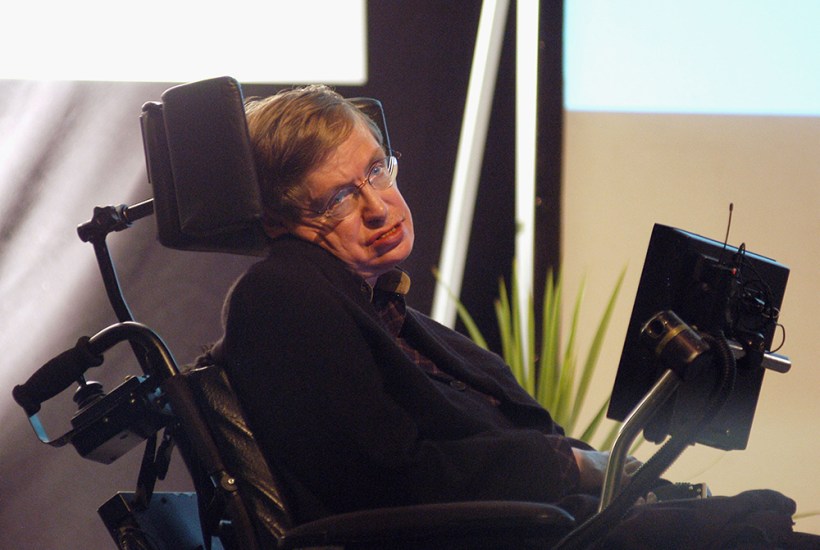
In this respect the lugubrious diaries of Hawking’s father Frank, a medical researcher, turn out to be accurate: ‘If he holds out for another ten years,’ Frank wrote of his son in 1975, ‘he may become a legend in the scientific world – partly for his brain and partly for his disability.’ For decades, Hawking was the visible icon of the triumph of mind over mere flesh – although, as he himself said, he probably wouldn’t have become such an impressive theoretician had it not been for his encroaching disease. He had been a rather negligent student, but this gave him a reason to concentrate.
From here on, we see Hawking noodling about with inflation theory and later string theory, getting a lot of young collaborators to do the calculating gruntwork for him and evincing rather a creepy attitude to women. (Ian McKellen once observed the 70-year-old Hawking using his computer screen to ask ‘an impressively buxom young woman’ the question: ‘Are you married?’) As he loses the ability to speak, the famous voice synthesizer is invented for him. But he never loses the ability to deliberately run over people’s feet in his wheelchair. Unforgivably, Hawking once tried to get a PhD student thrown out of Cambridge for having the gall to challenge one of his ideas.
In the meantime, his marriage to his first wife, Jane, whom he had made type out his PhD thesis on their honeymoon, had disintegrated. She fell in love with another man, while Hawking fell in love with one of his nurses, whom he later married and whom others accused of being violent towards him. All this stuff is rather tawdry and depressing, so it is a relief to get back to the physics conferences and learn a bit more about Hawking’s peripheral involvement with discoveries about the Cosmic Microwave Background and whatnot. But we also have to endure unnecessarily florid descriptions of seemingly every award ceremony and fancy dinner Hawking was invited to over decades. He did tell at least one good joke, at a celebration for Kip Thorne: ‘This talk will be about time travel, which has been an interest of Kip’s as he gets older. Is this a coincidence?’
So what was Hawking’s legacy? His proof of black-hole radiation was a brilliant scientific coup, but one worked out within the confines of existing theory. To his credit, Hawking himself always pooh-poohed any suggestion that he was on a par with Einstein or Newton as a physicist; one could add many more of greater stature, such as James Clerk Maxwell, Niels Bohr, Erwin Schrödinger and Penrose himself. Hawking once told Peter Higgs that the Higgs boson would never be discovered. The latter told him he was speaking ‘total crap’. The Higgs was, in due course, discovered at Cern, winning its namer a Nobel prize, an honour that Hawking himself was always annoyed not to have received. He might have, had he lived to see the first definitive observation of a black hole in 2019: a year later, Penrose got his.
Hawking should, though, be credited with helping launch the great popular science boom that followed the publication of A Brief History of Time in 1988. (Farmelo notes that Hawking originally intended to call it From the Big Bang to Black Holes: A Short History of Time. The brilliant pivot to ‘Brief’, promoting subtitle to title, which inspired so many subsequent copycats, was the brainchild of his editor at Bantam, Peter Guzzardi.) The book itself might not have been very good, but Hawking was to many an inspiring speaker. He had helped, he suggested not unreasonably, to make people feel that ‘they are not shut out of the big questions’.
Farmelo’s summation of his subject’s career seems wisely measured. Hawking was ‘the first physicist successfully to use quantum principles to improve our understanding of gravity’, and he made other predictions – for example, about ‘primordial’ black holes created at the beginning of the universe – that might still prove accurate in the future. It’s unfortunately true that Hawking was also a profound egotist who ‘rarely gave much public credit to his highest-achieving peers in theoretical physics’. On the other hand, he was ‘a stellar science communicator and did more than anyone else in his generation to make fundamental physics cool’. Reading this in an age where what is cool is to make billions of dollars from a tsunami of AI slop, one feels nostalgic for what might be a bygone age.
Got something to add? Join the discussion and comment below.
You might disagree with half of it, but you’ll enjoy reading all of it. Try your first month for free, then just $2 a week for the remainder of your first year.