Almost two decades ago, Jared Diamond cemented his international reputation with Guns, Germs and Steel, which argued that geography and environment rather than racial differences shaped the rise and conquest of nations. Still going strong at 88, he has now written a book on leadership. This is a crowded literary space, but Diamond offers a distinctive approach.
A distinguished biologist and polymath, he has little time for the Great Man theory of history popularised by the 19th–century essayist Thomas Carlyle. Altogether too subjective, he says, never mind the absence of women. Leo Tolstoy’s War and Peace is no better a guide, since it casts individuals as constrained by circumstance, with scant influence over events.
In search of certifiable proof of leadership, Diamond comes up with the ‘Hamlet test’. This postulates that no playwright other than Shakespeare could have written a masterpiece such as Hamlet,based on the output of contemporary rivals or judged by his earlier works, including Romeo and Juliet and Julius Caesar. Thus Shakespeare is not only uniquely talented but demonstrably so.
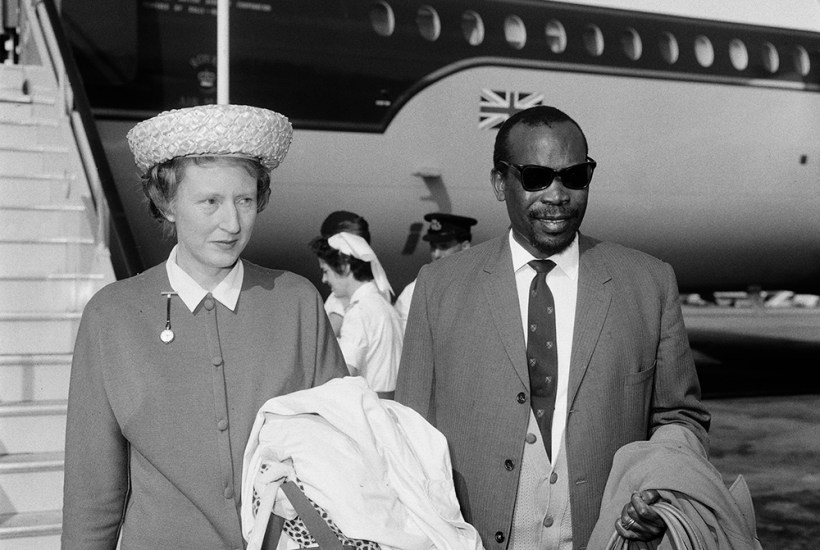
Applying this methodology to modern leaders, Diamond discards the usual suspects (Napoleon, Churchill and Roosevelt). Nor is he entirely convinced by Margaret Thatcher. His all-time winner is Seretse Khama, the founding president of Botswana, formerly the British protectorate of Bechuanaland.
An outstanding athlete, Khama took power in 1966 and dramatically changed the fortunes of a newly independent nation. He built institutions and put his country before his tribe. True, the discovery of diamond deposits in 1968 proved a game-changer; but Khama used the revenues wisely to invest in roads, telecommunications, healthcare, schools and colleges. Once destitute, Botswana became one of the richest, least corrupt and most stable countries in Africa. Hence the accolade ‘Shakespeare in Africa’.
In politics, Diamond concedes, there are many variables which affect whether leaders succeed or fail. Timing is important. Genghis Khan benefited from a consistently wet period on the steppe, which meant more grass for animals, more sheep and goats to eat, more horses to ride into battle and more Mongol babies becoming warriors.
Genetics matter too. Judged by an ‘inbreeding co-efficient’, Carlos the Imbecile of Spain (1665-1700) ranks at the bottom of Diamond’s heap. Conversely, he detects a correlation between mentally stronger monarchs and the expansion of territory and urban population. In terms of economic output, postwar Japanese prime ministers do well – though Lee Kuan Yew, Singapore’s longtime leader, surely deserves greater credit.
In sport, no football manager can match Sir Alex Ferguson, whose trophy-laden stint at Manchester United spanned more than 26 years. He combined elite man management with modern dietary techniques while instilling a relentless fear of failure (though he did not go so far as the most successful US basketball coach, Bobby Knight, who punched players and squeezed their testicles).
Diamond argues that game outcomes are rarely decided by the ability of individual coaches. Tell that to trigger-happy club owners in the Premier League. Other factors, such as budget, geography, injury lists and the quality of opposing teams, can tilt the scales. Diamond is generally sound on sporting leaders but he fails to mention Pep Guardiola’s record at Manchester City and picks the wrong All Blacks coach (Alex Wyllie) as best in class, based on an infinitesimally superior winning percentage.
When it comes to business leaders, the Hamlet test is more a hindrance than a help. Diamond downgrades tech titans such as Jeff Bezos, Steve Jobs and Elon Musk, the world’s richest man. Somebody else would have come along in their place, he blithely asserts. This does a disservice to Jobs, a modern Leonardo da Vinci. Instead, Diamond alights on Lynda and Stewart Resnick, the co-founders of socially aware businesses such as Fiji Water. Around the turn of the century, the California couple launched a premium pomegranate juice product against the combined weight of the American drinks industry – heartwarming, but hardly the stuff of history.
Towards the end of the book the sheen comes off Diamond’s folksy prose and he grows repetitive (where are the editors?). We learn that religion requires charismatic founders with a gift for organisation – no great insight there. Sticking with Christianity, Diamond records that the Mormons have thrived better than the Shakers, thanks to their elaborate mutual welfare plan and strong family ties. Especially helpful is ‘tithing’, by which church members voluntarily contribute 10 per cent of their annual income. These practices, he asserts, may be more important than any particular theological beliefs.
In his epilogue, Diamond suggests four further spheres for exploring leadership: military history, arts and culture, protest movements and science. This is a lot of acreage, but fertile territory for someone who always has something interesting to say, even if the end product on this occasion falls short.
Got something to add? Join the discussion and comment below.
You might disagree with half of it, but you’ll enjoy reading all of it. Try your first month for free, then just $2 a week for the remainder of your first year.