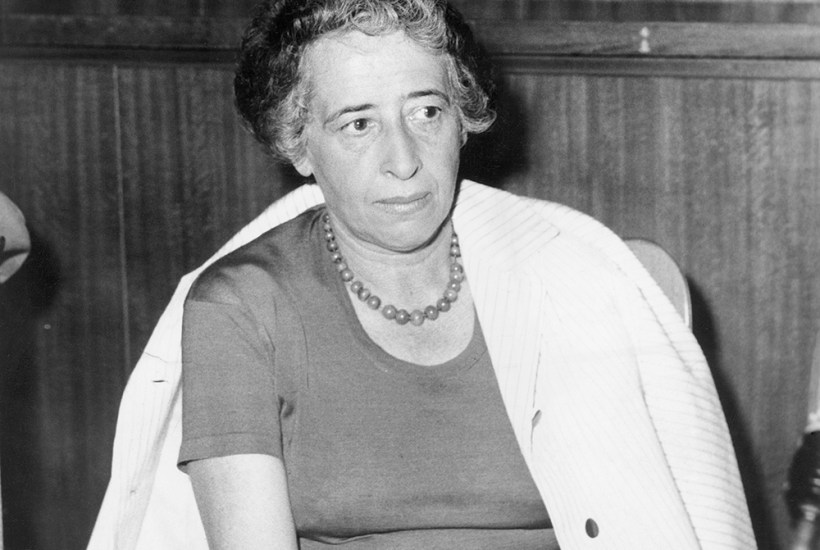
In 1975 – the year of her own death – Hannah Arendt published a heartfelt memorial essay about W.H. Auden in the New Yorker. It ranks, I think, as one of the finest tributes ever paid to the poet, that ‘expert in the infinite varieties of unrequited love’: a moving, tender harvest of 15 years’ warm friendship. The loveless Auden even wanted to marry Arendt after the death of the writer–philosopher’s second husband, Heinrich Blücher.
Now turn to Hannah Arendt: A Life of the Mind: a much-acclaimed German ‘biography’ of the Jewish exile from Königsberg who, from her apartment at 370 Riverside Drive in New York, became one of the most influential, and sturdily independent, political and social thinkers of the postwar decades. Auden appears just once, in passing. Thomas Meyer – professor of philosophy in Munich and editor of the critical edition of Arendt’s German-language works – airily claims that: ‘She refrained from writing anything about her friends W.H. Auden and Robert Gilbert’ (an émigré musician and songwriter).
Even Munich professors can stumble, of course. Yet this error is symptomatic of his entire misconceived project. Whatever its other virtues, this book should never have been published as a ‘biography’. The lofty view from Munich often treats basic data, not to mention simple chronology, as vulgar interruptions. Meyer never bothers to clarify that Hannah’s father, Paul (a gifted electrical engineer), died from syphilis. It would take a dogged sleuth to work out, from his few confusing asides, her own career trajectory in the US. Over precarious decades, the immigrant freelance wrote ‘without a banister’ but finally – in 1967, as never specified here – won a permanent post at the New School in New York.
It’s good to learn about the Haus der Bücher in Königsberg, then Europe’s largest bookstore, where little Hannah (born 1906 to a well-established merchant family) fed her imagination. But Meyer’s contempt for sequence means that such childhood colour begins on p.278. Her notorious affair with the future (if temporary) Nazi sage Martin Heidegger – a life-shaping encounter for both – merits a few lines in the chapter on her studies. To say more would ‘unnecessarily constrict our view of those years’. What, for instance, did Arendt make of her sojourn in Aberdeen, where she gave her swan-song Gifford Lectures on the ‘Life of the Mind’ in the early 1970s? This book won’t inform us.
Patient readers might still gain some profit from this thematic commentary on Arendt’s work, erratically interspersed with chunks of narrative and context. They may need to tackle it with a chronological crib to hand. Meyer has done plenty of original archival research, especially on Arendt’s 1930s Paris years, after her arrest by the Nazis and escape from Germany. He does properly explain how her courageous social work with refugee children, for Zionist organisations such as ‘Youth Aliyah’, nourished the later author of The Origins of Totalitarianism and The Human Condition. The Nazi, and Communist, ‘breach in civilisation’ mandated action, not contemplation, from thinkers.
As a welfare worker who supported kids ‘at the bottom of the victim hierarchy’, she flung herself into the vita activa that fuelled a lifelong suspicion of pure philosophy. At the same time, she embarked on the prolific stream of articles, reviews and essays that culminated, in 1963, in the explosive reportage of Eichmann in Jerusalem for William Shawn’s New Yorker. Meyer rightly dubs her a pioneer ‘media intellectual’ but, academic to his fingertips, has a tin ear for what wider literary engagement meant to her, or how it shaped her English prose. We get only the sketchiest glimpses of the cherished Manhattan pal of Auden, Mary McCarthy, Elizabeth Hardwick, Robert Lowell, et al.
Whatever its other virtues, this book should never have been published as a ‘biography’
Although he pays ritual homage to the ‘public sphere’, Meyer essentially views Arendt as a university philosopher manquée who, if genocidal ideology had not intervened, might have spent serene decades holding court in Göttingen or Marburg. His expositions of her friendships and rivalries with other thinkers can be excellent: with Heidegger, of course, who kept his uncanny grip on her loyalty, even affection, despite his Nazi interlude, or her beloved teacher Karl Jaspers, the ‘most important human relationship apart from her marriage’. Shelley Frisch’s translation skilfully avoids obfuscation but lets us sample the elusive, semi-poetic strangeness of the post–Heidegger German prose of thought.
Meyer also dives deep into Arendt’s tangled liaison with Zionism. The activist who studied the roots of European anti-Semitism, and sought release from it, grew into the ambivalent observer of the Eichmann trial. Gershom Scholem – who, with Arendt, rescued the legacy of their mutual friend Walter Benjamin – thought that she displayed a ‘lack of love for the Jewish people’. Arendt feared that 20th-century totalitarian hatred had ‘done permanent harm to mankind’s essence’, and maimed the spirit of hunters and hunted alike.
Meyer can be a sound, authoritative guide to the murky modern borderlands where politics and philosophy skirmish. Alas, he seems quite unqualified to draw a complete portrait across time of this many-sided figure, who insisted (as she wrote for Jaspers) that ‘one has to live and think in the open and not in one’s own little shell’. We scarcely meet the woman whom Auden longed, platonically, to wed. Arendt newcomers should turn instead to (say) Samantha Rose Hill’s compact life from 2021. Even better, enjoy the luminous essays where Arendt roots – as Meyer struggles to do – high ideas and ideals in the cross-grained humanity of what one great collection called Men in Dark Times.
Got something to add? Join the discussion and comment below.
You might disagree with half of it, but you’ll enjoy reading all of it. Try your first month for free, then just $2 a week for the remainder of your first year.