Next year’s Adelaide Festival is looming and it’s fascinating to see what Matthew Lutton has planned for us. Among the treasures is that sinister modernist classic Bluebeard’s Castle, in Romeo Castellucci’s staging, conducted by Lidiya Yankovskaya. Then there’s classic (in fact classical) theatre in the form of Oedipus with one of Australia’s most formidable actors, Richard Roxburgh. This Oedipus (no Rex) is Robert Icke’s version, the one performed in the West End by Mark Strong with Lesley Manville; here Roxburgh’s Jocasta is Heather Mitchell.
The original is the most celebrated play in the Greek canon – the play Aristotle used for his discussion of tragedy – and Sophocles is arguably the greatest master of dramatic form in any language.
It’s disconcerting that we don’t have a self-contained trilogy of Sophocles – the only extant trilogy is The Oresteia by Aeschylus – but we do have the collection of his Theban plays in the Fagles’ translation. Some people may have mourned Patrick Stewart the other week by listening to the 1985 BBC Radio production of these three, with Stewart playing Creon – the oppressive guy who comes undone – in each of them. He is a gleaming figure in Antigone, and the recording also has a magnificent Oedipus by Tim Pigott-Smith and a Jocasta by the great Siân Phillips, who says to Oedipus, all unknowing, ‘Many a man has dreamt as much.’
It’s interesting to imagine what Roxburgh will do when he realises he’s been sleeping in incestuous sheets. He is a very subtle, very intelligent actor who is also a master of technique. Does he seem a clear-cut choice for this man who grieves for his city and walks through endless ways of thought?
In some ways he is a less obvious choice than that warrior of an actor Keith Michell would have been. Michell toured here in Othello and Shaw’s The Apple Cart in 1978.
A few years ago, in New York, Rose Byrne played Euripides’ Medea in Simon Stone’s adaptation, and both Dame Judith Anderson and her protégée Zoe Caldwell did Medea in the Robinson Jeffers version to stupendous acclaim. It would be a marvellous thing to see her Medea here, and perhaps even more exciting if she were to do Sophocles’ Electra.
And while we’re being speculative it would be great to see that young marvel of an actress Jana Zvedeniuk – who did a miraculous Yentl and recently played Regan to Colin Friels’ Lear – take on one of the young women in Sophocles, perhaps Antigone.
Everyone is speculating at the moment about whether Jack Lowden is going to be the next James Bond, and the whisper is so loud it’s deafening: that masterly old actor Gary Oldman has been making it perfectly clear that he, like the rest of the world, acting and otherwise, wants it to happen. Lowden has certainly shown in Slow Horses that he has flexibility and subtlety as well as the manner of a sensitive, swift-footed man, and he has the advantage, typology-wise, of traversing class; it’s interesting to see him as the logical inheritor of his on-screen grandfather, Jonathan Pryce. His River Cartwright has had so much horror to cope with in Slow Horses – especially Kristin Scott Thomas’s recent moral duplicity as Diana Taverner – that it seems only fair that Lowden should receive the high and mighty accolade of 007.
It’s easy of course to get these things wrong. I would never have chosen Daniel Craig, and after a period of thinking Clive Owen would make a good Bond, I decided it should be Dougray Scott.
Sean Connery seems to have won everyone over simply by taking possession of Fleming’s hero through sheer force of histrionic presence. (At one time Fleming was wondering if James Mason could do it.)
Just at the moment we have a former James Bond, Pierce Brosnan, on our screens in MobLand, and Brosnan was always thought of as a cross between Connery and his successor Roger Moore, with Moore’s light touch and comic grace.
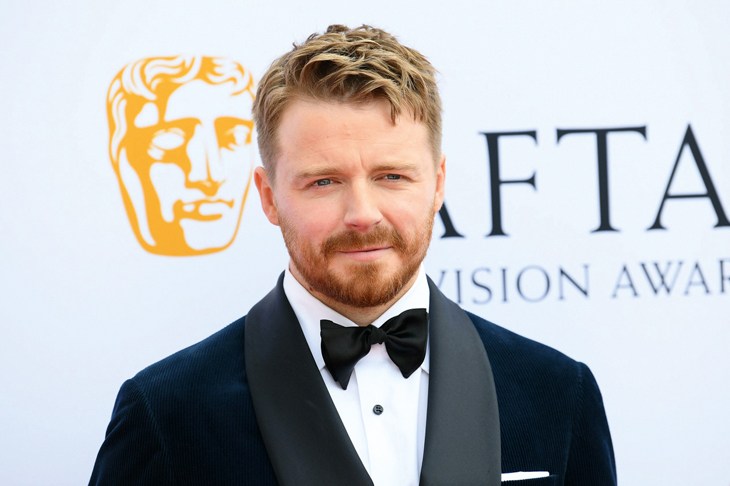
It’s interesting, the number of first-rate actors who are involved in this bloodbath. The other night on MobLand a new face loomed into view with extraordinary power. We were taken aback to discover this figure, looking a bit like the young Richard Harris and with unmistakeable star quality, was Johnny Flynn, whom we first saw years ago in Perth when he was acting with Ed Hall’s all-male Shakespeare company Propeller: Johnny played Curtis, one of Petruchio’s servants, in The Taming of the Shrew as well as Viola’s brother Sebastian in Twelfth Night. He had a mild boyish manner and, superb though he later was in Hangmen by that immense dramatic talent Martin McDonagh, you couldn’t have predicted this. His drop-dead presence as Frankie Cooper in MobLand upstages a great medley of Britain’s finest actors, led by Helen Mirren and Tom Hardy.
It must be a weird and wonderful thing for an actor to make a film written and directed by Martin McDonagh, given his extraordinary achievement: from The Beauty Queen of Leenane, the first play in his Leenane Trilogy, through that black comic masterpiece In Bruges to The Banshees of Inisherin, the great film of 2022. McDonagh is a genius, and his new film, Wild Horse Nine, now in cinemas, stars John Malkovich, who has been a riveting, magnetic actor for decades now. He was the Tennessee figure in the Joanne Woodward version of The Glass Menagerie and he played Mr Will in Places in the Heart with Sally Field. But Malkovich can do anything: he’s the ‘decent’ South African academic in the film of J.M. Coetzee’s Disgrace, he’s the greatest on-screen Ripley in Ripley’s Game, and in Raúl Ruiz’s film of Proust’s Time Regained he actually plays that towering embodiment of French grandeur and folly the Baron de Charlus. How anyone who is not French could dare to take it on is a mystery.
Got something to add? Join the discussion and comment below.
You might disagree with half of it, but you’ll enjoy reading all of it. Try your first month for free, then just $2 a week for the remainder of your first year.