I have learnt from bitter experience to avoid the danger of the Hawaiian shirt. You know the sort of thing: you are overseas in an exotic country, and you decide that you really must have a defining item of apparel.
Over the years, I have collected a fur hat from Russia, a brightly coloured jacket with embroidered llamas from Peru and a Fair Isle jumper from Norway. If I were being honest, there have been more items, but you get my drift. These purchases have not been a good idea; wearing them, particularly at home, is basically a disaster.
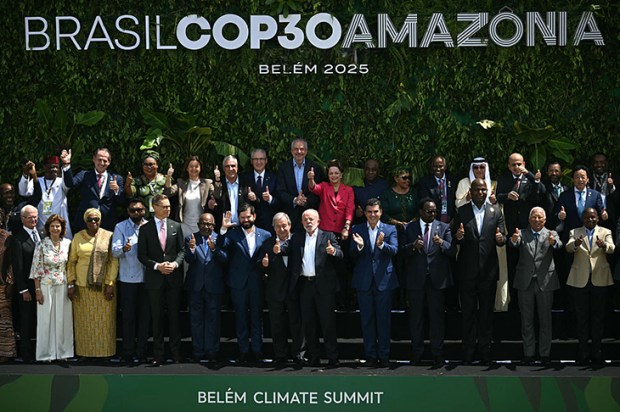
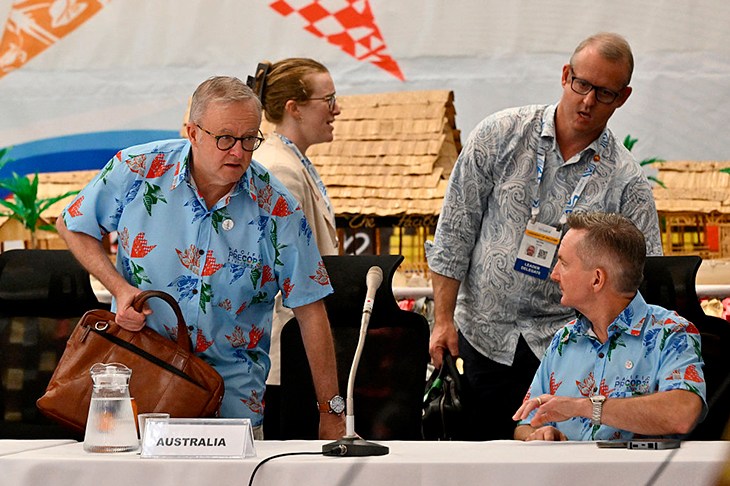
Now my guess is that our intrepid Climate Change and Energy Minister, Chris Bowen (B1 to Speccie readers), also knows this, but he had no real choice but to don the colourful shirts – and not just one style – during his triumphant pre-Cop conference held in Fiji, with a side-trip to Tuvalu.
He looked decidedly grumpy in the floral attire provided to him (and other participants) by the hosts. Mind you, the Australian taxpayer was no doubt footing the bill for these locally appropriate outfits, although I do wonder whether they had been made locally. (China is my guess.)
B1 did draw the line at parking the wreath of brightly coloured flowers on his noggin, although the Tuvaluans evidently were offended by his decision. It was Keating’s advice to avoid the local novelty headwear and B1 took it. (Actually, those garlands looked a bit like the one I wore for my wedding in the 1980s: they were very on trend.)
Let’s be honest here, B1 seemed decidedly annoyed during the entire pre-Cop confab. At one point, he even had a little kip, although I’m not sure I really blame him for that. Those pre-set ‘begging bowl’ speeches must have been so boring. He did perk up in anger to the journalist’s observation about the non-attendance of pretty much every world leader outside the Pacific save the leaders of Mauritius and Timor-Leste.
Mate, it was your party and hardly anyone showed up. We got it. I think we also got the fact that the three days were just part of a major shakedown by the Pacific Islands whose leaders will use any narrative to extract more money from ‘rich’ countries, particularly Australia and New Zealand. My island is sinking; give me more money is the message. It’s sort of compelling, at least to climate change fanatics.
So, what came out of the pre-Cop? Nothing really, but the mission has now shifted from the phasing down – or is it the elimination? – of fossil fuels, to achieving a global 30-per-cent electrification rate, whatever that precisely means. Add in some wacky target for rooftop solar panels, and Bob’s your uncle and aunt. I’m sure Messrs Trump, Xi and Putin were taking notes and will take immediate action, or not. Solar panels work so well in Siberia in the middle of winter.
Add in a commitment from Australia for more millions of dollars for the Pacific to install renewable energy as well as adapt to the effects of climate change and Bob’s your aunt as well, having adopted a non-binary status with preferred pronouns: they/them/theirs.
It was unfortunate that the High Court of Australia would decide in the same week as the pre-Cop flop on a matter related to the extension of a coal mine in New South Wales. The issue was whether the mine application had dealt sufficiently with Scope 3 emissions (those emitted by suppliers and customers) as required by NSW legislation. Had the planning authority taken this into account in agreeing to the extension? By a narrow margin, the court found that the planning authority had erred.
But B1 would not be drawn on the matter. It was not an issue that related to his role as Cop President of Negotiations. This was a pathetic response. Back in Australia, the Industry Minister, Tim Ayres, at least had the guts to say he didn’t approve of the decision. It makes no sense to include Scope 3 emissions in the decision making, he told us.
It involves massive double counting under the Paris climate agreement, and we could potentially miss out on the surging global demand for coal that Michael Baume recently described in this magazine.
While Ayres speaks some sense, the Albanese government showed very poor judgement earlier in the year. When the proposition that ‘a failure to curb fossil fuel production might constitute an internationally wrongful act’ came before the United Nations, Australia voted in favour. It was opposed by other major fossil fuel exporters, including the United States, Russia, Iran and Saudi Arabia.
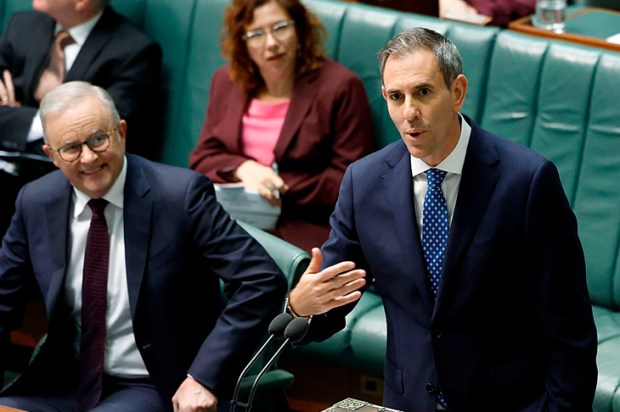
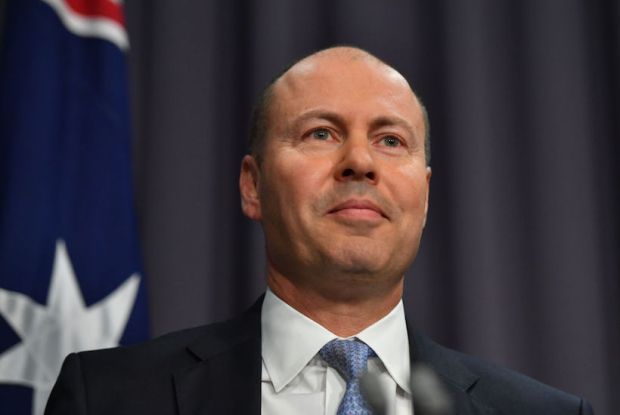
Then there are the newly imposed climate-related financial disclosures required of an increasing range of Australian companies. They were in fact around when Scott Morrison was the prime minister, but a decision was taken to delay them. Jimbo, the current Treasurer, had no hesitation and has proceeded with the requirement for companies.
Under the policy, companies must ‘publicly report on their exposure to climate risks and opportunities, as well as actions to manage them, supporting transparency, accountability, and Australia’s emissions reduction targets under the Paris Agreement.’
The mandatory disclosures include ‘statements related to climate-related risks and opportunities affecting operations and financial performance; governance and strategy for managing climate impacts; metrics and targets to track performance against climate-related objectives; and scenario analysis to assess resilience under different climate futures’.
This is not a joke; the compliance burden is over the top. But the key point here is that companies must report on Scope 3 emissions and what steps they are undertaking to reduce them. That’s right – they are expected to somehow control the behaviour of their customers, for instance. If they are not satisfied, they should refuse to supply them. Yeah, right.
The impact of this new regulation spills over to the big banks – they increasingly resemble credit unions – which must also submit climate-related financial disclosures, including the emissions of the companies to which they lend funds. The end-result is that Australian banks are increasingly refusing to lend funds to any fossil fuel projects, even if such lending activity is likely to be highly profitable.
Add in some pesky activist shareholders and some spineless chief executives, senior staff and board directors, and increasingly the Australian banking system is vacating the field of investing in valuable resource projects. There are other sources of finance for these projects, mainly sourced overseas, but the terms are often quite expensive.
It’s a clear case of Australia shooting itself in the foot. The budget has been saved largely because of our successful resources industry and the high commodity prices that have endured for nearly two decades. Without these factors, we really would be in a complete hole.
Labor is too weak to acknowledge the role of fossil fuels in underpinning the country’s wealth. It bodes badly for the future, but B1 has an important upcoming trip to Turkey, or whatever it’s called these days, so he’s not interested in what he regards as trash talk.
Got something to add? Join the discussion and comment below.
You might disagree with half of it, but you’ll enjoy reading all of it. Try your first month for free, then just $2 a week for the remainder of your first year.