Harold Pinter is one of the great dramatists of the last hundred years, perhaps the only one who can hold a candle to Beckett but richer in tone than the Irishman at least in his later work. Pinter does a fine line in his own variety of absurdism but he tends to be close to blood and laughter and he also has the tremendous benefit of having a clairvoyantly accurate ear for every kind of dialogue so that he ensnares the lunacies of any dramatic situation, however intrinsically improbable, with the sweep and cadence of the everyday world.
Did Harold Pinter get his sense of anticipatory action from all the farces he did as a young jobbing actor in repertory? It seems pretty clear he did and it’s a source of the tears but also the terror in The Homecoming. The man who knew the stage like a playing field knew how to subvert it and turn it to his will.
So it is with Greg Carroll’s superb production of The Homecoming, one of Pinter’s greatest plays, which Carroll captures with sureness of touch. He transforms the space of Melbourne’s Athenaeum Theatre 2 into a place where cruelty and confusion are clarified into a thing of beauty and darkness. The beckoning lounge room furniture is clearly a site for warfare and betrayal and the magic, deep and deadly, of what sexual delirium at an extremity can do to bewilder minds.
Peter Houghton as Teddy, the son who made good abroad, and acting with fire and restraint, turns up in the middle of the night to his London childhood home with his wife Ruth (Kate Kendall) who demands water as if it was the answer to some riddle and a walk in the night air according to a logic he can’t uncover.
Soon they collide with the smart brother, Lenny, played with consistently wry insinuation by Ben Geurens in a performance to die for, full of deadly self-assurance and with its own sinister sense of comic patter at the world’s expense.
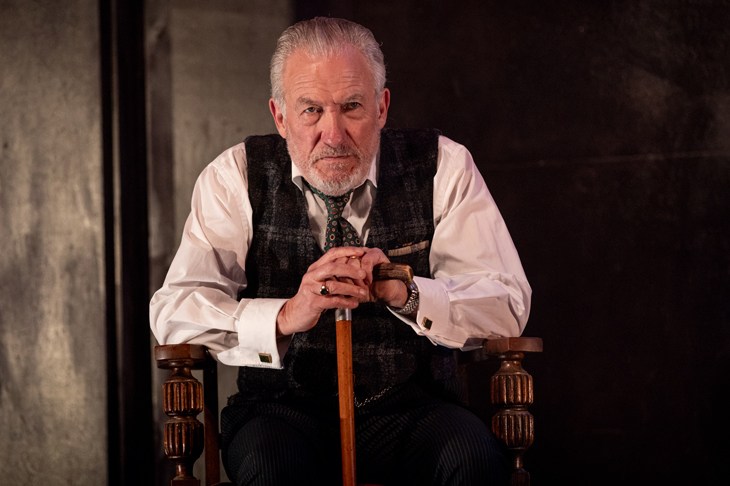
Geurens rides the implicit horror of a world grounded in derision and turns it into a delicious game. It calls up, as if from the deep, the atrocity of the father Max (Richard Piper in fine form) threatening the world with a walking stick full of bile and braggadocio, almost a palimpsest of brutality and arguably a step or two behind the gigantism of the dramatic conception but then rising to it with cries of death, gargling horrors of blood. There is the nightmare of paternalism as cannibalism and then there’s Piper’s overt mockery and nastiness to David Field’s Sam, his soft gayish brother who adored Piper’s late wife, the mother of this brood of men like swine. Field has his chauffeur’s job and his employers’ gift of cigars. He is a figure at the edge of desecration and his eventual collapse is an intimation of death and the last gasp of an innocence that partakes of a parasitism that is also doomed.
Then there’s Eddie Orton as Joey, the boxer, who is arguably a bit light for his role. It’s a young man’s performance: Orton has vigour but he doesn’t punch above his weight which sometimes is the trick with Pinter. On the other hand he does get better as the play deepens.
But it would be wrong to give away what happens in the second half of The Homecoming which is so unspeakable that the mind closes up at the prospect of it.
Peter Amesbury’s lighting, glimpsed with grandeur as a stairway is seen sideways, is an epiphany, a flash of light in darkness, indicating the total control of the action that Carroll’s production exhibits like a beacon. Carroll has designed this Homecoming himself, sleekly and brilliantly, in a production shared with his wife Margaret Goy – who lends a hand with the costumes alongside Amelia Carroll – and with Glenn Elston who has taught holidaying Melbourne how to enjoy Shakespeare in the Royal Botanic Gardens.
It was there that we first saw Kate Kendall as a dazzling Beatrice in a country and western Much Ado About Nothing. She was resplendent, with lightning timing and her performance as the wife Ruth has the same splendour in a notable role which requires a star quality pulled inside out. Kendall is utterly convincing in denoting the rhythm of a tragi-comedy that is both enigmatic and powerful. She broods over this production like a goddess of sex and betrayal.
It’s been too long since Melbourne has seen such a sensuous embodiment of a great play and this production of The Homecoming deserves to be ranked with the Kat Stewart/David Whiteley Who’s Afraid of Virginia Woolf directed by Sarah Goodes or the all-day marathon of the complete Doll at Red Stitch.
The Homecoming was taken in voraciously by an audience in the upstairs raked space with the kind of alertness that great music commands. There was none of that embarrassed laughter theatre so often provokes, though some women were appalled by what they perhaps misconstrued as the play’s politics where Pinter in fact presents a void on which we are invited to skate.
Back in the early-1990s you could see in London a production of The Homecoming that recapitulated the dominant image of Peter Hall’s 1965 production – subsequently filmed in 1973, with Nicholas Woodeson in the role of Lenny, Warren Mitchell in place of Paul Rogers. It was a remarkable example of dramatic consistency but the same can be said of this production. It is discernibly and classically a performance of a very great play which we recognise from afar.
Pinter is the great confounder of every possible plot. Carroll realises this and does him straight and the upshot is magic dark and light and in between. Carroll worked with Peter Corrigan, he’s worked with everyone. It would be cheerful to think of him in command of a state theatre company. He can do opera, he can do Hibberd, he can do Pinter.
The Homecoming is as mad as – or madder than – anything in Shakespeare. Sitting at Athenaeum Theatre 2 a few days ago felt as if Melbourne had found itself at home with one of the grandest atrocities the dramatic mind ever dreamt up. It was a coming home and a defiance of all sweet temperance. The whole country should see it.
Got something to add? Join the discussion and comment below.
You might disagree with half of it, but you’ll enjoy reading all of it. Try your first month for free, then just $2 a week for the remainder of your first year.