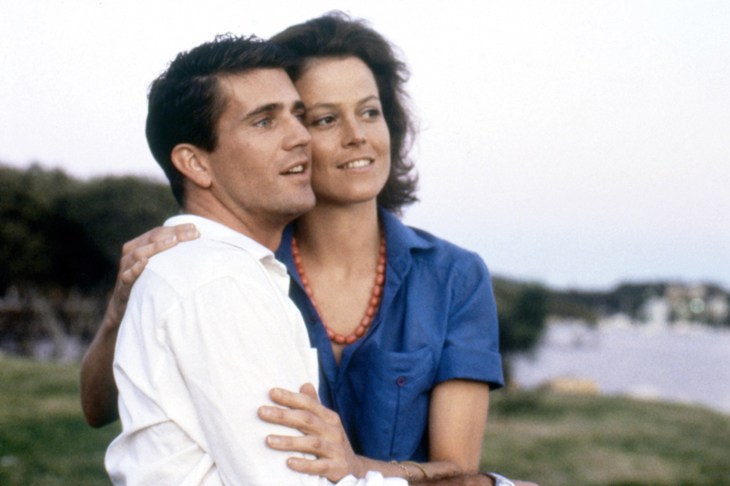
It’s striking what we can experience if we look back at the images of the recent past, aided by YouTube. The other night – in fact on the evening of Melbourne’s Grand Final public holiday – we watched The Year of Living Dangerously, which has as its backdrop the political turbulence of Indonesia in 1965 when impassioned communist supporters filled the streets with their emblems of hammers and sickles and Sukarno’s support was unsteady and half-complicit with the dangerous turbulence.
The film is directed by Peter Weir (who made Picnic at Hanging Rock) and it has a tautly brilliant script by Weir and David Williamson in collaboration with Christopher Koch who wrote the novel which sparked off this dazzling piece of film-making. It’s set in Jakarta at a time of curfews and confusion. Mel Gibson (sporting an almost archaic Australian accent) plays a young journalist, Guy Hamilton, and the film concentrates on the press corps. There’s Noel Ferrier rotund and regal and an English Sigourney Weaver as well as Bill Kerr playing a British army officer. And then taking over the film and giving it a sweeping poignancy there’s Linda Hunt the actress with dwarfism who in this film plays Billy Kwan, a well-connected (male) Chinese-Australian photojournalist. Her performance has an extraordinary heart-rending quality in a film that has no weak link and which serves as a reminder of how sophisticated Australian film could be in its early renaissance days.
Billy Kwan lives for his photographs but there is also a deep bond with Gibson. It’s easy to forget what a star quality Mel Gibson had before Hollywood discovered him after Mad Max. In The Year of Living Dangerously his command of dialogue has perfect pitch with no hint of blandness and it’s disconcerting just how good looking he was forty-four years ago. He has a dazzling Italianate male beauty and the ocker toughness of the voice simply highlights it by way of counterpoint.
This is a film full of the gasoline smell of political turmoil and the constant shadow of death. It is dramatically flawless. Williamson’s dialogue is clipped and with no hint of garrulousness: this is a world of intimate engagement and risk and travail. It is tightly plotted, piteous in its extremity but executed without a false step.
Peter Weir directs The Year of Living Dangerously with a lightning panache that is at once an honouring of the storylines and a profound tribute to the terrible nature of the horrors it depicts which present the murderous face of insurgency with a shocking power. It makes you wonder if David Williamson might have done more of this deeply pessimistic celebration of doomed youth if the stage had not pulled him in the direction of other glories.
The Year of Living Dangerously comes from another world, one which we lose at our peril. It’s worth remembering its grandeurs because they constitute our own past.
It’s also a reminder of how much the theatre lay behind Mel Gibson’s early screen presence. This was more or less the same period as the Romeo and Juliet he did at NIDA with Judy Davis and the Death of a Salesman – George Ogilvie’s, at the Nimrod in 1982 – in which he played Biff to Warren Mitchell’s Willy Loman.
Has it occurred to any of the world’s great actresses to ask Mel Gibson if he would do Antony and Cleopatra with them, or, indeed, that other great play for a couple of seasoned actors, Macbeth?
Mel Gibson was always going to be a star. The cinematography of the great Russell Boyd makes him look like a Greek god in The Year of Living Dangerously. He has made difficulties for himself all along the line with people repeating his prejudiced remarks but what an extraordinary career he’s had.
There’s the Hamlet with Zeffirelli which is almost phlegmatic in its throwaway quality but where Mel Gibson shares the drama of self-scrutiny with the greatest actors on earth – Glenn Close, Alan Bates, Ian Holm and Paul Scofield as the Ghost.
There’s the ‘ordinary’ epic Braveheart and the extraordinary Mayan tale, Apocalypto. There’s The Passion of the Christ filmed, God help us, in Aramaic, the language Jesus would have spoken, although the Gospels are in Greek.
He is, like him or loathe him, an extraordinary figure even if he’s sometimes thought the Catholic Church is not conservative enough for him.
A new Bill Henson show opened at Roslyn Oxley9 on 25 September and will run until 17 October. Bill is a photographer with the authority of a great painter. It’s significant that in the press release there is a quotation from one of Bill’s favourite writers, Elias Canetti, that speaks of beauty as both mysterious and familiar. There’s also a quotation from that great critic Robert Hughes, ‘Meaning comes from feeling, if you don’t feel anything it’ll never mean much to you.’ We sometimes forget the care for language with which we have discussed art in the past.
Think of the way we are addicted to podcasts. We’re captivated by them, not least by their informality. Yet how different they are from the full-dress documentaries of yesteryear.
Just at the moment people are preoccupied with great books as well as the great plays of Shakespeare. If you want a great Australian novel try Patrick White’s Voss – which he madly wanted to see filmed – but The Tree of Man is on par and David Malouf thought the first movement of The Twyborn Affair was the best thing White ever wrote. Then there’s Gerald Murnane who is rhapsodic and wizardly. Murray Bail, Peter Carey and Kate Grenville have all written novels of the first rank. The highest claims are made for Alexis Wright with her massive eloquence. Tim Winton’s Cloudstreet may be the most venerated novel of the period.
But if you want to brush up your Shakespeare try Maggie Smith’s Beatrice in Zeffirelli’s National Theatre Much Ado About Nothing with moving statues and Frank Finlay as the idiot Italian policeman, Dogberry. Have a look too at Paul Scofield’s King Lear, the greatest of his generation.
Got something to add? Join the discussion and comment below.
You might disagree with half of it, but you’ll enjoy reading all of it. Try your first month for free, then just $2 a week for the remainder of your first year.